

Key takeaways
- The condition was renamed Polyendocrine Metabolic Ovarian Syndrome (PMOS) in May 2026; PCOS remains in wide use during the transition.
- In a UK trial, every 1% of body weight lost raised the odds of ovulating again by about 5–6%, with no threshold.
- Routine fasting insulin and HOMA-IR testing is specifically not recommended.
- No GLP-1 medicine is licensed in the UK for PMOS; eligibility is judged on the obesity criteria.
If you have been told to lose weight for your PCOS, you have probably also been told a number — usually 5%. It is a well-meant simplification of something more useful.
First, the name
In May 2026 an international consensus process renamed polycystic ovary syndrome to Polyendocrine Metabolic Ovarian Syndrome (PMOS) [3]. The reasoning is that the old name put the emphasis on ovarian cysts, which are neither universal nor the central problem, and buried the metabolic part, which usually is.
There is a transition period, and “PCOS” remains the term most people, and most search engines, still use. This article uses both.
What it has to do with weight
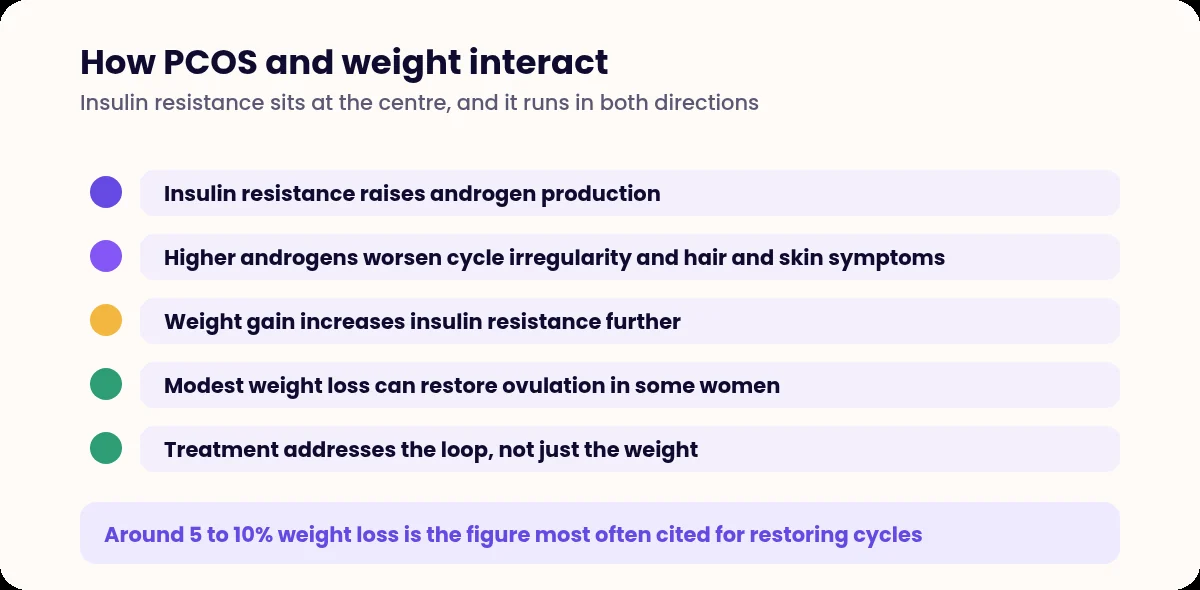
Insulin resistance sits near the centre of the condition — which is why “metabolic” is now in the name. Higher circulating insulin drives the ovaries to produce more androgens, which disrupts ovulation and produces the acne, excess hair growth and irregular or absent periods that bring most people to a GP.
Excess weight worsens insulin resistance. So weight and PMOS feed each other, which is frustrating, but also means the loop can be interrupted.
Not everyone with PMOS has a high BMI. Plenty of people with the condition are a healthy weight and still have marked insulin resistance. Weight is one lever, not the definition.
The number worth knowing
A UK multicentre trial, BAMBINI, studied 75 women with PMOS, obesity and absent ovulation. A post-hoc analysis produced the most useful figure in this area [2]:
- Each 1% reduction in body weight was associated with a 5.6% increase in the odds of ovulatory recovery
- There was no lower threshold — any degree of weight loss was associated with a higher likelihood of ovulating
- Recovery rates were highest in the 10–15% weight-loss band
That is a better message than “lose 5%”. It means the first two kilograms are already doing something, which matters when the target feels distant.
For context, in that trial ovulation returned in 72% of the surgical arm, which achieved 28.5% weight loss, against 31% in the medical arm, which lost under 2%.
The test you are likely to be offered and should decline
Private clinics and supplement sellers frequently offer fasting insulin or HOMA-IR testing for PCOS. International guidance is explicit that clinically available insulin assays are of limited clinical relevance and should not be used in routine care [1].
If you want a metabolic picture, HbA1c, lipids and blood pressure are the tests that change management.
How common is it, really
Community prevalence using diagnostic criteria is around 10 to 13%, and the Endocrine Society now quotes roughly 1 in 8 women. But UK GP-recorded prevalence was only 3.5% in 2020 [5].
The gap is under-diagnosis, not disagreement. If you have irregular cycles, unexplained acne or hair changes and have never been assessed, that is worth pursuing.
What actually helps
A sustainable energy deficit. International guidance is clear that no single diet composition is superior for PMOS [1]. Low carb is not required. What matters is a deficit you can maintain.
Resistance training. Muscle is the main site of glucose disposal, which is the exact thing that is not working well.
Metformin, sometimes. Guidance suggests considering it at BMI 25 and above for metabolic and anthropometric outcomes, usually starting low and building up to a maximum of 2.5 g daily. In the UK, metformin for PCOS is an off-label use — it is not licensed for this [1].
Letrozole, if you are trying to conceive. Now recommended ahead of clomifene for ovulation induction. Also off-label in the UK.
Weight-loss medicines, by the ordinary route. No GLP-1 medicine is licensed in the UK for PMOS. A woman with PMOS may be eligible under the usual weight-management criteria — that is a prescriber’s assessment. If you are prescribed tirzepatide and use oral contraception, note the specific advice to add a barrier method for four weeks after starting and after each dose increase.
When to speak to a clinician
Seek assessment if you:
- have fewer than nine periods a year, or none, and are not pregnant or on contraception that stops them
- have acne, excess facial or body hair, or scalp hair thinning alongside irregular cycles
- have been trying to conceive for a year, or six months if you are over 35
- have PMOS and have not had HbA1c, blood pressure and cholesterol checked
- have been offered insulin resistance testing and want to know whether it is worth doing
PMOS also carries a raised long-term risk of type 2 diabetes, so periodic metabolic screening is part of standard care rather than an extra.
Frequently asked questions
Has PCOS been renamed?
Yes. In May 2026 an international consensus renamed the condition Polyendocrine Metabolic Ovarian Syndrome, or PMOS, to reflect that it is a metabolic condition rather than primarily an ovarian cyst problem. There is a transition period, and PCOS remains widely used and understood.
How much weight do I need to lose for my periods to return?
There is no threshold. UK trial data show a continuous relationship: each 1% of body weight lost was associated with roughly a 5 to 6% increase in the odds of ovulating again. Any amount helps, and more helps more.
Should I get my insulin levels tested?
International guidance says clinically available insulin assays are of limited relevance and should not be used in routine care. Testing fasting insulin or HOMA-IR is not recommended, despite being widely offered privately.
Can I get Mounjaro or Wegovy for PCOS?
Not for PCOS itself — no GLP-1 medicine is licensed in the UK for this condition. A woman with PMOS can be prescribed one if she meets the ordinary criteria for weight management, which is a different question and is decided by a prescriber.
References
- Teede HJ, Tay CT, Laven J, et al. International Evidence-based Guideline for the Assessment and Management of Polycystic Ovary Syndrome. 2023. www.monash.edu/medicine/mchri/pcos/guideline
- Post hoc analysis of the BAMBINI randomised controlled trial: weight loss and ovulatory recovery. Human Reproduction. 2026;41(5):809. academic.oup.com/humrep/article/41/5/809/8513300
- International consensus on renaming polycystic ovary syndrome. The Lancet. 2026. www.thelancet.com/journals/lancet/article/PIIS0140-6736(26)00717-8/ful
- NHS. Polycystic ovary syndrome. www.nhs.uk/conditions/polycystic-ovary-syndrome-pcos/
- Trends in the incidence and prevalence of polycystic ovary syndrome in UK primary care. Journal of Clinical Endocrinology & Metabolism. 2024;110(5):e1580. academic.oup.com/jcem/article/110/5/e1580/7720647
Medical reviewer
Naeem Teni
Clinical Lead at Manova. Registered pharmacist and independent prescriber, GPhC 2215591. Reviews Manova’s clinical content for accuracy and safety.
Written by
Manova Editorial Team
Researched and written to our editorial policy, using NICE, NHS, MHRA and peer-reviewed sources.
This article is for general information and isn’t a substitute for advice from your own clinician. If you feel unwell, contact your GP or NHS 111. In an emergency, call 999.