

Key takeaways
- Clinical definitions combine a short time to ejaculation, poor control and personal distress — all three.
- Combined behavioural and pharmacological treatment outperforms either alone.
- Only two products have a UK licence for PE; SSRIs used for it are off-label.
- Erectile dysfunction and PE frequently coexist, and the erection problem is usually treated first.
Premature ejaculation is the most common male sexual difficulty and the least discussed, partly because the thing men measure themselves against is usually not a clinical standard but pornography.
What it actually means
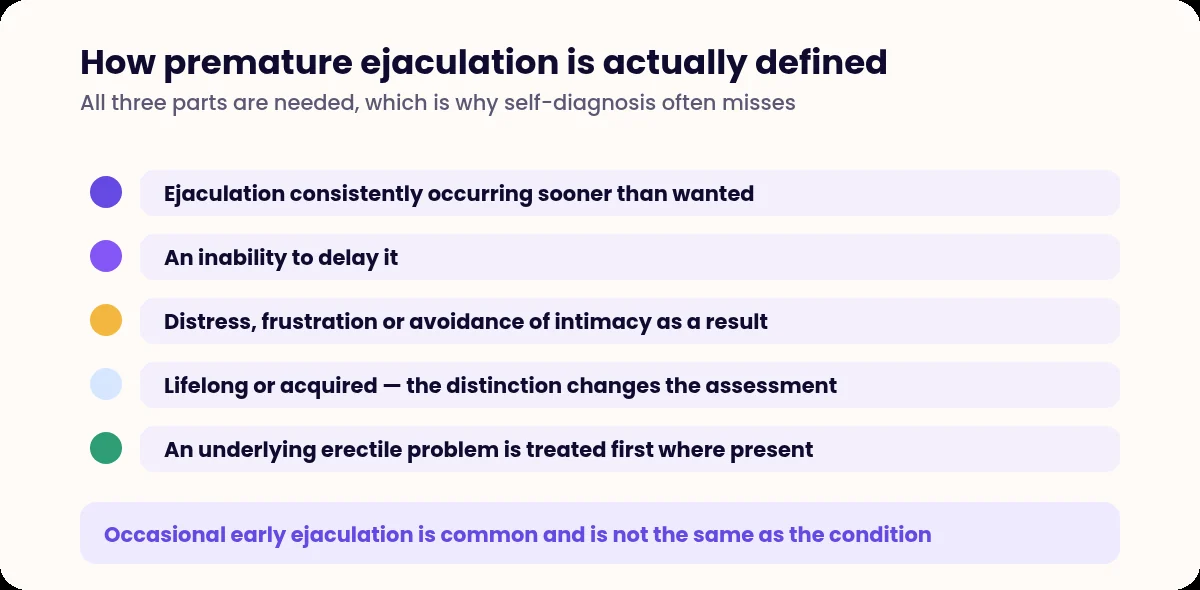
The clinical definition combines three components, and all three are required:
- Time — ejaculation that consistently occurs within about one to two minutes of penetration, or before it
- Control — an inability to delay ejaculation
- Consequence — marked personal distress, frustration, or avoidance of intimacy
The third one matters. A short time without distress is not a disorder. Equally, distress with an ordinary time is real and worth addressing — it is just a different problem, usually to do with expectation or anxiety.
Two patterns are recognised:
Lifelong (primary) — present from the first sexual experiences.
Acquired (secondary) — develops after a period of normal function. This one usually has a cause worth finding: erectile dysfunction, prostatitis, thyroid disease, relationship difficulty, anxiety, or a change in medication.
The overlap with erectile dysfunction
This is the most useful clinical point on the page.
Men who are struggling to maintain an erection often, consciously or not, rush to ejaculate before the erection is lost. The result looks like premature ejaculation and is actually an erection problem.
Because of that, where both are present, guidance is generally to treat the erectile dysfunction first — the ejaculation timing frequently settles once the anxiety about losing the erection goes.
It also means that a man presenting with new premature ejaculation deserves the same assessment as one presenting with ED.
Behavioural approaches
The NIHR review of interventions found that behavioural therapies are better than waiting-list control, that pharmacological treatments generally outperformed behavioural techniques in direct comparison, and — the most useful finding — that combined behavioural and pharmacological treatment is superior to either alone [1].
The techniques themselves:
Stop–start. Stimulation continues to just before the point of inevitability, then stops until the sensation subsides, then resumes. Repeated several times before allowing ejaculation. Practised alone first, then with a partner.
The squeeze technique. As above, with gentle pressure applied just below the head of the penis to reduce arousal.
Pelvic floor training. There is reasonable evidence for pelvic floor muscle training in men with lifelong PE. It takes weeks to months.
Reducing performance pressure. Broadening what counts as sex beyond penetration reduces the anxiety that shortens time further. This sounds like a consolation and is actually one of the more effective interventions.
All of these work better with a partner involved, and all take practice over weeks rather than days.
What is licensed in the UK
Only two products hold a UK licence for premature ejaculation, and both are prescription-only:
Dapoxetine — a short-acting SSRI taken on demand before sexual activity. It has a specific set of cardiac and psychiatric contraindications and should not be used with other serotonergic medicines.
Fortacin — a lidocaine and prilocaine spray, licensed specifically for primary premature ejaculation, applied to the glans five minutes before intercourse [3]. Note that hypersensitivity in either the patient or their partner is a contraindication.
Both are covered in more detail in dapoxetine and Fortacin.
Commonly used but off-label in the UK: daily SSRIs such as paroxetine, sertraline and fluoxetine; clomipramine; topical lidocaine-prilocaine cream; and tramadol. These are genuinely used and can work, but it is worth knowing they are being prescribed outside their licence, and why.
Not UK products: US over-the-counter “delay sprays” containing benzocaine are not licensed here.
Things that do not help
Thicker condoms and distraction techniques are frequently suggested and rarely effective for long. Alcohol delays ejaculation and worsens erections, which trades one problem for another. Numbing products bought without advice can transfer to a partner and cause loss of sensation for both.
The expectation problem
Studies of intravaginal ejaculatory latency in the general population produce median times of around five to six minutes. Pornography is not a reference standard, and a large proportion of men who seek help are functioning normally against a distorted benchmark.
That does not mean distress is not real. It means the treatment may be the expectation rather than the timing.
When to speak to a clinician
See a GP if you:
- have developed the problem after a period of normal function
- have erectile difficulties as well
- have pain on ejaculation, blood in semen, or urinary symptoms
- have low libido, fatigue, or other symptoms suggesting low testosterone or thyroid disease
- are distressed, avoiding intimacy, or it is affecting your relationship
- started a new medicine around the time it began
This is a common reason to consult and a routine one to assess. It is not a conversation any competent clinician will find remarkable.
Frequently asked questions
What counts as premature ejaculation?
Clinical criteria combine three things: ejaculation typically within about a minute or two of penetration, an inability to delay it, and marked personal distress or relationship difficulty. All three matter — a short time without distress is not a disorder.
Do behavioural techniques work?
They work better than nothing, and the best UK evidence review found that pharmacological treatments generally outperformed behavioural techniques in direct comparison, while combined treatment was superior to either alone.
What treatments are licensed in the UK?
Two: dapoxetine, taken on demand before activity, and Fortacin, a lidocaine and prilocaine spray licensed specifically for primary premature ejaculation. Both are prescription-only. SSRIs taken daily are commonly used but are off-label for this.
Can it be cured?
Lifelong premature ejaculation is usually managed rather than cured, often very effectively. Acquired premature ejaculation — where it develops after a period of normal function — often has an identifiable cause such as erectile dysfunction, thyroid disease or anxiety, and treating that frequently resolves it.
References
- Interventions to treat premature ejaculation: a systematic review short report. NIHR Health Technology Assessment. 2015;19(21). www.ncbi.nlm.nih.gov/books/NBK279870/
- NHS. Ejaculation problems. www.nhs.uk/conditions/ejaculation-problems/
- Fortacin (lidocaine/prilocaine) Summary of Product Characteristics. Revised 14 November 2024. www.medicines.org.uk/emc/product/100391/smpc
- British Society for Sexual Medicine. Guidelines on the management of erectile dysfunction in men. 2018. bssm.org.uk/wp-content/uploads/2023/02/BSSM-ED-guidelines-2018-1.pdf
Medical reviewer
Naeem Teni
Clinical Lead at Manova. Registered pharmacist and independent prescriber, GPhC 2215591. Reviews Manova’s clinical content for accuracy and safety.
Written by
Manova Editorial Team
Researched and written to our editorial policy, using NICE, NHS, MHRA and peer-reviewed sources.
This article is for general information and isn’t a substitute for advice from your own clinician. If you feel unwell, contact your GP or NHS 111. In an emergency, call 999.