

Key takeaways
- Weight attributable to hypothyroidism is usually modest — commonly described as around 2–5 kg, much of it fluid rather than fat.
- Starting levothyroxine does not reliably produce weight loss; in one cohort the median change was close to zero.
- NICE recommends measuring TSH first, adding FT4 on the same sample if TSH is raised.
- Thyroid hormone must never be used as a weight-loss treatment in people with normal thyroid function.
“Could it be my thyroid?” is one of the most common questions in any weight conversation, and one of the most reasonable. It is also, most of the time, not the answer — and the reason matters, because the alternative explanations are the ones you can act on.
What hypothyroidism actually does to weight
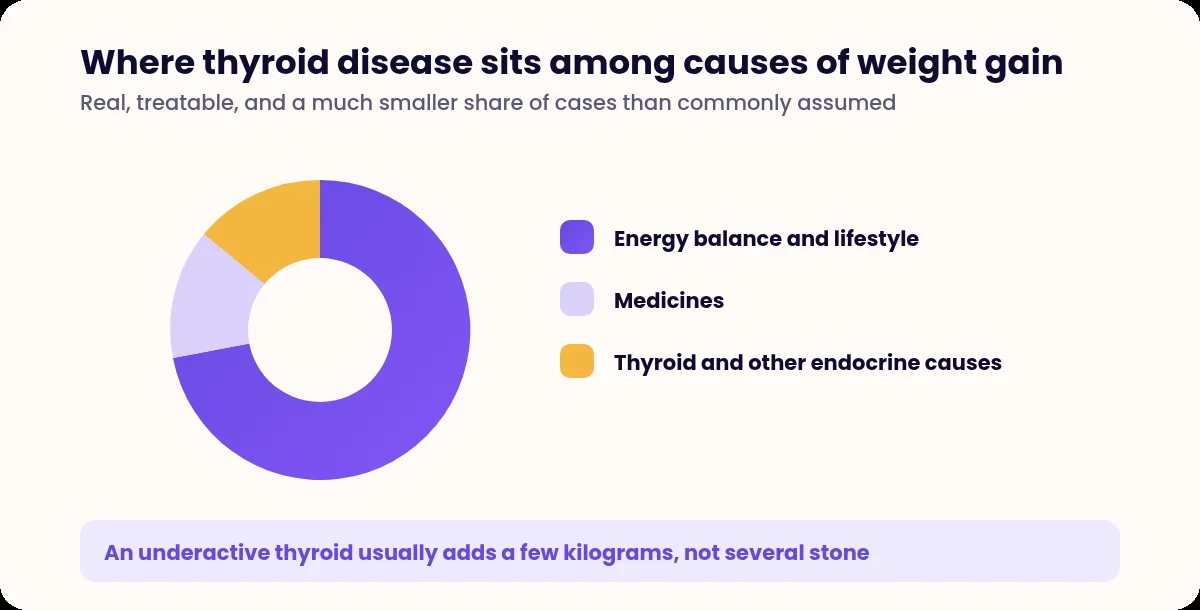
An underactive thyroid slows metabolic rate, and weight does rise. But the magnitude is smaller than the reputation. The American Thyroid Association’s summary is that around 5 to 10 pounds (roughly 2 to 5 kg) may be related to the thyroid depending on severity, and that most of the weight gained is retained salt and water rather than fat [2].
That is a meaningful amount. It is not two stone.
The other symptoms are usually the more reliable clue: fatigue, cold intolerance, constipation, dry skin, hair thinning, low mood, heavy or irregular periods, slowed thinking.
The part that surprises people
Treating it does not usually reverse the weight.
A cohort of 101 adults with newly diagnosed primary hypothyroidism — TSH of 10 or above, median 18.3 — were followed until their TSH normalised on levothyroxine. The median weight change was −0.1 kg. Only about half lost any weight at all, and among those who did, the average loss was under 4 kg [3].
The authors put it plainly: contrary to popular belief, no significant weight change occurs after starting levothyroxine.
So if you have been waiting for treatment to undo the gain, that wait is the problem. Correcting the hormone deficiency is important for many reasons. Weight loss is not reliably one of them.
How it is tested in the UK
NICE guidance is specific [1]:
- Measure TSH alone first, where pituitary disease is not suspected
- If TSH is raised, measure FT4 on the same sample
- If TSH is suppressed, measure FT4 and FT3
Reference ranges are set by the individual laboratory and differ between assays, so the figure your result is compared against is local rather than national.
For overt hypothyroidism, levothyroxine is started at about 1.6 micrograms per kilogram per day in adults under 65 without heart disease, and lower with gradual titration in older adults or those with cardiac history. TSH is rechecked every three months until stable, then annually [1].
Subclinical hypothyroidism
Raised TSH with a normal FT4. This is where most of the argument happens.
NICE supports considering levothyroxine when TSH is 10 or above on two occasions three months apart, and considering a six-month trial in adults under 65 whose TSH is above range but below 10 and who have symptoms — stopping if symptoms do not improve [1].
In older adults the evidence is unfavourable. The TRUST trial found no benefit on symptoms or quality of life from levothyroxine in adults aged 65 and over with subclinical hypothyroidism [4].
Weight loss is not an indication for treating subclinical hypothyroidism, and no UK guideline supports it.
The thing not to do
Do not take thyroid hormone to lose weight if your thyroid function is normal. It does not produce useful fat loss, it does cause loss of muscle and bone, and at higher doses it causes atrial fibrillation. Thyroid hormone sold online as a slimming aid is one of the more dangerous things in that market.
If the tests are normal
That is worth treating as information rather than a dead end. The usual explanations for stalled weight loss — a smaller deficit than it feels like, weekends undoing weekdays, liquid calories, short sleep, a medicine you take — are covered in why am I not losing weight.
When to speak to a clinician
Ask for thyroid function tests if you have:
- unexplained weight gain with fatigue, cold intolerance, constipation or dry skin
- a slow pulse, hoarse voice, or puffiness around the eyes
- heavy or irregular periods with fatigue
- a family history of thyroid disease, or another autoimmune condition
- a neck swelling
Also speak to a clinician if you are already on levothyroxine and have not had a TSH check in the last year, or if your dose has changed and symptoms have not.
Frequently asked questions
Can an underactive thyroid cause weight gain?
Yes, but usually a modest amount. The commonly quoted figure is around 2 to 5 kg, and a large part of that is retained salt and water rather than fat. Hypothyroidism rarely explains a large weight gain on its own.
Will levothyroxine help me lose weight?
Generally not. In a cohort of adults starting levothyroxine for clear hypothyroidism, the median weight change was about zero, and only around half lost any weight at all. Levothyroxine corrects a hormone deficiency; it is not a weight-loss medicine.
Should I get my thyroid tested if I can't lose weight?
It is a reasonable test to have done once, particularly alongside symptoms like fatigue, cold intolerance, constipation, dry skin or heavy periods. It is not usually the explanation, but it is cheap to exclude.
What about subclinical hypothyroidism?
Where TSH is raised but thyroid hormone is normal, UK guidance supports treatment mainly when TSH is 10 or above on two occasions, or in people under 65 with symptoms as a time-limited trial. Treating it to aid weight loss is not a recognised indication.
References
- NICE. Thyroid disease: assessment and management. NG145. www.nice.org.uk/guidance/ng145
- American Thyroid Association. Thyroid and weight. www.thyroid.org/thyroid-and-weight/
- Lee SY, Braverman LE, Pearce EN. Changes in body weight after treatment of primary hypothyroidism with levothyroxine. Endocrine Practice. 2014;20(11):1122-1128. doi.org/10.4158/EP14072.OR
- Stott DJ, Rodondi N, Kearney PM, et al. Thyroid hormone therapy for older adults with subclinical hypothyroidism. New England Journal of Medicine. 2017;376(26):2534-2544. doi.org/10.1056/NEJMoa1603825
- NHS. Underactive thyroid (hypothyroidism). www.nhs.uk/conditions/underactive-thyroid-hypothyroidism/
Medical reviewer
Naeem Teni
Clinical Lead at Manova. Registered pharmacist and independent prescriber, GPhC 2215591. Reviews Manova’s clinical content for accuracy and safety.
Written by
Manova Editorial Team
Researched and written to our editorial policy, using NICE, NHS, MHRA and peer-reviewed sources.
This article is for general information and isn’t a substitute for advice from your own clinician. If you feel unwell, contact your GP or NHS 111. In an emergency, call 999.