

Key takeaways
- The NHS Type 2 Diabetes Path to Remission Programme is free and available across England.
- Eligibility: aged 18–65, diagnosed within 6 years, BMI over 27 (over 25 for some ethnic groups).
- Real-world results: mean 8.3% weight loss among starters; 27% of starters with data were in remission at one year.
- In DiRECT, 46% were in remission at 12 months but around 13% at five years.
For a long time type 2 diabetes was described as progressive and irreversible. That turned out to be wrong for a substantial minority of people, and the evidence for it is British.
What remission means
Blood glucose back in the non-diabetic range — usually an HbA1c below 48 mmol/mol — sustained without glucose-lowering medication.
It is not a cure. The underlying tendency remains, monitoring continues, and remission can be lost. But it is a genuine and meaningful state, and it is more achievable than most people are told.
The trial
DiRECT delivered total diet replacement — around 825–853 kcal a day for three to five months — followed by structured food reintroduction and ongoing support, in ordinary GP practices [2].
| Timepoint | Intervention | Control |
|---|---|---|
| 12 months | 46% in remission | 4% |
| 24 months | 36% | 3% |
| 5 years | ~13% (extension group) | 5% |
The 46% figure is the one everybody quotes. The five-year figure is the one that tells you what to plan for [3].
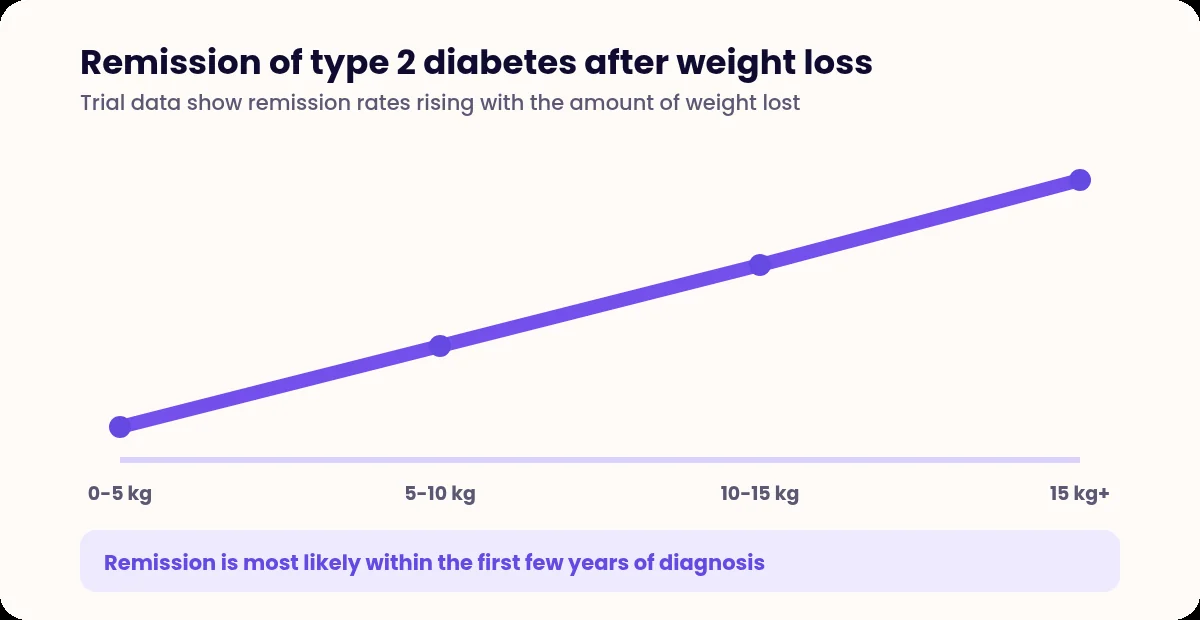
Two findings worth holding together. Remission tracked weight loss closely — at 12 months, 86% of those who lost 15 kg or more were in remission. And of those in remission at two years, 26% were still in remission at five years.
So: substantial weight loss produces remission in many people, and ongoing support determines how long it lasts.
The NHS programme
NHS England built a national programme on this, and it is now available in every local health area in England [1].
Eligibility: – Aged 18 to 65 – Type 2 diabetes diagnosed within the last 6 years – BMI above 27, or above 25 for people of Black, Asian and other minority ethnic backgrounds
What it involves: 12 weeks of total diet replacement at 800–900 kcal a day using soups, shakes and bars, then structured food reintroduction, within a 12-month behavioural support programme. In person or digital. Your GP manages medication changes alongside it. It is fully NHS-funded.
The real-world results, from the peer-reviewed national evaluation [4]:
- Mean weight loss among everyone who started: 8.3%, about 9.4 kg
- Among completers: 9.3%, about 10.3 kg
- 27% of starters with two HbA1c readings were in remission at one year, having lost an average of 13.4%
- 32% of completers with two readings were in remission
- Completion was 55%
NHS England’s headline is that a third go into remission losing almost 16 kg. That is the completers-with-data figure. The denominator-inclusive figure is 27%, with 55% completing. Both are true; the second is the one to plan around.
More than 30,000 people have been through it since the 2020 pilot.
Who it works best for
The pattern across the evidence is consistent:
- Diagnosed recently. The six-year cut-off is not arbitrary — beta cell function declines over time.
- Able to lose a substantial amount. The relationship with weight lost is strong and continuous.
- Not on insulin. People on insulin are generally not eligible for the NHS programme, though weight loss remains valuable.
- Able to commit to the reintroduction and maintenance phase, which is where durability is decided.
The medication point
This matters practically. If you are on glucose-lowering medication — particularly insulin or a sulfonylurea — and you dramatically reduce intake, you can become hypoglycaemic within days. Blood pressure medicines often need reducing too.
That is why this is done with GP involvement rather than bought off a shelf. If you are considering an 800 calorie approach on your own, speak to your practice first.
What about medication-based approaches
Weight-loss medicines produce substantial weight loss, and weight loss is what drives remission. But the NHS remission programme is specifically the total diet replacement route, and the durability evidence comes from that.
Bariatric surgery produces the largest and most durable effects — in the STAMPEDE trial, 29% of gastric bypass patients had an HbA1c of 6.0% or below at five years, against 5% on medical therapy alone.
Which route suits someone depends on how recently they were diagnosed, how much weight they need to lose, what else is going on, and what they can sustain.
When to speak to a clinician
Ask your GP practice about the programme if you:
- have type 2 diabetes diagnosed within the last six years and are aged 18 to 65
- are unsure whether you are eligible — referral usually goes through your practice
- take glucose-lowering or blood pressure medicines and are planning a substantial dietary change
- are in remission and want to know what monitoring you still need — annual review continues
Seek urgent advice for symptoms of very high glucose — extreme thirst, passing large amounts of urine, drowsiness, vomiting — or repeated hypoglycaemia.
Frequently asked questions
Can type 2 diabetes be reversed?
Remission is possible for some people, particularly those diagnosed recently who achieve substantial weight loss. Remission means blood glucose in the non-diabetic range without glucose-lowering medication. It is not the same as a cure, and it can be lost.
Who can join the NHS programme?
Adults aged 18 to 65 with type 2 diabetes diagnosed within the last 6 years and a BMI above 27, or above 25 for people of Black, Asian and other minority ethnic backgrounds. It is now available across every local health area in England.
How much weight do you have to lose?
In DiRECT, remission was closely related to weight lost — 86% of those who lost 15 kg or more achieved remission at 12 months. In the NHS programme, those in remission at one year had lost around 13 to 14% of their body weight on average.
Does remission last?
For some people. In DiRECT's five-year follow-up, around 13% of the extension group remained in remission against 5% of controls, and of those in remission at two years, 26% were still in remission at five. Ongoing support matters.
References
- NHS England. Type 2 Diabetes Path to Remission Programme. www.england.nhs.uk/diabetes/treatment-care/diabetes-remission/
- Lean MEJ, Leslie WS, Barnes AC, et al. Primary care-led weight management for remission of type 2 diabetes (DiRECT). The Lancet. 2018;391(10120):541-551. doi.org/10.1016/S0140-6736(17)33102-1
- Lean MEJ, Leslie WS, Barnes AC, et al. Durability of a primary care-led weight management intervention for remission of type 2 diabetes: 5-year results of the DiRECT trial. The Lancet Diabetes & Endocrinology. 2024;12(4):233-246. doi.org/10.1016/S2213-8587(23)00385-6
- National evaluation of the NHS Type 2 Diabetes Path to Remission Programme. The Lancet Diabetes & Endocrinology. 2024. pubmed.ncbi.nlm.nih.gov/39116897/
- Diabetes UK. Diabetes remission. www.diabetes.org.uk/diabetes-the-basics/type-2-remission
Medical reviewer
Naeem Teni
Clinical Lead at Manova. Registered pharmacist and independent prescriber, GPhC 2215591. Reviews Manova’s clinical content for accuracy and safety.
Written by
Manova Editorial Team
Researched and written to our editorial policy, using NICE, NHS, MHRA and peer-reviewed sources.
This article is for general information and isn’t a substitute for advice from your own clinician. If you feel unwell, contact your GP or NHS 111. In an emergency, call 999.