

Key takeaways
- Excess weight is the second biggest preventable cause of cancer in the UK, after smoking.
- It accounted for 6.3% of UK cancer cases in 2015 — over 18,000 cases a year.
- The largest attributable fractions are womb cancer in women (34%) and oesophageal cancer in men (31%).
- Whether losing weight reduces risk is likely but not definitively established — Cancer Research UK is careful about this.
This is the least-known major fact about body weight in the UK. Only around 15% of people are aware of the link, which leaves it doing a great deal of damage quietly.
The headline
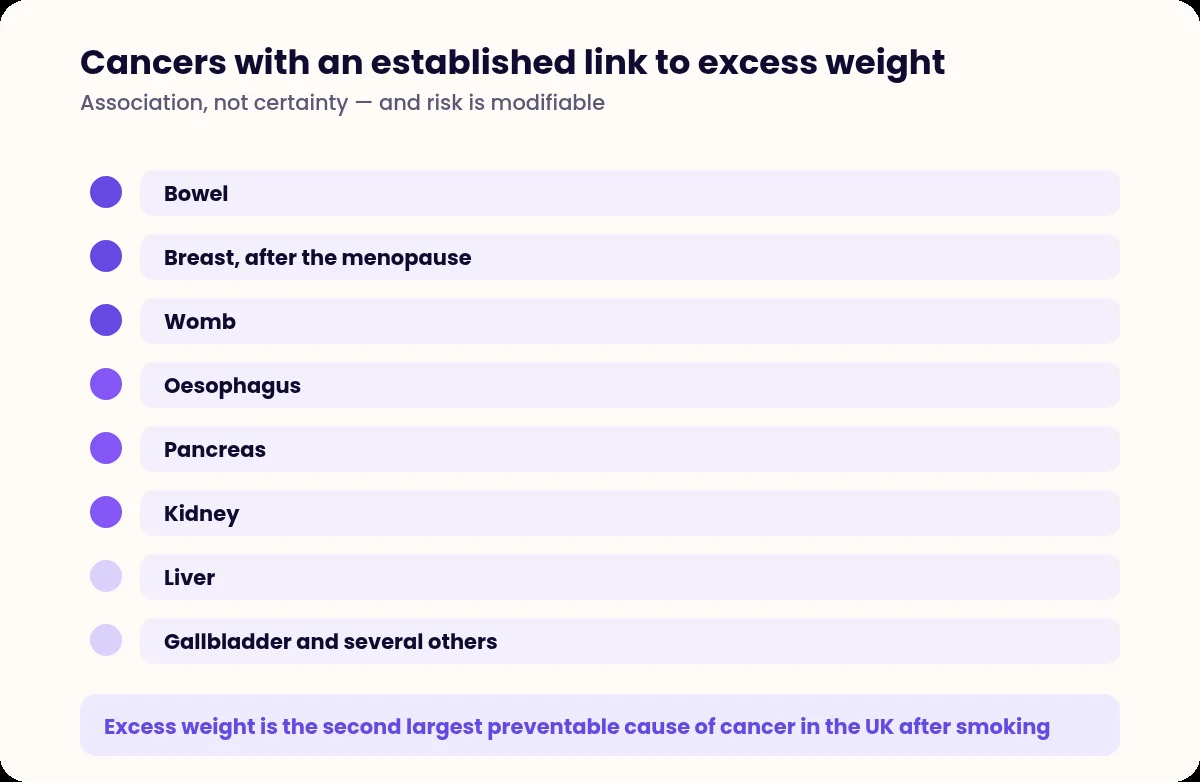
Excess weight is the second biggest preventable cause of cancer in the UK, after smoking [1].
A detailed analysis of UK cancer cases in 2015 found that overweight and obesity accounted for 6.3% of all cases — 7.5% in women and 5.2% in men, with smoking at 15.1% [2]. Cancer Research UK’s public figure is over 18,000 cases a year.
Which cancers
A 2016 review by the International Agency for Research on Cancer brought the total to 13 cancers linked to excess body fat [3], including bowel, post-menopausal breast, womb, oesophageal adenocarcinoma, pancreatic, kidney, liver, gallbladder, gastric cardia, ovarian and thyroid cancers, along with meningioma and multiple myeloma.
The strength of the link varies a great deal between them.
| Cancer | Attributable to excess weight in the UK |
|---|---|
| Womb (endometrial), women | 34.0% |
| Oesophageal, men | 31.3% |
| Kidney | around a quarter |
| Oesophageal overall | more than a fifth |
Womb cancer, specifically
The clearest and largest link, and the one least talked about.
Women with obesity have more than twice the risk. In absolute terms: of 1,000 women at a healthy weight, around 16 develop womb cancer in their lifetime; of 1,000 women with obesity, around 41 — 25 extra cases per 1,000 [1].
Around 2,900 extra womb cancer cases a year in the UK are caused by excess weight, and womb cancer rates have risen sharply over the past two decades, largely attributed to rising body weight.
This is also why postmenopausal bleeding should always be investigated promptly, regardless of weight.
Why fat affects cancer risk
Cancer Research UK describes three main mechanisms [1]:
Hormones. Fat tissue produces oestrogen, particularly after the menopause, and higher oestrogen levels drive cell division in the womb lining and in breast tissue.
Growth signals. Higher insulin and insulin-like growth factors encourage cells to divide more often.
Inflammation. Excess fat tissue produces a chronic low-grade inflammatory state, and inflammation increases cell turnover.
More cell divisions means more opportunities for the errors that lead to cancer.
The honest uncertainty
Does losing weight reduce the risk?
Cancer Research UK is careful here, and it is worth reproducing their position rather than improving on it: whether cancer risk decreases after someone loses weight is not so clear, while research so far suggests that weight loss does help [1].
The reason it is hard to establish is methodological. Undiagnosed cancer itself causes weight loss, which confuses the picture, and relatively few people maintain substantial loss for long enough to study.
So the honest framing is: the risk from carrying excess weight is well established; the benefit of losing it is likely and supported but not proven to the same standard. That is still a reason to act — it is simply not a reason to overstate.
What this is not
It is not a reason for alarm about a particular body. Most people with a high BMI will not develop any of these cancers, and plenty of people at a healthy weight do.
It is also not a reason to skip screening. Bowel, breast and cervical screening apply regardless of weight, and attendance is more protective than any single risk factor is dangerous.
When to speak to a clinician
See a GP promptly if you have:
- bleeding after the menopause, or unusual bleeding between periods — always investigate
- a change in bowel habit lasting three weeks or more, or blood in your stool
- difficulty swallowing, or food sticking
- unexplained weight loss
- a new lump anywhere, or a change in a mole
- persistent bloating, particularly if you are a woman over 50
- blood in your urine
- a cough lasting three weeks or more, or coughing blood
Take up screening invitations when they arrive. Bowel, breast and cervical screening are the highest-value things on this page.
Frequently asked questions
How many cancers are linked to being overweight?
A 2016 international review brought the total to 13, including bowel, post-menopausal breast, womb, oesophageal, pancreatic, kidney, liver, gallbladder, ovarian and thyroid cancers, as well as meningioma and multiple myeloma.
How much cancer does excess weight cause in the UK?
Excess weight accounted for 6.3% of UK cancer cases in 2015 — 7.5% in women and 5.2% in men. Cancer Research UK's public figure is over 18,000 cases a year.
Does losing weight reduce cancer risk?
Probably, but the evidence is not as firm as for the risk itself. Cancer Research UK states that whether risk decreases after weight loss is not so clear, while noting that research so far suggests it does help.
Which cancer has the strongest link?
Womb cancer. Women with obesity have more than twice the risk, and around 34% of UK womb cancer cases are attributable to excess weight. Around 2,900 extra cases a year in the UK are caused by it.
References
- Cancer Research UK. Obesity, weight and cancer. www.cancerresearchuk.org/about-cancer/causes-of-cancer/obesity-weight-
- Brown KF, Rumgay H, Dunlop C, et al. The fraction of cancer attributable to modifiable risk factors in England, Wales, Scotland, Northern Ireland, and the United Kingdom in 2015. British Journal of Cancer. 2018;118:1130-1141. doi.org/10.1038/s41416-018-0029-6
- Lauby-Secretan B, Scoccianti C, Loomis D, et al. Body fatness and cancer — viewpoint of the IARC Working Group. New England Journal of Medicine. 2016;375(8):794-798. doi.org/10.1056/NEJMsr1606602
- NHS. Signs and symptoms of cancer. www.nhs.uk/conditions/cancer/symptoms/
Medical reviewer
Naeem Teni
Clinical Lead at Manova. Registered pharmacist and independent prescriber, GPhC 2215591. Reviews Manova’s clinical content for accuracy and safety.
Written by
Manova Editorial Team
Researched and written to our editorial policy, using NICE, NHS, MHRA and peer-reviewed sources.
This article is for general information and isn’t a substitute for advice from your own clinician. If you feel unwell, contact your GP or NHS 111. In an emergency, call 999.