

Key takeaways
- The UK product information for these medicines does not prohibit alcohol, but several risks make caution sensible.
- If you also take insulin or a sulfonylurea, alcohol adds to the risk of low blood sugar, which these medicines already raise.
- Alcohol is an independent risk factor for pancreatitis, and the MHRA strengthened pancreatitis warnings across this class in January 2026.
- Trial evidence suggests semaglutide reduces alcohol craving and heavy drinking days — an unlicensed effect that is being studied, not a treatment.
This question comes up constantly, and the honest answer has several parts. The UK product information for these medicines does not forbid alcohol. There are still four good reasons to think about it carefully.
This page is information about prescription-only medicines, not personal advice. Anyone taking one should raise this with their own prescriber.
Four reasons for caution
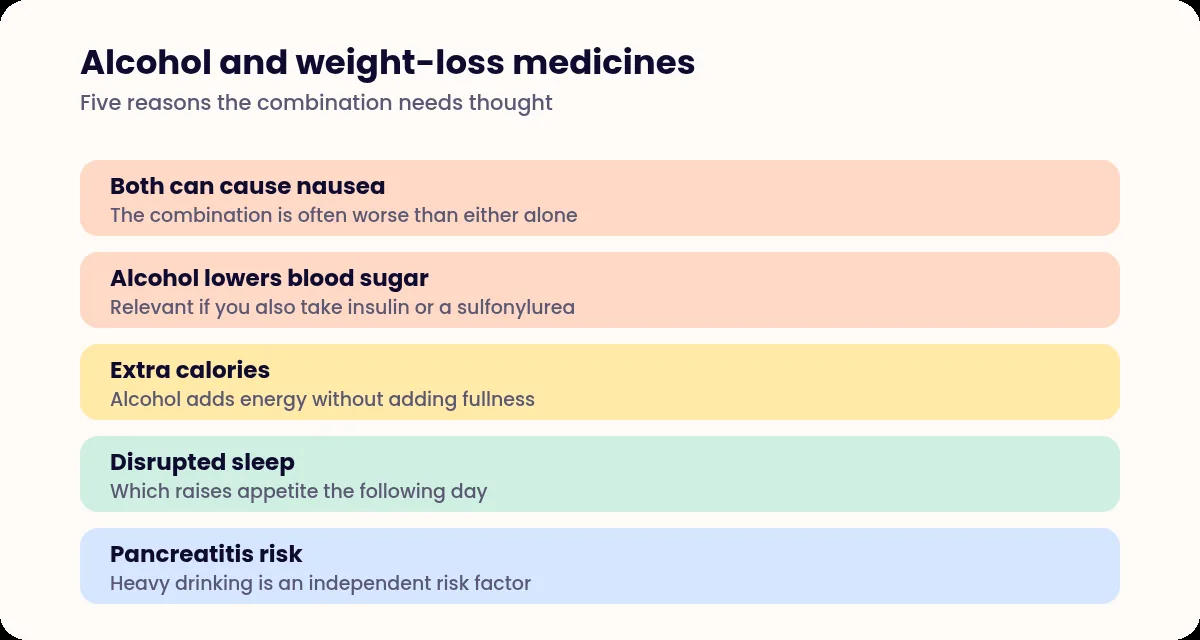
1. It makes the side effects worse. These medicines slow stomach emptying and, in the early weeks, leave a lot of people feeling queasy. Alcohol irritates the stomach lining and relaxes the valve at the top of the stomach. Nausea and reflux are the predictable result, and they are worst in the days after a dose increase.
2. Low blood sugar, if you take certain diabetes medicines. GLP-1 medicines rarely cause hypoglycaemia on their own, but both SmPCs warn that the risk rises when they are combined with insulin or a sulfonylurea, and advise considering a dose reduction of those medicines [1][2]. Alcohol independently impairs the liver’s ability to release stored glucose, which is why hypoglycaemia after drinking is a recognised problem in diabetes care [6]. Stacking the two is the combination to be careful with.
3. Pancreatitis. Alcohol is one of the two leading causes of acute pancreatitis. In January 2026 the MHRA strengthened warnings across the GLP-1 and dual GIP/GLP-1 class following reports of severe, necrotising and fatal pancreatitis, advising that the medicine be stopped immediately if pancreatitis is suspected and not restarted if it is confirmed [3]. The product information does not describe alcohol as an interacting substance, but two risk factors for the same serious condition is a reasonable thing to want to avoid.
4. The calories are working against the medicine. A pint is up to 222 kcal before anything you eat with it. Our guide to alcohol and weight goes through the arithmetic properly.
The unexpected finding
A number of people on these medicines report that they simply want to drink less — that the pull of a second or third drink quietly disappears.
That observation has now been tested. In a randomised controlled trial published in JAMA Psychiatry in February 2025, 48 adults with alcohol use disorder received low-dose semaglutide or placebo for nine weeks. The semaglutide group had reduced alcohol craving, fewer heavy drinking days and fewer drinks per drinking day, along with lower consumption in a laboratory measure [4].
Two things matter about how that is read.
It is a small, short trial, and the dose was low. Larger studies are under way.
And these medicines are not licensed to treat alcohol problems in the UK. Taking a weight-management medicine because you want to drink less would be using it outside its licence, and anyone whose drinking is a problem should be talking to their GP, who can refer to services that are designed for it and have evidence behind them.
If you do drink while taking one
- Not in the days after a dose increase, when the gut is least tolerant.
- Eat first. Drinking on a stomach that is already emptying slowly, with little food in it, is the recipe for both nausea and — if you take insulin or a sulfonylurea — low blood sugar.
- Keep to the guideline. No more than 14 units a week, spread over three or more days, with drink-free days [5].
- Know your own hypo signs if you take insulin or a sulfonylurea, and tell whoever you are with.
- Be honest with your prescriber about how much you drink. It changes what is safe to prescribe, and it is not a moral question.
When to seek help
Severe, persistent abdominal pain — particularly radiating to the back with vomiting — needs urgent medical attention. So does vomiting that stops you keeping fluids down.
If cutting down is harder than it should be, that is worth raising with your GP in its own right, separately from any weight-management treatment.
Suspected side effects can be reported through the MHRA Yellow Card scheme [7].
Frequently asked questions
Can you drink alcohol on Mounjaro or Wegovy?
The UK product information does not contain a blanket prohibition on alcohol. That is not the same as it being a good idea. Alcohol adds calories, worsens nausea for many people, is a risk factor for pancreatitis, and raises the risk of low blood sugar in anyone also taking insulin or a sulfonylurea.
Does alcohol make the side effects worse?
Many people find it does. These medicines slow stomach emptying and irritate the gut in the early weeks; alcohol irritates the stomach lining too. Nausea and reflux are the commonest complaints.
Do weight loss injections stop you wanting to drink?
Some people report exactly that. In a randomised trial published in JAMA Psychiatry in February 2025, low-dose semaglutide reduced alcohol craving, heavy drinking days and drinks per drinking day in adults with alcohol use disorder. It is not licensed for that purpose and should not be sought for it.
Is alcohol more likely to cause low blood sugar on these medicines?
On their own, GLP-1 medicines rarely cause hypoglycaemia. The risk rises substantially if you also take insulin or a sulfonylurea, and alcohol independently impairs the liver's ability to release glucose. That combination needs care and a conversation with your prescriber.
How much is safe?
UK Chief Medical Officers advise no more than 14 units a week for everyone, spread over three or more days with drink-free days. That guidance does not change because you are taking a weight-management medicine, and the practical reasons to drink less while on one are stronger.
References
- Eli Lilly and Company Limited. Mounjaro KwikPen: Summary of Product Characteristics. Electronic Medicines Compendium. www.medicines.org.uk/emc/product/15484/smpc
- Novo Nordisk Limited. Wegovy: Summary of Product Characteristics. Electronic Medicines Compendium. www.medicines.org.uk/emc/product/13803/smpc
- MHRA. GLP-1 receptor agonists and dual GLP-1/GIP receptor agonists: strengthened warnings on acute pancreatitis. Drug Safety Update, 29 January 2026. www.gov.uk/drug-safety-update/glp-1-receptor-agonists-and-dual-glp-1-s
- Hendershot CS, Bremmer MP, Paladino MB, et al. Once-weekly semaglutide in adults with alcohol use disorder: a randomized clinical trial. JAMA Psychiatry. 12 February 2025. pubmed.ncbi.nlm.nih.gov/39937469/
- Department of Health. UK Chief Medical Officers' low risk drinking guidelines. 2016. www.gov.uk/government/publications/alcohol-consumption-advice-on-low-r
- NHS. Low blood sugar (hypoglycaemia). www.nhs.uk/conditions/low-blood-sugar-hypoglycaemia/
- MHRA. Yellow Card: report a suspected side effect. yellowcard.mhra.gov.uk/
Medical reviewer
Naeem Teni
Clinical Lead at Manova. Registered pharmacist and independent prescriber, GPhC 2215591. Reviews Manova’s clinical content for accuracy and safety.
Written by
Manova Editorial Team
Researched and written to our editorial policy, using NICE, NHS, MHRA and peer-reviewed sources.
This article is for general information and isn’t a substitute for advice from your own clinician. If you feel unwell, contact your GP or NHS 111. In an emergency, call 999.