

Key takeaways
- When men are actively questioned, sexual dysfunction is reported by a large proportion of people taking SSRIs and SNRIs — far more than the single-digit figures that come from spontaneous reporting.
- SSRIs and SNRIs sit at the top of the range, vortioxetine intermediate, and bupropion lowest, though bupropion is not licensed as an antidepressant in the UK.
- Options include watchful waiting, dose adjustment, switching agent, timing the dose, and adding a PDE5 inhibitor where erectile dysfunction is the main problem.
- Post-SSRI sexual dysfunction is recognised by the EMA and MHRA, but its frequency is not established and there is no proven treatment — and it is not a reason to stop medication without advice.
The figure in the patient information leaflet and the figure you get when you ask people directly are not remotely the same number. That is the single most important thing to understand about this topic.
Spontaneous reporting — waiting for a patient to raise it unprompted — produces single-digit rates of sexual dysfunction on antidepressants. Structured questioning produces something entirely different. Montejo’s prospective study of 1,022 outpatients found rates in the region of 30 to 60% and above for SSRIs and SNRIs once people were actively asked [1]. A 2025 prospective study of 452 patients, 161 of them men, reported sexual dysfunction in 84.5% of the men.
So if this has happened to you, you are not an outlier. You are in the group most likely to say nothing about it.
What the effects actually are
They are not one symptom. It helps enormously to separate them, because the answer differs:
- Reduced desire — often the earliest and the one most easily confused with the depression itself.
- Erectile difficulty — the effect with the best-evidenced treatment.
- Delayed or absent ejaculation — the most characteristically serotonergic effect.
- Reduced orgasm intensity, or genital numbness — the one men find hardest to describe and most often do not mention.
Being specific about which of these is happening changes what a prescriber can offer.
The class differences
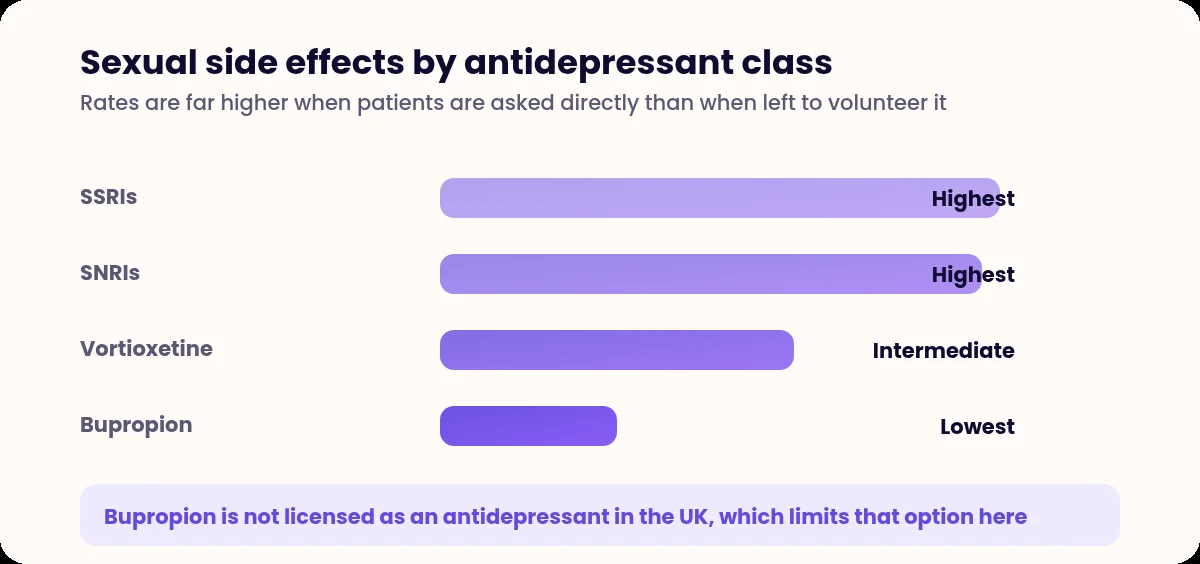
The ranking across studies is reasonably consistent [1, 5]:
Highest rates: SSRIs and SNRIs. Notably, there are no significant differences between individual SSRIs for overall sexual dysfunction — the idea that one is clearly gentler than another is not well supported. Paroxetine is the exception in one specific respect: it is generally reported as the worst for ejaculatory delay.
Intermediate: vortioxetine.
Lowest: bupropion.
A UK point that matters. Bupropion is licensed in the UK as Zyban, for smoking cessation. It is not licensed here as an antidepressant, unlike in the United States where it is a mainstream first-line choice. A great deal of the advice you will read online about “just switch to bupropion” is written for an American reader and does not describe UK practice. It can be prescribed off-label by a specialist, but that is a different conversation from a routine switch.
Other agents reported at lower rates: mirtazapine, agomelatine, moclobemide and trazodone.
Why untangling cause matters here
Loss of desire is a diagnostic symptom of depression. It is also a side effect of the treatment for depression. Those two facts are routinely confused, in both directions — men who stop an effective antidepressant for a symptom their depression was causing, and men who accept a drug side effect as inevitable low mood.
The timing usually separates them. A symptom that was present before treatment started and has improved alongside mood is probably the depression. A symptom that appeared within weeks of starting or increasing a dose is probably the drug. Our article on what causes erectile dysfunction covers the other contributors worth ruling out at the same time.
What can be done
There are more options than most people are offered, and none of them starts with stopping your medication unilaterally.
Watchful waiting. Some effects settle over the first few months. This is a reasonable choice early, particularly if the depression is responding well, but it should be a decision with a review date rather than a way of avoiding the conversation.
Dose reduction. Where the depression is well controlled, a lower dose sometimes retains the benefit with fewer sexual effects. This needs prescriber involvement — it is not a thing to do by halving tablets at home.
Switching agent. Moving to one of the lower-rate agents above. The limiting factor is that the antidepressant needs to work for your depression first, and a switch carries a risk of losing a response that took months to achieve.
Adding a PDE5 inhibitor. Where erectile dysfunction is the main problem, this is the best-evidenced add-on in men. These are prescription only medicines in the UK and need an assessment; our explainer on how PDE5 inhibitors work covers what they do and do not do.
Timing the dose. Taking the dose after sexual activity rather than before can help for some agents. Modest, but occasionally enough.
Drug holidays — deliberately missing doses before planned sexual activity — are sometimes suggested online. The evidence is weak, the approach risks discontinuation symptoms and relapse, and it is not routinely recommended.
One side note worth knowing: the ejaculatory delay that is a problem for most men is occasionally used deliberately. Certain SSRIs are prescribed off-label in the UK for premature ejaculation for exactly this reason, as our article on what causes premature ejaculation explains.
Post-SSRI sexual dysfunction
PSSD describes sexual symptoms — most often genital numbness, loss of desire and reduced orgasm — that persist after an SSRI or SNRI has been stopped.
It is not a fringe theory. In 2019 the European Medicines Agency formally acknowledged that sexual dysfunction may persist after discontinuation and required changes to product labelling [2]. The MHRA added a corresponding warning to SSRI and SNRI labels in the UK the same year and convened a Commission on Human Medicines expert working group [3]. Health Canada followed in 2021 and Australia’s TGA in 2024.
What is not known is how often it happens. There are no reliable epidemiological estimates of incidence or prevalence, and nothing that would let anyone quote a percentage honestly. There is also no proven treatment.
The correct framing is all four of these at once: real, regulator-recognised, rare but genuinely unquantified, and without established treatment. And it is not a reason to stop an antidepressant without medical advice — stopping abruptly carries its own risks, including relapse of a condition that causes sexual dysfunction in its own right.
If you think this describes you, raise it with your prescriber and ask for it to be recorded and reported through the Yellow Card scheme.
How to raise it
Say which of the four effects it is. Say when it started relative to the medicine. Say whether the depression is better. And say explicitly that you want to keep the depression treated while addressing this, because that reframes the appointment from “stop or continue” to “what else can we try”.
Frequently asked questions
How common are sexual side effects with antidepressants?
Much more common than the patient information leaflet's spontaneous-reporting figures suggest. In a classic study of over a thousand outpatients, actively questioning people produced rates in the region of 30 to 60% or higher for SSRIs and SNRIs, against single-digit rates when waiting for people to volunteer it. A 2025 prospective study of 452 patients reported dysfunction in 84.5% of the men.
Which antidepressants are least likely to affect sex?
Agents consistently reported at lower rates include mirtazapine, agomelatine, vortioxetine, moclobemide and trazodone. Bupropion has the lowest rates of all, but in the UK it is licensed only for smoking cessation, not as an antidepressant, which is a real difference from US practice. Switching is a decision for your prescriber, since effectiveness for your depression comes first.
Should I stop my antidepressant because of this?
Not on your own. Stopping abruptly can cause discontinuation symptoms and risks relapse of the depression, which itself causes sexual dysfunction. Book an appointment, describe the specific problem — desire, erection, ejaculation, orgasm — and ask what the options are. There are usually several, and most do not involve stopping treatment.
What is PSSD?
Post-SSRI sexual dysfunction describes sexual symptoms that persist after an SSRI or SNRI has been stopped. The European Medicines Agency formally acknowledged it in 2019 and required label changes, and the MHRA added a corresponding UK warning the same year. Its frequency is not established, there are no reliable estimates, and no treatment has been proven. It is real and it is uncommon enough that no one can currently quantify it.
References
- Montejo AL et al. Incidence of sexual dysfunction associated with antidepressant agents: a prospective multicentre study of 1,022 outpatients. Journal of Clinical Psychiatry. www.psychiatrist.com/jcp/
- European Medicines Agency. PRAC recommendation on persistent sexual dysfunction after SSRI/SNRI discontinuation, 2019. www.ema.europa.eu/
- MHRA. SSRIs and SNRIs: labelling on persistent sexual dysfunction, 2019. www.gov.uk/government/organisations/medicines-and-healthcare-products-
- NICE. Depression in adults: treatment and management. NG222. www.nice.org.uk/guidance/ng222
- British National Formulary. Antidepressant drugs. bnf.nice.org.uk/
- NHS. SSRI antidepressants. www.nhs.uk/mental-health/talking-therapies-medicine-treatments/medicin
Medical reviewer
Naeem Teni
Clinical Lead at Manova. Registered pharmacist and independent prescriber, GPhC 2215591. Reviews Manova’s clinical content for accuracy and safety.
Written by
Manova Editorial Team
Researched and written to our editorial policy, using NICE, NHS, MHRA and peer-reviewed sources.
This article is for general information and isn’t a substitute for advice from your own clinician. If you feel unwell, contact your GP or NHS 111. In an emergency, call 999.