

Key takeaways
- Ghrelin is the only well-established circulating hormone that increases appetite; the rest of the system is largely made up of satiety signals from the gut.
- Leptin's evolved role is better described as a starvation signal than a satiety brake, because falling leptin produces much stronger responses than rising leptin does.
- The Sumithran study found appetite hormone changes still present a year after weight loss, but it had 50 participants, no control group and only one post-loss timepoint.
- At matched weight loss, bariatric surgery produces a more favourable hormone profile than dieting, which suggests the response is not simply a function of how much weight was lost.
Appetite is not a single signal. It is a set of overlapping messages from the stomach, the small intestine, the pancreas and fat tissue, arriving at the brain on different timescales and with different jobs.
Understanding which hormone does what is genuinely useful, because it explains why hunger behaves the way it does during weight loss. It is also an area where popular writing runs far ahead of the evidence, particularly on leptin.
The main signals
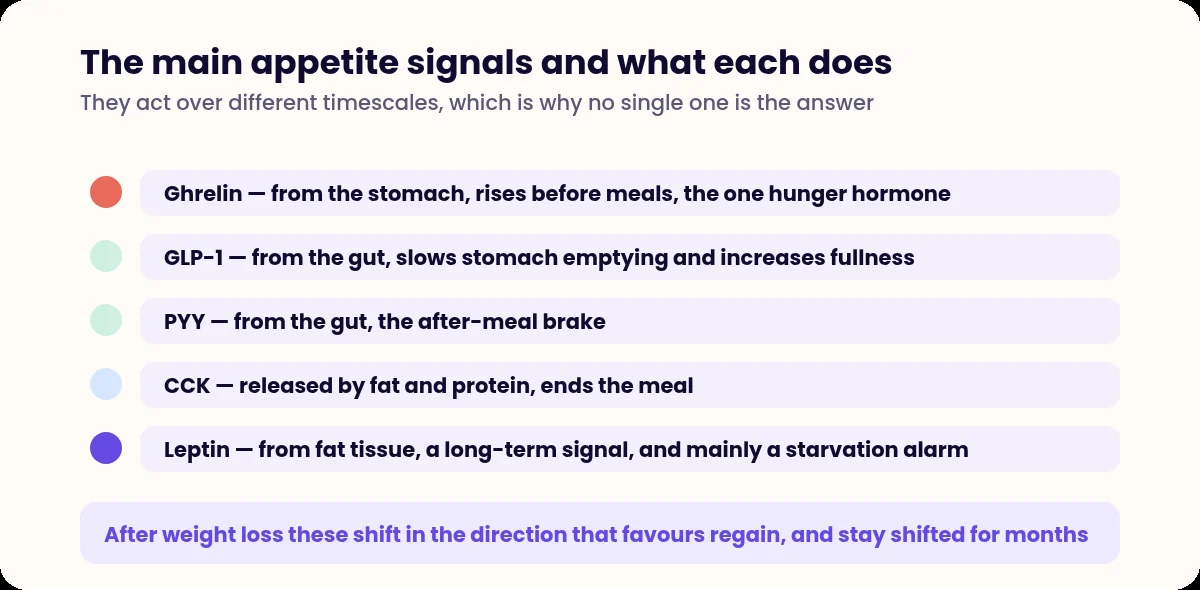
Ghrelin comes from X/A-like cells in the stomach lining. It is the only well-established circulating hormone that increases appetite. It rises before meals and falls after eating, and the acylated form is the bioactive one. Almost everything else in this system pushes the other way.
Leptin is released by fat cells in proportion to fat mass. It is a long-term adiposity signal rather than a meal-to-meal one, telling the brain roughly how much stored energy exists.
GLP-1 comes from L-cells in the distal gut. It slows gastric emptying, increases satiety, and stimulates insulin release in a glucose-dependent way. Its native half-life is one to two minutes, which is why the natural hormone was never a plausible treatment and why the medicines in this class are engineered to resist breakdown.
PYY, specifically PYY3-36, also comes from L-cells and produces post-meal satiety. It is part of what is sometimes called the ileal brake, the mechanism that slows things down when nutrients reach the far end of the small intestine.
CCK comes from I-cells in the duodenum and jejunum, released in response to fat and protein. It is short-acting, contributes to meal termination and makes the gallbladder contract.
Leptin is a starvation signal, not a satiety brake
This is the single most useful correction to the popular account.
If leptin worked as a brake, having more fat would suppress appetite in proportion, and obesity would be self-limiting. It is not. What the biology actually shows is that falling leptin produces powerful compensatory responses — increased hunger, reduced energy expenditure, changes in thyroid and reproductive signalling — while rising leptin produces comparatively little.
In other words, the system is built to detect and resist energy deficit. It is much less interested in surplus. That asymmetry runs through everything else on this page, and it is the same asymmetry described in set point and body weight.
Leptin resistance
The observation is solid. People living with obesity have high circulating leptin and do not respond to exogenous leptin. Proposed explanations include impaired transport across the blood-brain barrier, intracellular signalling inhibition through SOCS3 and PTP1B, endoplasmic reticulum stress and hypothalamic inflammation.
Here is the honest position. Leptin resistance is a description of a phenomenon, not an adequately characterised mechanism. There is no clinical test for it. There is no treatment for it. Leptin given as a medicine works only in congenital leptin deficiency and in lipodystrophy, both rare conditions in which the problem is too little leptin rather than too much [5].
Content promising to “reset your leptin” through particular foods, fasting patterns or supplements has no evidential basis. There is no established way to measure the thing being reset, and no demonstrated intervention that resets it.
What the Sumithran study actually found
This 2011 study in the New England Journal of Medicine is the most cited paper in this field, and it is routinely over-claimed [1].
What it did. Fifty adults completed a ten-week very low energy diet. Hormones and subjective appetite were measured at baseline, at ten weeks and at 62 weeks. Mean weight loss at ten weeks was 13.5kg.
At ten weeks, there were reductions in leptin, PYY, CCK, insulin and amylin, increases in ghrelin, GIP and pancreatic polypeptide, and a significant increase in subjective appetite. In other words, every hormonal change went in the direction of restoring lost weight, and people felt hungrier.
At 62 weeks, a full year after the weight loss and despite partial regain, leptin, PYY, CCK, insulin, ghrelin, GIP, pancreatic polypeptide and hunger were all still significantly different from baseline. The authors concluded that these mediators “do not revert to the levels recorded before weight loss”.
The limitations that get left out
- n=50, single centre. Small, and not representative of weight loss as most people attempt it
- No non-dieting control group. There is no comparison arm showing what these hormones did over the same 14 months in people who did not diet
- An aggressive very low energy diet. A 13.5kg loss in ten weeks is at the extreme end. Whether the same applies to gradual loss is not established
- One post-loss timepoint. Persistence is demonstrated only to about 14 months. Not indefinitely, not for life
- Participants had regained weight by 62 weeks, so some of the hormonal picture reflects an ongoing state of being below a previous maximum rather than a permanent scar
- No adequate longer-term replication
None of that makes the finding worthless. It is a real and important result. But “appetite hormones never normalise after weight loss” is a claim the study does not support, and repeating it as though it does is both inaccurate and demoralising to people who are told their biology has been permanently rewritten.
The bariatric comparison is the genuinely interesting bit
A 2023 study did something more informative than measuring dieters alone: it matched the weight loss [2].
Fifteen people after sleeve gastrectomy, fourteen after gastric bypass and fifteen on a very low energy diet were compared after roughly ten weeks of similar weight loss and similar ketosis. In both surgical groups, basal and post-meal acylated ghrelin fell and post-meal GLP-1 rose, both significantly more than in the diet group. Desire to eat improved more after both operations.
The key point: at matched weight loss, surgery produces a more favourable hormonal profile than dieting. That matters because it shows the hormonal response is not simply a function of how much weight was lost. Something about how the weight is lost changes the signal.
The ghrelin fall is more consistent after sleeve gastrectomy than after bypass, which makes anatomical sense — the fundus, where most ghrelin is produced, is resected.
The caveats are real: about fifteen people per group, ten weeks, and a design that cannot establish whether this explains the durability difference between surgery and dieting. Bariatric surgery explained covers the procedures and what UK access looks like.
What this means in practice
Increased hunger after weight loss is a physiological response, not a failure of willpower. That reframing is the most useful thing this literature offers, and it is well supported even where the details are not.
It also explains why maintenance behaves differently from loss. The signals arguing for regain do not switch off when the target is reached, which is why keeping weight off requires an active plan rather than simply stopping. The intrusive, persistent food thoughts many people describe are covered in food noise.
Medicines acting on the GLP-1 pathway work partly by supplementing a signal this system produces naturally, in a form that lasts far longer than the native hormone. Whether that is appropriate for any individual is a matter for clinical assessment against NICE criteria [6], not something to infer from a hormone diagram.
When to speak to a clinician
- Hunger severe enough that it is affecting your ability to work, sleep or function
- Any pattern of restricting, bingeing or purging, or a preoccupation with food and weight that feels out of control — ask your GP about referral to an eating disorder service
- Rapid unintentional weight loss, which needs assessment rather than reassurance
- Before spending money on supplements or programmes claiming to correct a hormone imbalance
Frequently asked questions
What is ghrelin?
A hormone released by X/A-like cells in the stomach lining. It is the only well-established circulating hormone that increases appetite. Levels rise before meals and fall after eating, and the acylated form is the biologically active one. Ghrelin rises during weight loss, which is part of why hunger increases.
Does leptin resistance exist?
The observation is real: people living with obesity have high circulating leptin and do not respond to extra leptin given as treatment. But leptin resistance is a description of that phenomenon rather than an adequately characterised mechanism. There is no clinical test for it and no treatment, and content promising to reset your leptin has no evidential basis.
Do appetite hormones return to normal after weight loss?
The most cited study found several still significantly different from baseline 62 weeks after a very low energy diet, which is about 14 months. It had no control group and only one post-loss measurement, so persistence beyond that point is an extrapolation rather than a finding. It is widely over-claimed as proof that they never normalise.
Why does bariatric surgery affect appetite differently?
In a study matching surgical and dietary weight loss over about ten weeks, acylated ghrelin fell and post-meal GLP-1 rose significantly more after sleeve gastrectomy and gastric bypass than after a very low energy diet, and desire to eat improved more. The ghrelin fall is more consistent after sleeve gastrectomy, where the part of the stomach producing most ghrelin is removed.
References
- Sumithran P, Prendergast LA, Delbridge E, et al. Long-term persistence of hormonal adaptations to weight loss. New England Journal of Medicine. 2011;365(17):1597-1604. doi.org/10.1056/NEJMoa1105816
- Aukan MI, Coutinho S, Boyesen GA, et al. Differences in gastrointestinal hormones and appetite after sleeve gastrectomy, gastric bypass and diet. Obesity. 2023;31(2):399-411. doi.org/10.1002/oby.23655
- NHS. Obesity: causes. www.nhs.uk/conditions/obesity/causes/
- Speakman JR, Hall KD. Models of body weight and fatness regulation. Philosophical Transactions of the Royal Society B. 2023;378:20220231. doi.org/10.1098/rstb.2022.0231
- British National Formulary. Treatment summaries: obesity and endocrine disorders. bnf.nice.org.uk/
- NICE. Overweight and obesity management. NG246. www.nice.org.uk/guidance/ng246
Medical reviewer
Naeem Teni
Clinical Lead at Manova. Registered pharmacist and independent prescriber, GPhC 2215591. Reviews Manova’s clinical content for accuracy and safety.
Written by
Manova Editorial Team
Researched and written to our editorial policy, using NICE, NHS, MHRA and peer-reviewed sources.
This article is for general information and isn’t a substitute for advice from your own clinician. If you feel unwell, contact your GP or NHS 111. In an emergency, call 999.