

Key takeaways
- Dutasteride is not licensed for androgenetic alopecia anywhere in the UK or EU; the UK licence covers benign prostatic hyperplasia only, so hair loss use is off-label.
- It is licensed for androgenetic alopecia in South Korea and Japan, which is the source of much of the confusion about its status.
- A meta-analysis of three trials found 28.57 more hairs in a small target area with dutasteride than finasteride over 24 weeks, but the trials were short and underpowered for rare harms.
- Finasteride has a plasma half-life of about six to eight hours; dutasteride's terminal half-life is up to about five weeks, so any adverse effect takes far longer to clear.
This page is medicine information rather than an advert. Dutasteride is a prescription only medicine in the UK [6], and whether it is suitable is a decision for a prescriber after an assessment.
Dutasteride occupies an unusual position in hair loss treatment: more pharmacologically potent than the licensed alternative, supported by comparison trials that favour it, and yet not licensed for the indication in this country at all.
The licensing position, stated plainly
In the UK, dutasteride 0.5mg is licensed for benign prostatic hyperplasia — prostate enlargement — and for nothing else [4, 5]. It is not licensed for androgenetic alopecia anywhere in the UK or the EU.
It is licensed for androgenetic alopecia at 0.5mg in South Korea and Japan. That is the origin of a great deal of confusion: international sources describe an approved hair loss treatment, and UK readers reasonably assume that applies here.
UK use for hair loss is therefore off-label. As with any off-label prescribing, that is lawful, but it requires the prescriber to take personal responsibility for the decision and to record a conversation covering the unlicensed indication and the limits of the evidence.
How it differs from finasteride
Both belong to the same class. They block 5-alpha reductase, the enzyme converting testosterone into dihydrotestosterone, which is the hormone driving follicle miniaturisation in male pattern baldness.
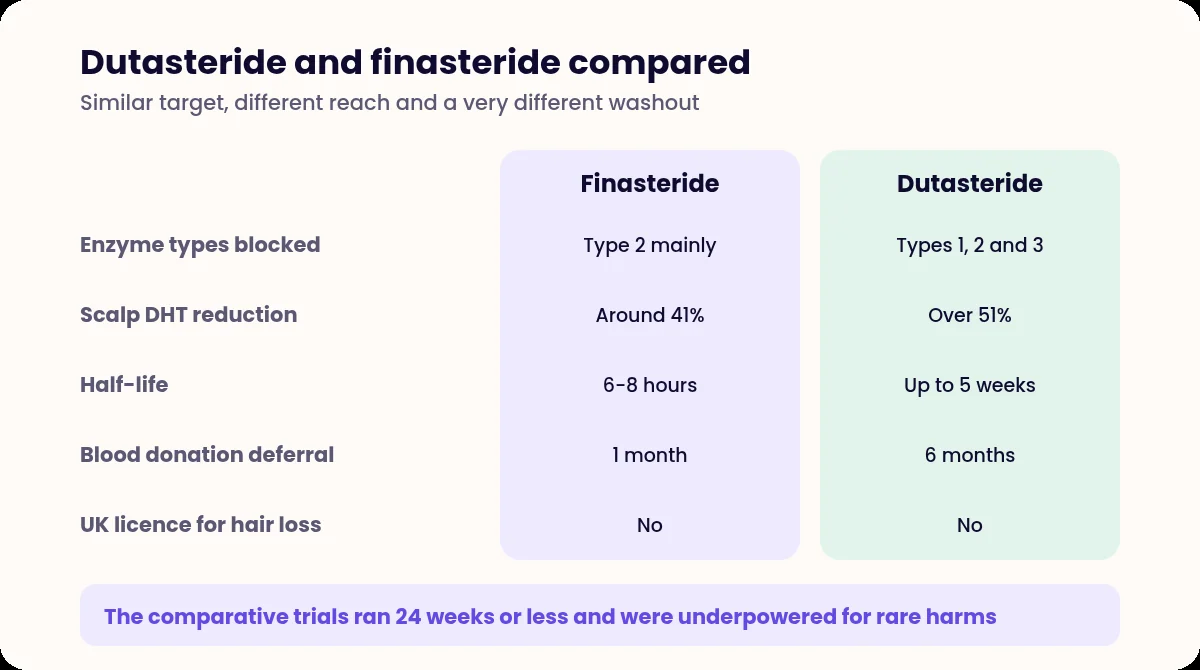
The difference is which forms of the enzyme they block. Finasteride inhibits type 2, and weakly type 3. Dutasteride inhibits types 1, 2 and 3 [1].
That translates into greater potency: roughly three times more potent than finasteride against type 2, and around 100 times more potent against type 1 [1]. The downstream effect is measurable. Scalp DHT falls by more than 51% with dutasteride against about 41% with finasteride, and serum DHT suppression is above 90% compared with around 70% [1].
The half-life, which is the important part
This is the difference that ought to weigh most heavily in a decision, and it is rarely the one people ask about.
Finasteride has a plasma half-life of about six to eight hours. Dutasteride has a terminal half-life of up to around five weeks, with detectable serum levels for four to six months after the last dose [1].
Two practical consequences follow.
First, washout. If someone develops a side effect on finasteride and stops, systemic exposure falls away over days. If someone develops the same side effect on dutasteride and stops, meaningful exposure continues for months. Where the concern is a sexual or psychiatric symptom, that asymmetry is not a technicality — it determines how quickly the experiment can be reversed.
Second, blood donation. UK donation is deferred for six months after the last dose of dutasteride, compared with one month for finasteride, because of the theoretical risk to a pregnant recipient.
The same pregnancy and teratogenicity precautions that apply to finasteride apply here, and the long half-life makes them more stringent rather than less. Women who are or may become pregnant should not handle leaking capsules, and the risk relates to abnormalities of the external genitalia in a male foetus. Finasteride side effects covers the handling rules in full.
Because the enzyme blockade is broader, the dose-response argument is often presented as straightforwardly better. It is not quite that simple: the same broader blockade is also the reason the effects of the drug take longer to reverse, and DHT suppression above 90% has no established advantage over 70% in terms of what a patient sees in the mirror.
What the comparison trials found
The best synthesis is a systematic review and meta-analysis published in Clinical Interventions in Aging in 2019, pooling three randomised trials in 576 men — 290 on dutasteride 0.5mg and 286 on finasteride 1mg [1].
Hair count favoured dutasteride by a mean difference of 28.57 hairs (95% CI 18.75 to 38.39, p<0.00001) over 24 weeks, measured in a 2.54 square centimetre target area.
Assessment scores also favoured dutasteride: investigator assessment at the vertex (mean difference 0.68, p=0.02) and at the frontal area (0.63, p=0.01), and patient self-assessment (0.56, p=0.003) [1].
On safety, there was no statistically significant difference between the two for altered libido (OR 1.12, p=0.54), erectile dysfunction (OR 1.18, p=0.70) or ejaculation disorders (OR 0.75, p=0.58) [1].
The caveats that go with those numbers
The trials were 24 weeks or shorter. Pattern hair loss is treated for years, and a six-month hair count is a surrogate for a decision about a decade.
They were underpowered to detect rare harms. With 576 men in total, the absence of a statistically significant difference in side effects is not evidence of equivalence — it is the expected result of a study too small to answer the question. This is a distinction worth holding onto, because “no significant difference in side effects” is routinely quoted as though it meant “the same safety profile”.
The target area was small, and hair count in a defined patch correlates only loosely with what someone sees in the mirror. The studies were also conducted in men already suitable for a 5-alpha reductase inhibitor, which is not the same population as everyone asking about dutasteride online.
The direction of the efficacy evidence is consistent. The confidence with which it is often presented is not warranted by 576 men over six months.
The 2026 safety change
In May 2026 the MHRA added a precautionary psychiatric warning to dutasteride product information on class grounds, by analogy with finasteride [2].
The sequence behind that is worth knowing. The EMA’s Article 31 referral, concluded by European Commission decision in August 2025, confirmed suicidal ideation as a side effect of finasteride but found insufficient evidence to establish a causal association for dutasteride [3]. A precautionary class warning was added anyway, and the MHRA followed in 2026.
So the dutasteride warning is precautionary rather than evidence-driven. That is not a reason to disregard it. Given the half-life, the argument for taking a psychiatric warning seriously is arguably stronger for dutasteride than for finasteride, because stopping does not produce a quick answer.
Anyone noticing mood change, low mood or thoughts of self-harm on either medicine should seek medical advice promptly rather than waiting; thoughts of harming yourself mean contacting your GP the same day, calling 111, or going to A&E.
Where it reasonably sits
For most men, the licensed option is the starting point, and finasteride explained covers it. Dutasteride is generally considered where finasteride has been tried properly and the response has been inadequate, with the conversation covering off-label status, the long washout, and the fact that the comparison evidence is short-term. Topical finasteride is a different attempt at the same problem.
Frequently asked questions
Is dutasteride licensed for hair loss in the UK?
No. In the UK, dutasteride 0.5mg is licensed for benign prostatic hyperplasia only, and it is not licensed for androgenetic alopecia anywhere in the UK or EU. It is licensed for that indication in South Korea and Japan. Any UK prescription for hair loss is off-label and needs a documented discussion of what that means.
Is dutasteride more effective than finasteride?
In short comparison trials it produced higher hair counts. A meta-analysis of three randomised trials in 576 men found a mean difference of 28.57 hairs in a 2.54 square centimetre target area over 24 weeks, favouring dutasteride, with investigator and patient assessments also favouring it. Twenty-four weeks is a short window on which to judge a treatment taken for years.
Why does the half-life matter?
Finasteride clears from plasma in hours, so stopping produces a fairly quick washout. Dutasteride's terminal half-life is up to around five weeks, with detectable serum levels for four to six months after the last dose. If a side effect appears, the exposure continues for months rather than days, and that asymmetry is the main reason many clinicians reach for finasteride first.
Can I give blood while taking dutasteride?
No, and not for some time afterwards. UK blood donation is deferred for six months after the last dose of dutasteride, compared with one month for finasteride, because of the risk to a pregnant recipient. Tell the donation service what you take rather than assuming.
References
- The efficacy and safety of dutasteride compared with finasteride in treating men with androgenetic alopecia: a systematic review and meta-analysis. Clinical Interventions in Aging, 2019. www.dovepress.com/the-efficacy-and-safety-of-dutasteride-compared-with
- MHRA. Finasteride and dutasteride: updated safety warnings for psychiatric side effects and sexual dysfunction. Drug Safety Update, 11 May 2026. www.gov.uk/drug-safety-update/finasteride-and-dutasteride-updated-safe
- European Medicines Agency. Finasteride and dutasteride containing medicinal products: Article 31 referral. www.ema.europa.eu/en/documents/referral/finasteride-dutasteride-contai
- British National Formulary. Dutasteride. bnf.nice.org.uk/drugs/dutasteride/
- Summary of Product Characteristics: dutasteride 0.5 mg soft capsules. Electronic Medicines Compendium. www.medicines.org.uk/emc/search?q=dutasteride
- The Human Medicines Regulations 2012, regulation 284. www.legislation.gov.uk/uksi/2012/1916/regulation/284
Medical reviewer
Naeem Teni
Clinical Lead at Manova. Registered pharmacist and independent prescriber, GPhC 2215591. Reviews Manova’s clinical content for accuracy and safety.
Written by
Manova Editorial Team
Researched and written to our editorial policy, using NICE, NHS, MHRA and peer-reviewed sources.
This article is for general information and isn’t a substitute for advice from your own clinician. If you feel unwell, contact your GP or NHS 111. In an emergency, call 999.