

Key takeaways
- Emotional eating is a learned regulation strategy, not a lack of discipline.
- Under-eating during the day is one of the most common and most fixable drivers.
- Naming the trigger, delaying briefly and substituting a specific action works better than prohibition.
- Loss of control, secrecy, or compensating afterwards suggests something that needs proper assessment.
Eating because you feel something rather than because you are hungry is one of the most common human behaviours there is. It also gets described as a personal failing more often than almost anything else in weight management, which is both unkind and unhelpful, because it points the solution in the wrong direction.
Why it happens
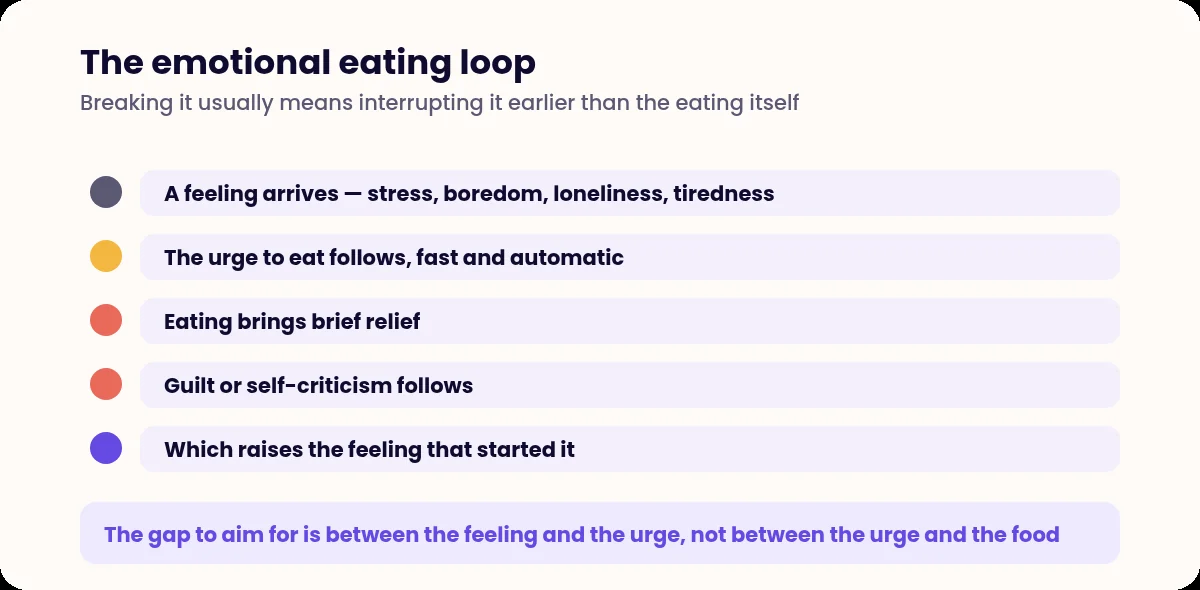
Because it works.
Eating something palatable produces a genuine, immediate shift in how you feel. It is quick, it is available, it requires nothing of anyone else, and the relief arrives within seconds. As a regulation strategy it is efficient. The cost arrives later and separately, which is precisely the structure that makes a behaviour stick.
Describing that as weakness misses what is actually happening. It is a learned response that has been reinforced hundreds of times.
The four things usually underneath it
1. You are genuinely under-fed. This is the most common and the most fixable. A skipped breakfast and a rushed lunch make a 4pm raid close to inevitable, and it is physiology rather than emotion. If your evening eating is the problem, look at your daytime eating first.
2. You are tired. Short sleep raises appetite, increases the pull of energy-dense food and reduces the capacity to resist it. In a randomised trial, adults who extended short sleep by about 1.2 hours a night ate 270 fewer calories a day without any dietary instruction [4].
3. You are regulating a feeling. Stress, boredom, loneliness, anger, anxiety, and sometimes relief or celebration.
4. It is just there. Habit attached to a cue — the kettle, the sofa, the end of the working day. No feeling required.
They look identical from the outside and need different responses, which is why the first useful step is noticing which one you are in.
What actually interrupts it
Remove the conditions rather than fighting the urge
Three regular meals with protein and fibre. Enough sleep. Not arriving at the evening depleted. This does more than any technique, because it reduces the number of times the situation arises.
Name it, without judgement
“I’m about to eat because I’m fed up” is, oddly, one of the more effective interventions available. Not because naming it removes the urge, but because it converts an automatic behaviour into a decision, and decisions can go either way.
Delay, briefly
Ten minutes. Not “never” — that provokes resistance — just ten minutes. Many urges lose their intensity in that window. Some do not, and then you eat, and that is allowed.
Substitute something specific
“Do something else” fails because it is not a plan. A named action works better: put the kettle on and drink the tea standing up, step outside, message someone, do ten minutes of a task you have been avoiding. Decide it in advance.
Change the environment
The single most reliable structural change. Not keeping the thing in the house is not deprivation, it is removing a decision you keep losing at 9pm. Equally, having something you actually like that you can eat freely — fruit, yoghurt, a hot drink — matters more than most advice admits.
Do not compensate
Skipping the next meal to make up for it restarts the cycle in a stronger form. The next meal happens normally.
The thing prohibition does
Banning a food raises its salience, makes eating it feel like a violation, and turns “I had some” into “I’ve blown it, so I may as well finish it”. That escalation is the part that does the damage, not the original biscuit.
Planned inclusion works better than prohibition for most people. So does eating the thing at a table, on a plate, paying attention — which sounds precious and reliably reduces how much is eaten.
When it is something more
Emotional eating is common. Some patterns need proper assessment rather than self-help:
- Eating an unusually large amount in a discrete period with a distinct sense of loss of control
- Secrecy — hiding food, eating differently alone
- Compensating afterwards — vomiting, laxatives, fasting, or exercise driven by having eaten
- Marked distress, shame or preoccupation with food and weight
- Eating patterns that are affecting relationships, work or health
Binge eating disorder is the most common eating disorder in adults, it is frequently missed, and it responds well to treatment [3]. Raising it with a GP does not mean being told to try harder.
If it is easier to start anonymously, Beat runs a UK helpline and online support [2].
When to speak to a clinician
Speak to your GP if you:
- eat with a sense of loss of control, or eat in secret
- make yourself sick, use laxatives, or fast or exercise to compensate for eating
- think about food, weight or your body in a way that is distressing or takes up much of your day
- are low in mood, anxious, or using food as the main way of coping
- have lost or gained weight rapidly without meaning to
If you are struggling and need to talk to someone now, Samaritans can be reached free on 116 123 at any time. If you are in immediate danger, call 999.
Frequently asked questions
What is emotional eating?
Eating in response to a feeling rather than physical hunger — stress, boredom, loneliness, anger, or sometimes relief and celebration. It is extremely common and works in the short term, which is why it persists.
How do I stop emotional eating?
Rarely by trying to stop. More reliably by removing the conditions that make it likely — regular meals, enough protein, adequate sleep — and by having a specific alternative action ready rather than relying on resisting.
Is emotional eating the same as binge eating?
No. Emotional eating is a common pattern. Binge eating involves eating an unusually large amount in a discrete period with a distinct sense of loss of control, and often distress and secrecy afterwards. That is a recognised condition that responds well to proper treatment.
Why do I eat when I'm not hungry?
Usually one of four things: you are actually under-fed earlier in the day, you are tired, you are regulating a feeling, or the food is simply there and habit has attached it to a moment. The four have different solutions, which is why noticing which one it is matters.
References
- NHS. Every Mind Matters. www.nhs.uk/every-mind-matters/
- Beat Eating Disorders. Support and information. www.beateatingdisorders.org.uk/
- NICE. Eating disorders: recognition and treatment. NG69. www.nice.org.uk/guidance/ng69
- Tasali E, Wroblewski K, Kahn E, Kilkus J, Schoeller DA. Effect of sleep extension on objectively assessed energy intake among adults with overweight in real-life settings. JAMA Internal Medicine. 2022;182(4):365-374. doi.org/10.1001/jamainternmed.2021.8098
Medical reviewer
Naeem Teni
Clinical Lead at Manova. Registered pharmacist and independent prescriber, GPhC 2215591. Reviews Manova’s clinical content for accuracy and safety.
Written by
Manova Editorial Team
Researched and written to our editorial policy, using NICE, NHS, MHRA and peer-reviewed sources.
This article is for general information and isn’t a substitute for advice from your own clinician. If you feel unwell, contact your GP or NHS 111. In an emergency, call 999.