

Key takeaways
- Traffic lights are per 100 g: red for fat is over 17.5 g, saturates over 5 g, sugars over 22.5 g, salt over 1.5 g.
- The Reference Intake is a fixed reference for an average adult woman, not a personal target.
- The 'Sugars' figure is total sugars including those in fruit and milk, not free sugars.
- Front-of-pack traffic lights are voluntary in the UK, not mandatory.
UK food labels contain more useful information than almost anywhere else in the world. Two figures on them are routinely misunderstood, and both mislead in the direction of eating more.
The traffic lights
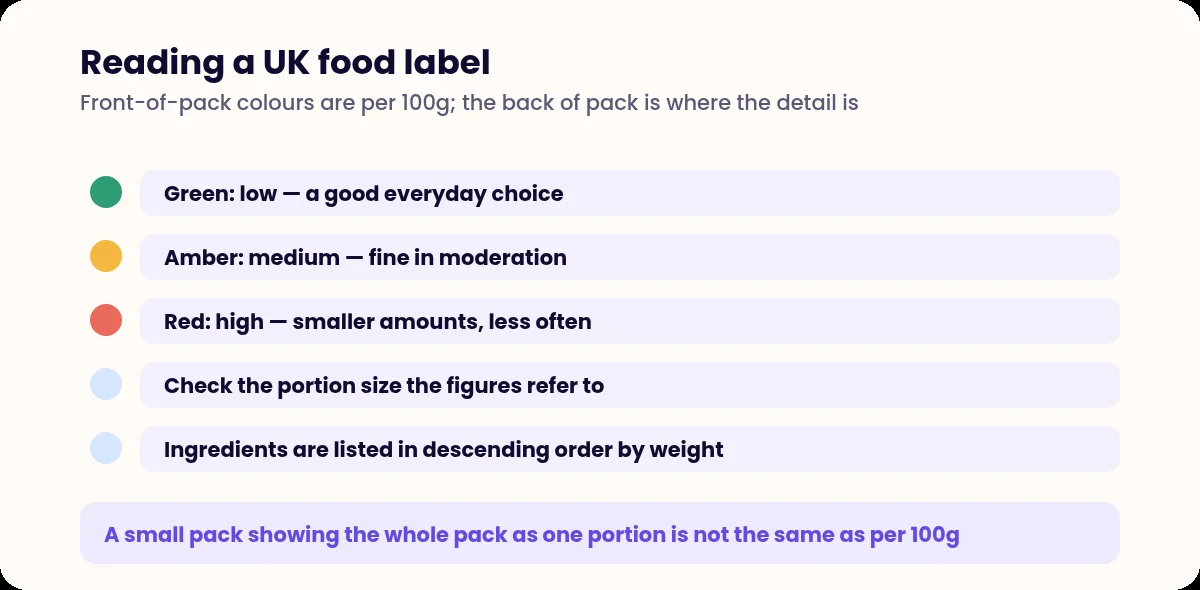
Colours are set by concentration per 100 g of food [1]:
| Nutrient | Green (low) | Amber (medium) | Red (high) |
|---|---|---|---|
| Fat | 3.0 g or less | 3.0–17.5 g | over 17.5 g |
| Saturates | 1.5 g or less | 1.5–5.0 g | over 5.0 g |
| Sugars | 5.0 g or less | 5.0–22.5 g | over 22.5 g |
| Salt | 0.3 g or less | 0.3–1.5 g | over 1.5 g |
Drinks use lower thresholds per 100 ml — for sugars, red is above 11.25 g.
There are also per-portion red thresholds where a portion is bigger than 100 g: fat over 21 g, saturates over 6 g, sugars over 27 g, salt over 1.8 g.
A red light is not a verdict. Olive oil is red for fat. Cheese is red for saturates. Both are reasonable foods. The colour describes concentration, and what matters is how much and how often.
Where the colours are most useful is comparing two similar products. Two pasta sauces side by side, one amber and one red for sugar, is genuinely informative.
One thing worth knowing: front-of-pack traffic lights are voluntary in the UK. Government recommends them and most major retailers use them, but they are not legally required, and their absence tells you nothing about the food.
Misreading number one: the Reference Intake
The %RI figure is based on a fixed reference [1]:
Energy 2,000 kcal · Fat 70 g · Saturates 20 g · Sugars 90 g · Salt 6 g
That reference is an average adult woman. It is not adjusted for your height, weight, age, sex or activity. A 95 kg man and a 55 kg woman see the same percentage from the same packet.
So “this is 15% of your daily intake” is a comparison against a standard figure, not a statement about you.
Misreading number two: sugars
This one matters more.
The “Sugars” line means total sugars — including sugars naturally present in fruit and in milk. The 90 g reference intake refers to that total.
UK health guidance is about something different: free sugars, which are added sugars plus those in honey, syrups and fruit juice. SACN recommends no more than 5% of total energy from free sugars, roughly 30 g a day for adults [2].
So the packet’s 90 g and the guidance’s 30 g are not the same measure. Reading the label’s figure as the health limit gets you to three times the recommendation.
Practical rule: plain yoghurt and milk show sugar on the label and contain no free sugars. A fruit yoghurt shows more, and the difference is usually added.
Reading the ingredients list
Ingredients are listed by weight, largest first. Two consequences worth using:
Where sugar appears tells you how much there is. If it is in the first three ingredients, there is a lot. Sugar also appears under many names — glucose syrup, invert sugar, dextrose, maltodextrin, fruit juice concentrate — so several small entries can add up to a large one.
Allergens are in bold, which UK law requires.
Per 100 g versus per portion
Always check which one you are reading. “Per portion” figures are useful only if the stated portion is what you actually eat, and it frequently is not — a “portion” of crisps or cereal is often smaller than what ends up in the bowl.
Compare products per 100 g. Judge your own intake per the portion you actually have.
Eating out
In England, businesses with 250 or more employees must display calories at the point of choice, alongside the statement that adults need around 2,000 kcal a day [4]. It applies to menus, boards, online ordering and delivery platforms.
This is England only. Scotland, Wales and Northern Ireland have not implemented equivalent mandatory requirements, so UK-wide statements about menu calories are wrong for three nations.
When to speak to a clinician
Ask for advice from a pharmacist, GP or dietitian if you:
- have diabetes and want help using carbohydrate figures on labels
- have coeliac disease, a food allergy or intolerance and are unsure how to read declarations
- have chronic kidney disease and need to manage potassium, phosphate or salt
- have high blood pressure and want help identifying the salt in your diet, most of which is not added at the table
- are following a restricted diet and are unsure whether it is nutritionally adequate
Frequently asked questions
What do the traffic light colours mean?
They are thresholds per 100 g of food. Green is low, amber medium, red high. For fat, red is above 17.5 g per 100 g; saturates above 5 g; total sugars above 22.5 g; salt above 1.5 g. Drinks use lower thresholds per 100 ml.
Is a red light bad?
Not necessarily. Olive oil and cheese are red for fat and are perfectly reasonable foods. The colours describe concentration per 100 g, not whether a food belongs in your diet. How much and how often matters more.
What does %RI mean?
Reference Intake — a fixed reference of 2,000 kcal, 70 g fat, 20 g saturates, 90 g sugars and 6 g salt. It is based on an average adult woman and is not personalised to you.
Does the sugar figure on a label include natural sugars?
Yes. 'Sugars' means total sugars, including those naturally in fruit and milk. Health guidance on free sugars — no more than about 5% of energy, roughly 30 g a day — is a different measure from the 90 g reference intake.
References
- Food Standards Agency. Front of pack nutrition labelling guidance. www.food.gov.uk/sites/default/files/media/document/fop-guidance_0.pdf
- Scientific Advisory Committee on Nutrition. Carbohydrates and Health. 2015. www.gov.uk/government/publications/sacn-carbohydrates-and-health-repor
- NHS. Food labels. www.nhs.uk/live-well/eat-well/food-guidelines-and-food-labels/how-to-r
- The Calorie Labelling (Out of Home Sector) (England) Regulations 2021. www.legislation.gov.uk/ukdsi/2021/9780348223538
Medical reviewer
Naeem Teni
Clinical Lead at Manova. Registered pharmacist and independent prescriber, GPhC 2215591. Reviews Manova’s clinical content for accuracy and safety.
Written by
Manova Editorial Team
Researched and written to our editorial policy, using NICE, NHS, MHRA and peer-reviewed sources.
This article is for general information and isn’t a substitute for advice from your own clinician. If you feel unwell, contact your GP or NHS 111. In an emergency, call 999.