

Key takeaways
- Gut bacteria differ on average between people with and without obesity, but direction of causation in humans is not established.
- The Firmicutes-to-Bacteroidetes ratio does not hold up as a marker of obesity.
- Probiotics show no significant effect on body weight in the most recent meta-analysis.
- No direct-to-consumer microbiome test sold in the UK has been shown to improve weight outcomes.
The gut microbiome is one of the most genuinely interesting areas in human biology and one of the most heavily monetised. Separating the two is worth doing before you spend anything.
What is established
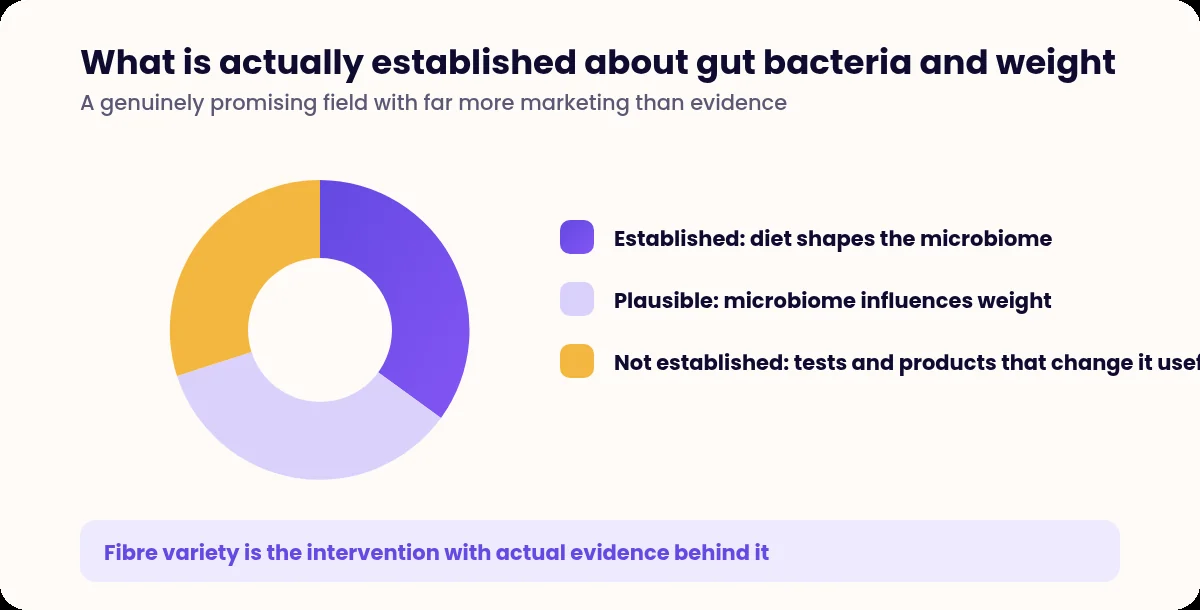
The composition differs on average. Groups of people with and without obesity have measurably different gut bacterial communities.
Diet changes it. Fibre quantity and plant diversity have clear, reproducible effects on the microbiota within days to weeks.
Fermentation produces useful compounds. Bacteria ferment fibre into short-chain fatty acids, which have measurable metabolic and appetite-signalling effects.
Faecal transplant works — for one thing. It is an effective treatment for recurrent Clostridioides difficile infection. It is not a treatment for obesity.
What is not established
That your microbiome is causing your weight. Direction of causation in humans is unresolved. The differences seen in people with obesity are at least partly a consequence of what they eat and of adiposity itself, rather than a cause.
Much of the excitement traces back to germ-free mouse transplant experiments, and those foundations have been directly challenged in the literature.
The Firmicutes-to-Bacteroidetes ratio. This is the number most often quoted by commercial tests. It does not hold up. A detailed review concluded it is not a reliable marker of dysbiosis in obesity [1], and a large childhood cohort found no consistent relationship with BMI.
If a test report leads with that ratio, it is telling you something about the test rather than about you.
Probiotics
The most recent meta-analysis pooled 10 randomised trials, 633 participants, 8–12 weeks [2]:
- Body weight: no significant difference
- Lean body mass: no significant difference
- BMI: significant, but attenuated to borderline when a study with baseline imbalance was excluded
- Fat mass: small effect that lost significance on sensitivity analysis
Heterogeneity was very high. The authors described their own findings as preliminary.
The honest summary is that probiotics are not a weight-loss treatment. They have other uses — antibiotic-associated diarrhoea, some irritable bowel symptoms — where the evidence is better.
Microbiome tests
Direct-to-consumer microbiome testing is a growing UK market. No such test has been shown to improve weight outcomes, and no UK regulator endorses them for this purpose.
Three practical problems: the science does not yet support personalised dietary prescriptions from a stool sample; results vary substantially depending on what you ate recently and how the sample was handled; and the advice generated is usually generic — eat more fibre, more plant variety, less ultra-processed food.
You can have that advice now, for nothing.
What actually helps
Fibre. The single best-supported lever. UK guidance is 30 g a day; average intake is around 18–20 g. Higher fibre intake is associated with lower body weight and with substantially lower rates of heart disease, stroke, type 2 diabetes and colorectal cancer [4]. See fibre and weight loss.
Plant diversity. Different plants feed different bacteria. Variety is easier to act on than any specific target.
Fermented foods. Live yoghurt, kefir, sauerkraut, kimchi. The evidence is less strong than for fibre but the foods are cheap and harmless.
Fewer very low-fibre, energy-dense processed foods. Partly for the microbiome, mostly for everything else.
Reasonable antibiotic use. Take them when they are indicated; they are not a lifestyle choice either way.
The framing worth keeping
The microbiome is probably part of the story of body weight, in a way that will look clearer in ten years. Right now, the interventions with real evidence behind them are the same ones that were recommended before anyone sequenced a stool sample.
That is not a reason to be dismissive about the science. It is a reason to be sceptical about anything sold on the strength of it.
When to speak to a clinician
Speak to a GP rather than buying a test if you have:
- a persistent change in bowel habit lasting three weeks or more
- blood in your stool, or bleeding from the bottom
- unexplained weight loss with bowel symptoms
- persistent bloating, particularly if you are a woman over 50 — this needs assessing rather than treating as a gut health issue
- ongoing abdominal pain, or symptoms that wake you at night
- a family history of bowel cancer or inflammatory bowel disease
These symptoms need investigation, not probiotics.
Frequently asked questions
Can gut bacteria make you gain weight?
The microbiota of people with and without obesity differ on average, and diet clearly changes the microbiota. Whether those differences cause weight gain in humans, or largely result from diet and adiposity, is not settled.
Do probiotics help you lose weight?
The most recent meta-analysis found no significant effect on body weight. Effects on BMI and fat mass were small and did not survive sensitivity analysis. The authors described their own findings as preliminary.
Are microbiome tests worth it?
No UK regulator endorses them for weight management, and none has been shown to improve weight outcomes. The dietary advice they generate is generally the advice you would get anyway: more fibre, more plant variety, less ultra-processed food.
What actually improves gut health?
Fibre quantity and plant diversity are the changes with the most support, along with fermented foods for some people. None of this is exotic, and it overlaps entirely with ordinary good dietary advice.
References
- Magne F, Gotteland M, Gauthier L, et al. The Firmicutes/Bacteroidetes ratio: a relevant marker of gut dysbiosis in obese patients? Nutrients. 2020;12(5):1474. doi.org/10.3390/nu12051474
- Probiotic supplementation and body composition: systematic review and meta-analysis of 10 randomised trials. Physical Activity and Nutrition. 2026. pubmed.ncbi.nlm.nih.gov/42438848/
- McBurney MI, et al. Understanding the role of the human gut microbiome in overweight and obesity. Annals of the New York Academy of Sciences. 2024. doi.org/10.1111/nyas.15215
- Reynolds A, Mann J, Cummings J, et al. Carbohydrate quality and human health: a series of systematic reviews and meta-analyses. The Lancet. 2019;393(10170):434-445. doi.org/10.1016/S0140-6736(18)31809-9
Medical reviewer
Naeem Teni
Clinical Lead at Manova. Registered pharmacist and independent prescriber, GPhC 2215591. Reviews Manova’s clinical content for accuracy and safety.
Written by
Manova Editorial Team
Researched and written to our editorial policy, using NICE, NHS, MHRA and peer-reviewed sources.
This article is for general information and isn’t a substitute for advice from your own clinician. If you feel unwell, contact your GP or NHS 111. In an emergency, call 999.