

Key takeaways
- A commonly used safe pace is 0.5–1 kg a week, which is roughly 2–4 kg in a month.
- The first week or two often shows more than that. Much of it is water released as your body uses up stored carbohydrate.
- Losing 5–10% of your starting weight produces measurable health benefits, and that is a more useful goal than a round number on the scales.
- Faster is not automatically worse for long-term results, but it usually means more muscle loss, more side effects and less time to build habits.
It’s the first question almost everyone asks, usually with a date in mind — a wedding, a holiday, a birthday with a zero in it.
The short answer: 2 to 4 kg in a month, at the pace generally considered safe and sustainable. The longer answer is more useful, because it explains why your first month will probably beat that and your third probably won’t.
The standard advice, and where it comes from
The NHS weight loss plan works to a rate of 0.5–1 kg (1–2 lb) a week [1]. Over four weeks that’s 2–4 kg, or roughly half a stone at the upper end.
That range isn’t arbitrary. It’s about the largest deficit most people can hold without the side effects — hunger, fatigue, muscle loss, nutritional shortfalls — that make a diet collapse.
Why your first two weeks flatter you
If you lose 3 kg in week one, you have not lost 3 kg of fat. You’d have needed a deficit of around 23,000 kcal to do that, which is more than most people eat in a fortnight.
What you’ve lost is largely water. Your body keeps a store of carbohydrate called glycogen in muscle and liver, and glycogen is stored along with a substantial amount of water. Cut your food intake, particularly carbohydrate, and those stores run down — taking the water with them [5]. The same mechanism works in reverse, which is why a single big carbohydrate meal can put 1–2 kg on the scales overnight without a gram of fat being gained.
Two practical consequences:
- Don’t extrapolate from week one. If you do, week three will feel like failure when it’s actually normal.
- Don’t panic at a jump. A 1.5 kg rise after a weekend away is almost always water and food volume, not fat.
A better target than a round number
Rather than “a stone by June”, the evidence points towards percentages. Losing 5% of your starting weight produces measurable improvements in blood sugar, blood pressure and blood fats; benefits continue to accumulate at 10% and 15% [3].
For a 100 kg person, 5% is 5 kg. That is a genuinely achievable first goal, and it’s the point at which health markers start to move — long before anyone reaches a “goal weight”.
NICE’s current guideline pushes in the same direction, encouraging personalised goals agreed with the person — finding stairs easier, being able to play with grandchildren — rather than a number alone, and explicitly noting that weight regain shouldn’t be treated as failure [2].
What a realistic four months looks like
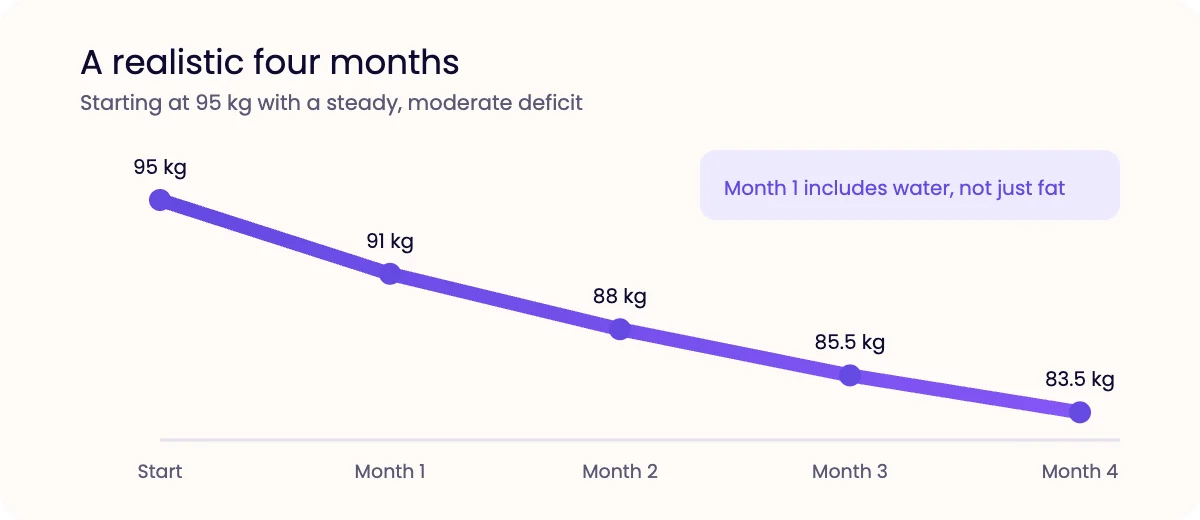
Starting at 95 kg with a consistent, moderate deficit:
| Month | Typical loss | Running total |
|---|---|---|
| 1 | 4 kg (including water) | 91 kg |
| 2 | 3 kg | 88 kg |
| 3 | 2.5 kg | 85.5 kg |
| 4 | 2 kg | 83.5 kg |
Note the slope. Each month delivers less than the last on the same effort, because a lighter body needs less energy. That’s the physiology explained in our guide to calorie deficits, and it’s the single most common reason people conclude something has gone wrong when nothing has.
Is faster ever better?
Here the evidence is more interesting than the standard advice implies. A randomised trial that compared rapid weight loss with gradual weight loss found no difference in the proportion regained over the following three years [4]. The intuition that slow loss “sticks” better isn’t well supported.
So why still recommend a moderate pace? Three reasons that have nothing to do with regain:
- Muscle. Bigger deficits take a larger share of weight from lean tissue, especially without enough protein and strength training.
- Gallstones. Rapid weight loss is a recognised risk factor [6].
- Habits. The behaviours that keep weight off take months to become automatic. A crash gives you the loss without the learning.
Rapid approaches, including very low calorie diets, do have a legitimate place — but under clinical supervision, with monitoring and nutritional support, not improvised from the internet.
Signs you’re going too fast
- Losing consistently more than 1% of your body weight a week over several weeks
- Persistent tiredness, feeling cold, dizziness or hair thinning
- Losing strength in the gym or struggling with stairs you managed a month ago
- Periods becoming irregular or stopping
- Preoccupation with food, or feeling out of control around it
Any of those is a reason to ease off and, if they persist, to speak to a clinician.
When to get help
Speak to your GP or a Manova clinician if you’re losing weight without trying, if weight loss comes with other symptoms, or if you’ve been consistent for two months with no change at all. And if your relationship with food or your body feels like it’s becoming the problem, that deserves support in its own right — your GP can refer you, and the National Alliance for Eating Disorder helpline can point you to resources.
Frequently asked questions
How much weight can I lose in a month?
At a steady pace of 0.5 to 1 kg a week, expect 2 to 4 kg a month. Your first month often shows more because of water loss, and later months usually show less as your body needs less energy at a lower weight.
Is losing 10 kg in a month realistic?
Not safely, for most people. Losing that much in four weeks implies an extreme deficit that is hard to sustain, increases muscle loss, and raises the risk of gallstones, nutrient shortfalls and fatigue. Very low calorie diets that achieve rates like this are used clinically, but with medical supervision.
Why did I lose 3 kg in the first week then almost nothing?
Early rapid loss is mostly water. Your body stores carbohydrate as glycogen, and glycogen holds water with it. When you eat less, those stores empty and the water goes with them. Once that is done, the scales start reflecting fat loss, which is slower and less dramatic.
Is slow weight loss better for keeping it off?
The evidence is less clear-cut than the advice suggests. One randomised trial found that people who lost weight rapidly were no more likely to regain it than those who lost it gradually. The stronger arguments for a moderate pace are about muscle, nutrition and the time it takes to build habits, rather than regain.
How long until other people notice?
It varies with height and starting weight, but many people find changes in how clothes fit arrive before anything is visible to others, often after about 4 to 5% of body weight has gone.
References
- NHS. 12-week weight loss plan, week 1 guide (safe rate of 0.5–1 kg a week). assets.nhs.uk/tools/download-panels/data/weight-loss/pdf/wlp1.pdf
- National Institute for Health and Care Excellence. Overweight and obesity management (NG246). Published 14 January 2025. www.nice.org.uk/guidance/ng246
- Ryan DH, Yockey SR. Weight loss and improvement in comorbidity: differences at 5%, 10%, 15% and over. Current Obesity Reports. 2017;6(2):187-194. doi.org/10.1007/s13679-017-0262-y
- Purcell K, Sumithran P, Prendergast LA, Bouniu CJ, Delbridge E, Proietto J. The effect of rate of weight loss on long-term weight management: a randomised controlled trial. The Lancet Diabetes & Endocrinology. 2014;2(12):954-962. doi.org/10.1016/S2213-8587(14)70200-1
- Kreitzman SN, Coxon AY, Szaz KF. Glycogen storage: illusions of easy weight loss, excessive weight regain, and distortions in estimates of body composition. American Journal of Clinical Nutrition. 1992;56(1 Suppl):292S-293S. doi.org/10.1093/ajcn/56.1.292S
- NHS. Gallstones — causes. www.nhs.uk/conditions/gallstones/causes/
- NHS Better Health. Lose weight. www.nhs.uk/better-health/lose-weight/
Medical reviewer
Naeem Teni
Clinical Lead at Manova. Registered pharmacist and independent prescriber, GPhC 2215591. Reviews Manova’s clinical content for accuracy and safety.
Written by
Manova Editorial Team
Researched and written to our editorial policy, using NICE, NHS, MHRA and peer-reviewed sources.
This article is for general information and isn’t a substitute for advice from your own clinician. If you feel unwell, contact your GP or NHS 111. In an emergency, call 999.