

Key takeaways
- In the TREAT trial, 16:8 eating produced no significant weight advantage over three structured meals a day.
- In a 12-month trial, 4:3 fasting beat daily calorie restriction by about 2.6 percentage points of body weight.
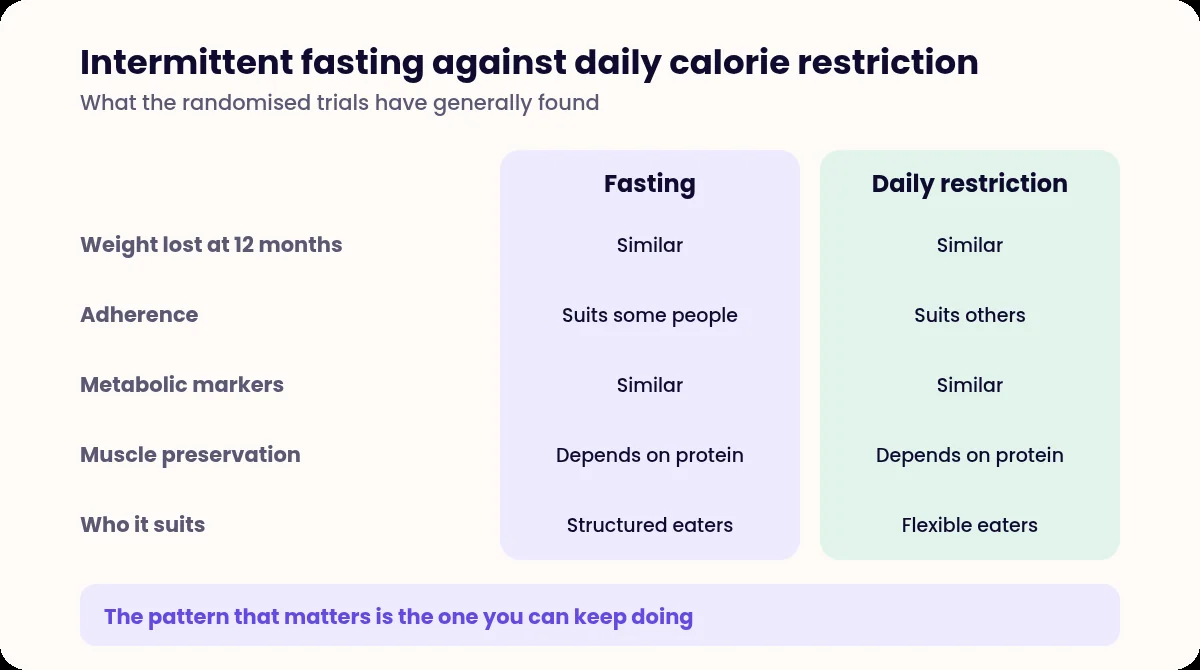
- When calories are matched, fasting is not superior to ordinary restriction.
- NICE has made no recommendation for or against intermittent fasting — it classed it as a research gap.
Intermittent fasting has been sold as a mechanism — something about the fasted state that makes fat loss work differently. The trials are the fastest way through the noise.
The trial that found nothing
TREAT randomised 116 adults with overweight or obesity to either 16:8 time-restricted eating — all food between midday and 8pm — or three structured meals a day, for 12 weeks [1].
- Time-restricted eating: −0.94 kg
- Three meals a day: −0.68 kg
- Difference: −0.26 kg, not statistically significant
No significant differences in fasting insulin, glucose or HbA1c either.
There was one finding worth noting. In the subgroup who had body composition measured in person, the fasting group lost significantly more lean mass than the control group. That is not a trivial detail if you are trying to protect muscle.
The trial that found something
DRIFT randomised 165 adults to 4:3 intermittent fasting — three non-consecutive very-low-intake days a week — or daily calorie restriction, for 12 months, with substantial behavioural support and a 300-minute-a-week activity target in both arms [2].
- 4:3 fasting: −7.6% of body weight
- Daily restriction: −5.0%
- Difference: 2.6 percentage points, favouring fasting
- 58% versus 47% achieved at least 5% loss
That is a real result over a proper duration. It is also a single centre, with heavy support in both arms, and it has not been replicated.
The resolution
A 2025 meta-analysis of 20 randomised trials asked the cleaner question: when calories are matched, does fasting win? [3]
It does not. Fasting was found to be “an effective alternative to” continuous restriction, not superior to it. And the comparison threw up something practically useful: continuous restriction produced significantly lower hunger, lower fatigue and lower triglycerides than fasting.
So the mechanism story does not survive. What survives is simpler: for some people, a rule about when to eat is easier to follow than a rule about how much. That is a legitimate reason to use it. It is just not a metabolic one.
What NICE says
Nothing, deliberately. NG246 has a heading for intermittent fasting in adults, and under it points only to a recommendation for research [4]. There is no NICE recommendation for or against.
That is worth knowing if someone tells you NICE endorses it, or that NICE has ruled it out. Neither is true.
If you want to try it
Pick the version that fits your life. 16:8 is the least disruptive. 5:2 and 4:3 involve genuinely low-intake days, which some people find easier to do occasionally than to do a little every day.
Do not treat the eating window as unlimited. The window controls timing, not quantity. People who lose weight on 16:8 are eating less overall; people who do not are eating the same amount in a shorter period.
Keep protein up. Given the lean-mass signal in TREAT, aim for 1.2 to 1.6 g per kg of body weight per day, and keep resistance training in the plan.
Expect the first fortnight to be uncomfortable, and judge it after six weeks rather than six days.
Who should not
- Anyone with a history of an eating disorder or disordered eating. Rules about when you may eat are a poor fit for a mind that already has too many of them.
- People with type 1 diabetes, or type 2 diabetes on insulin or a sulfonylurea, without prescriber-led dose adjustment first — hypoglycaemia risk is real.
- Pregnancy and breastfeeding.
- Children and adolescents.
- Frail older adults, or anyone at risk of malnutrition or muscle loss.
- Anyone taking medicines that need to be taken with food, or at fixed times relative to food.
When to speak to a clinician
Speak to a clinician before starting if you:
- take insulin, a sulfonylurea, or any medicine that must be taken with food
- have type 1 diabetes
- are pregnant, breastfeeding or trying to conceive
- have a history of an eating disorder, or find food rules become difficult to relax
- are frail, underweight, or have lost weight without meaning to
- feel faint, shaky or unwell during fasting periods
Frequently asked questions
Does intermittent fasting work for weight loss?
It can, but mainly because it is a way of eating fewer calories rather than because of the timing itself. In trials where calorie intake was matched between fasting and ordinary restriction, fasting was not superior.
Is 16:8 better than counting calories?
Not in the best-controlled test of it. In a 12-week randomised trial, 16:8 time-restricted eating produced a weight change of −0.94 kg against −0.68 kg for three structured meals, a difference that was not statistically significant.
Who should not try intermittent fasting?
Anyone with a history of an eating disorder or disordered eating, people with type 1 diabetes or on insulin or sulfonylureas without prescriber-led dose adjustment, during pregnancy or breastfeeding, children and adolescents, and frail older adults at risk of malnutrition.
Does fasting trigger autophagy and slow ageing?
This is not established in humans for weight or health outcomes. It is one of the more heavily over-claimed areas in nutrition, and nothing in UK guidance rests on it.
References
- Lowe DA, Wu N, Rohdin-Bibby L, et al. Effects of time-restricted eating on weight loss and other metabolic parameters in women and men with overweight and obesity: the TREAT randomized clinical trial. JAMA Internal Medicine. 2020;180(11):1491-1499. doi.org/10.1001/jamainternmed.2020.4153
- 4:3 intermittent fasting versus daily caloric restriction: a randomised trial. Annals of Internal Medicine. 2025;178(5). doi.org/10.7326/ANNALS-24-01631
- Intermittent fasting versus continuous energy restriction under isocaloric conditions: systematic review and meta-analysis of 20 randomised trials. Nutrition, Metabolism and Cardiovascular Diseases. 2025. pubmed.ncbi.nlm.nih.gov/39732588/
- NICE. Overweight and obesity management. NG246. January 2025. www.nice.org.uk/guidance/ng246
Medical reviewer
Naeem Teni
Clinical Lead at Manova. Registered pharmacist and independent prescriber, GPhC 2215591. Reviews Manova’s clinical content for accuracy and safety.
Written by
Manova Editorial Team
Researched and written to our editorial policy, using NICE, NHS, MHRA and peer-reviewed sources.
This article is for general information and isn’t a substitute for advice from your own clinician. If you feel unwell, contact your GP or NHS 111. In an emergency, call 999.