

Key takeaways
- Retaining some weight at 12 months is common and is not a failure.
- Breastfeeding raises energy needs, but the net effect on weight in the evidence is small and inconsistent.
- Very low calorie diets and total diet replacement are not appropriate while breastfeeding.
- Weight-loss medicines differ: semaglutide is not for use while breastfeeding; tirzepatide's product information now says it could be considered.
Most postnatal weight advice is written as though you have the time, sleep and autonomy of someone who is not looking after a newborn. This one tries not to.
What is actually normal
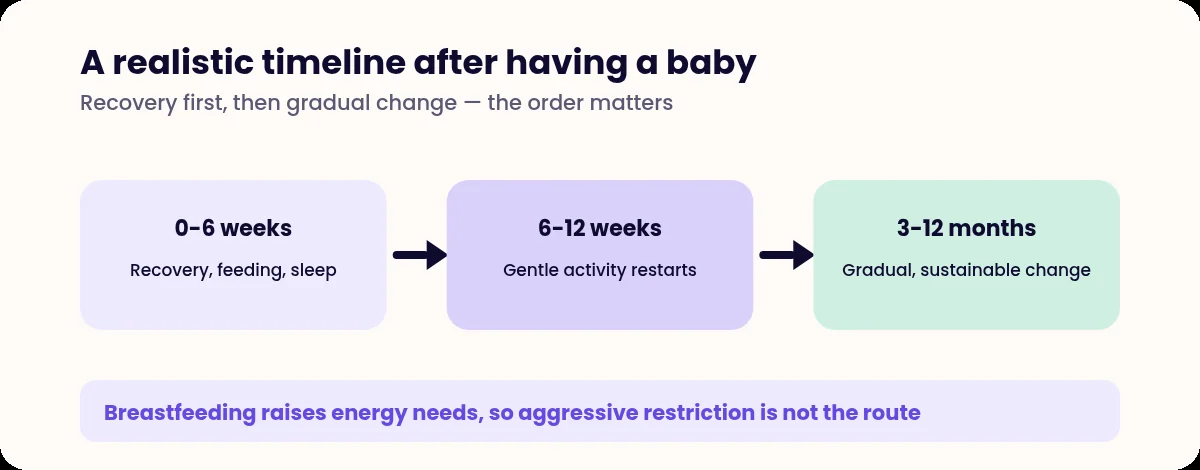
Weight gained during pregnancy is usually lost gradually across 6 to 12 months, and it is common to still be carrying some at a year. That is not a failure, and it is not unusual.
Several things are happening at once that have nothing to do with willpower: fluid shifts in the first fortnight, disrupted sleep, recovery from birth or surgery, changed appetite, and a schedule that makes planned eating close to impossible.
The first six weeks are for recovery. Anyone giving you a weight target in that window is not being helpful.
The breastfeeding claim
“Breastfeeding burns 500 calories a day, so the weight falls off.”
The first half is roughly true — lactation genuinely increases energy requirements substantially. The second half does not follow. Intake tends to rise to meet the demand, and activity often falls. Across systematic reviews, the net effect of breastfeeding on postpartum weight retention is small and inconsistent.
This matters because women who breastfeed and do not lose weight are frequently told they must be eating too much, when the evidence never supported the promise in the first place.
Breastfeed for the reasons breastfeeding is recommended. Treat weight loss as a possible bonus rather than a mechanism.
Dieting while breastfeeding
A modest, nutritionally adequate deficit is generally reasonable once feeding is established. What is not appropriate:
- Very low calorie diets and total diet replacement — NICE restricts these to specialist services with a clinical need for rapid loss, which does not describe lactation [2]
- Aggressive carbohydrate restriction
- Anything that leaves you short of fluid, protein or micronutrients
Practical version: eat regularly rather than sporadically, prioritise protein and fibre, keep fluids up, and continue a vitamin D supplement. If milk supply drops, or you feel dizzy, exhausted beyond the ordinary newborn exhaustion, or unwell, ease off and get advice.
Movement, when you can
The NHS position is sensible and unambitious: gentle activity as soon as you feel up to it, and a conversation at the six-week postnatal check before returning to higher-impact exercise. Recovery takes longer after a caesarean or a complicated birth [1].
Two things are worth prioritising over cardio in the early months:
Pelvic floor exercises. Start early, do them daily, and get a referral to a specialist physiotherapist if you have leaking, heaviness or pain — those are treatable and should not be accepted as permanent.
Walking with the pram. It is activity, it is outdoors, and it does not require childcare.
If you have an abdominal separation that has not closed, or any pain, get assessed before doing loaded abdominal work.
Weight-loss medicines afterwards
This is an area where general statements have recently stopped being accurate, so it is worth the detail.
Semaglutide product information advises against use during breastfeeding [4].
Tirzepatide product information now states that it “could be considered for use during breast-feeding”, on the basis that concentrations in breast milk were undetectable to very low after a single dose, and that as an amino acid sequence it would be expected to be broken down rather than absorbed intact by an infant [3].
“Could be considered” moves the decision to a prescriber rather than settling it. But a blanket claim that these medicines are never compatible with breastfeeding is no longer accurate.
If you are not breastfeeding, the usual eligibility criteria apply, and contraception advice matters — fertility can return before periods do.
The part people find hardest
Not the eating. The identity.
Bodies change permanently after pregnancy in ways weight loss does not undo — rib cage width, skin, the distribution of what is there. Aiming to return to an exact previous shape sets up a target that may not be available.
If food, weight or body image is occupying a distressing amount of your attention, or if you are low in mood, tearful, anxious or struggling to enjoy the baby, that is worth raising with your GP or health visitor. Postnatal depression and anxiety are common, treatable, and frequently presented as “just tiredness”.
When to speak to a clinician
Contact your GP, midwife or health visitor if you:
- have heavy bleeding, fever, severe pain, or a wound that is not healing
- have urinary or bowel leakage, or a feeling of heaviness in the pelvis
- feel persistently low, anxious, tearful or detached, or have thoughts of harming yourself or the baby — seek help promptly
- are losing weight rapidly without trying
- have concerns about milk supply while reducing intake
- want to discuss weight-loss medication, contraception, or both
If you had gestational diabetes, you should be offered a blood glucose test after birth and annual checks afterwards, because the risk of type 2 diabetes is raised long term.
Frequently asked questions
How long does it take to lose baby weight?
Weight gained in pregnancy is typically lost gradually over 6 to 12 months, and many women retain some at a year. There is no standard timetable, and the pace depends on sleep, feeding, recovery from birth and the practicalities of having a baby.
Does breastfeeding help you lose weight?
It raises energy requirements, but intake usually rises to compensate. Across systematic reviews the net effect on weight retention is small and inconsistent. Breastfeeding is worth doing for many reasons; reliable weight loss is not one you should count on.
Can I diet while breastfeeding?
A modest, nutritionally adequate deficit is generally reasonable once feeding is established. Very low calorie diets and total diet replacement are not appropriate. If milk supply drops or you feel unwell, ease off and seek advice.
Can I take weight-loss medication after birth?
It depends on the medicine and whether you are breastfeeding. Semaglutide product information advises against use while breastfeeding. Tirzepatide product information now states it could be considered. Either way this is a prescriber's assessment, not a self-service decision.
References
- NHS. Keeping fit and healthy with a baby. www.nhs.uk/conditions/baby/support-and-services/keeping-fit-and-health
- NICE. Overweight and obesity management. NG246. January 2025. www.nice.org.uk/guidance/ng246
- Mounjaro (tirzepatide) Summary of Product Characteristics, section 4.6. www.medicines.org.uk/emc/product/15484/smpc
- Wegovy (semaglutide) Summary of Product Characteristics. www.medicines.org.uk/emc/product/13803/smpc
- NHS. Your post-pregnancy body. www.nhs.uk/conditions/baby/support-and-services/your-post-pregnancy-bo
Medical reviewer
Naeem Teni
Clinical Lead at Manova. Registered pharmacist and independent prescriber, GPhC 2215591. Reviews Manova’s clinical content for accuracy and safety.
Written by
Manova Editorial Team
Researched and written to our editorial policy, using NICE, NHS, MHRA and peer-reviewed sources.
This article is for general information and isn’t a substitute for advice from your own clinician. If you feel unwell, contact your GP or NHS 111. In an emergency, call 999.