

Key takeaways
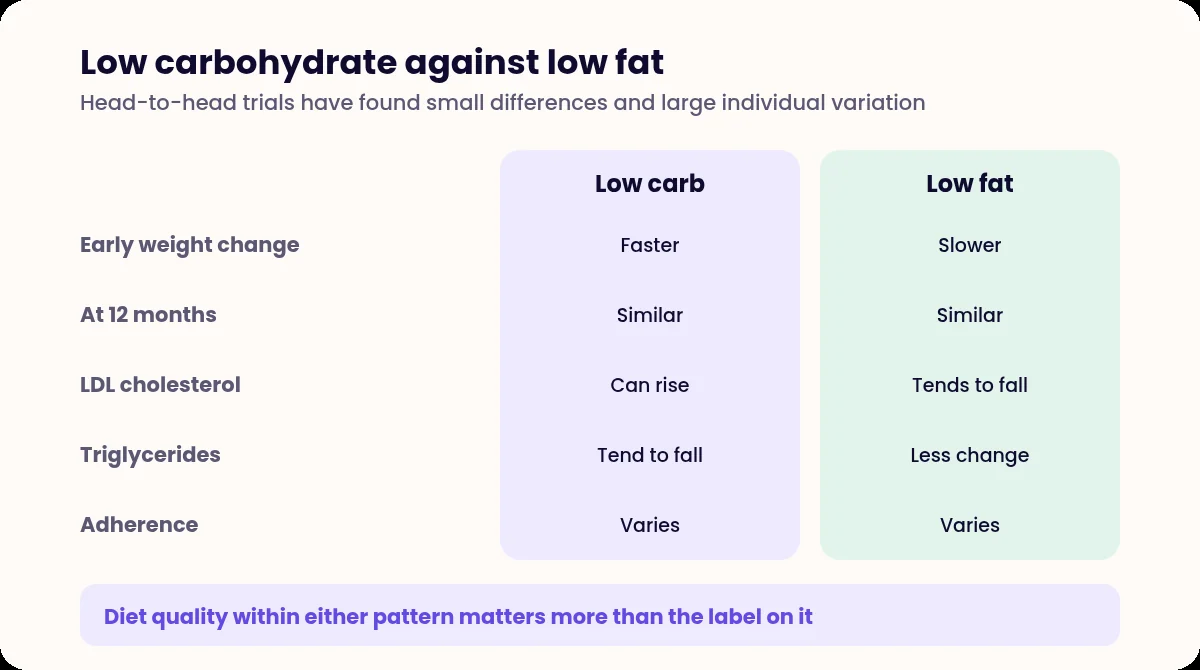
- In head-to-head trials of a year or more, low-carbohydrate and low-fat diets produce similar average weight loss.
- Adherence predicts the result far better than macronutrient split does.
- The approaches differ in their effects on blood lipids: low carb lowers triglycerides and raises HDL; low fat lowers LDL more.
- NICE no longer specifies a diet composition, only that intake must be below expenditure.
This argument has been running since the 1970s and generates more content than almost any other question in nutrition. The trial evidence is remarkably consistent, and remarkably dull.
The headline finding
DIETFITS randomised 609 adults to a healthy low-fat or healthy low-carbohydrate diet for 12 months, with substantial dietary counselling in both arms and no calorie target in either [1].
- Low fat: −5.3 kg
- Low carbohydrate: −6.0 kg
- Difference: not statistically significant
The study also tested whether genetic profile or baseline insulin secretion predicted which diet suited whom. Neither did.
A meta-analysis of named diet programmes across 48 trials reached the same conclusion: differences between branded diets were small, and adherence was the dominant factor [2].
Why the early weeks mislead
Cutting carbohydrate depletes glycogen, and glycogen is stored with roughly three times its weight in water. That produces a fast, dramatic drop in the first one to two weeks that has almost nothing to do with fat.
It is genuinely motivating, and it is genuinely not fat. When the rate slows in week three, that is the water finishing, not the diet failing.
What does differ
The weight outcome converges. The blood results do not.
A meta-analysis of 73 trials found that diet composition shaped the lipid pattern [4]:
- Low-carbohydrate diets reduced triglycerides and raised HDL more
- Low-fat diets reduced triglycerides and LDL cholesterol, and raised HDL
If you have high LDL, that difference is worth knowing. If you have high triglycerides, so is the other one. Bring it to whoever manages your lipids.
Weight loss itself, by any route, does more for triglycerides than for LDL. Per kilogram lost through lifestyle change, triglycerides fall by roughly 0.045 mmol/L and LDL by roughly 0.033 mmol/L [4].
What NICE now says
Nothing about composition. NG246 replaced the older guidance and dropped the familiar “600 kcal deficit” recommendation. The current position is simply that total energy intake should be below energy expenditure, achieved by low-fat, low-carbohydrate or other means [3].
That is a guideline explicitly declining to pick a side.
So how do you choose
By asking which one you can still be doing in six months.
Low carbohydrate tends to suit people who find protein and fat filling, who snack on carbohydrate-heavy foods, who have high triglycerides, or who like clear rules.
Low fat tends to suit people who genuinely enjoy bread, rice, potatoes and fruit, who eat out often, who are vegetarian, or who have high LDL cholesterol.
Neither suits someone who picks it because it is supposed to be optimal and hates every meal.
A few practical points regardless of which you choose: keep protein at roughly 1.2 to 1.6 g per kg of body weight while losing weight; keep fibre up, which is harder on low carbohydrate and worth deliberate effort; and keep resistance training in the plan.
A note on medicines
If you take medicines for type 2 diabetes, a sharp reduction in carbohydrate can cause hypoglycaemia on insulin or sulfonylureas, and needs dose review first. SGLT2 inhibitors carry a specific risk of diabetic ketoacidosis with very low carbohydrate intake, sometimes at near-normal blood glucose. Both are prescriber conversations before you start, not after.
When to speak to a clinician
Speak to a clinician before a significant dietary change if you:
- take insulin or a sulfonylurea for diabetes
- take an SGLT2 inhibitor, because of the ketoacidosis risk on very low carbohydrate intake
- have chronic kidney disease, where protein intake may need limiting
- have had pancreatitis or a gallbladder condition, where a high-fat approach needs care
- take warfarin, where large changes in vegetable intake affect control
- have a history of an eating disorder
Frequently asked questions
Is low carb better than low fat for weight loss?
Not on average. Trials lasting a year or more consistently find similar weight loss between the two, with individual variation within each group far larger than the difference between them.
Why do I lose weight faster on low carb at first?
Reducing carbohydrate depletes glycogen, and each gram of glycogen is stored with about three grams of water. The rapid early loss is mostly water, which is why it slows sharply after the first fortnight.
Does NICE recommend a particular diet?
No. NICE guidance now says only that total energy intake should be below energy expenditure, achieved by whatever method suits the person — low fat, low carbohydrate, or another approach.
What about keto?
Ketogenic diets are a strict form of low carbohydrate eating. They produce similar long-term weight outcomes to other approaches, are harder to sustain for most people, and need care alongside some medicines, particularly diabetes medicines and SGLT2 inhibitors.
References
- Gardner CD, Trepanowski JF, Del Gobbo LC, et al. Effect of low-fat vs low-carbohydrate diet on 12-month weight loss in overweight adults: the DIETFITS randomized clinical trial. JAMA. 2018;319(7):667-679. doi.org/10.1001/jama.2018.0245
- Johnston BC, Kanters S, Bandayrel K, et al. Comparison of weight loss among named diet programs in overweight and obese adults: a meta-analysis. JAMA. 2014;312(9):923-933. doi.org/10.1001/jama.2014.10397
- NICE. Overweight and obesity management. NG246. January 2025. www.nice.org.uk/guidance/ng246
- Effect of weight loss interventions on lipid profiles: systematic review and meta-analysis of 73 randomised trials. Journal of Clinical Endocrinology & Metabolism. 2020. pubmed.ncbi.nlm.nih.gov/32954416/
Medical reviewer
Naeem Teni
Clinical Lead at Manova. Registered pharmacist and independent prescriber, GPhC 2215591. Reviews Manova’s clinical content for accuracy and safety.
Written by
Manova Editorial Team
Researched and written to our editorial policy, using NICE, NHS, MHRA and peer-reviewed sources.
This article is for general information and isn’t a substitute for advice from your own clinician. If you feel unwell, contact your GP or NHS 111. In an emergency, call 999.