

Key takeaways
- Shakes work by removing decisions and fixing portions, not through any metabolic effect.
- Structured total diet replacement under clinical supervision is a genuinely evidence-based intervention.
- Over-the-counter shakes used casually alongside normal eating rarely change much.
- The risk is that nothing is learned about ordinary food, which is what maintenance depends on.
A meal replacement shake contains no ingredient that causes weight loss. What it contains is a fixed number of calories and no decisions.
That turns out to be worth quite a lot, and to have a specific failure mode.
Why they work
Three things, none of them metabolic.
The portion is decided. You cannot serve yourself a slightly generous shake.
The decision is removed. A large share of excess intake comes from choosing badly while hungry. A shake takes that moment away.
The calories are known. No estimating.
A systematic review found that meal replacements produce greater weight loss than conventional diets at 12 months when used within a supported programme [4]. The effect is real. It is an effect of structure.
Where they are genuinely evidence-based
The strongest use is not a shake alongside your normal lunch. It is total diet replacement under supervision.
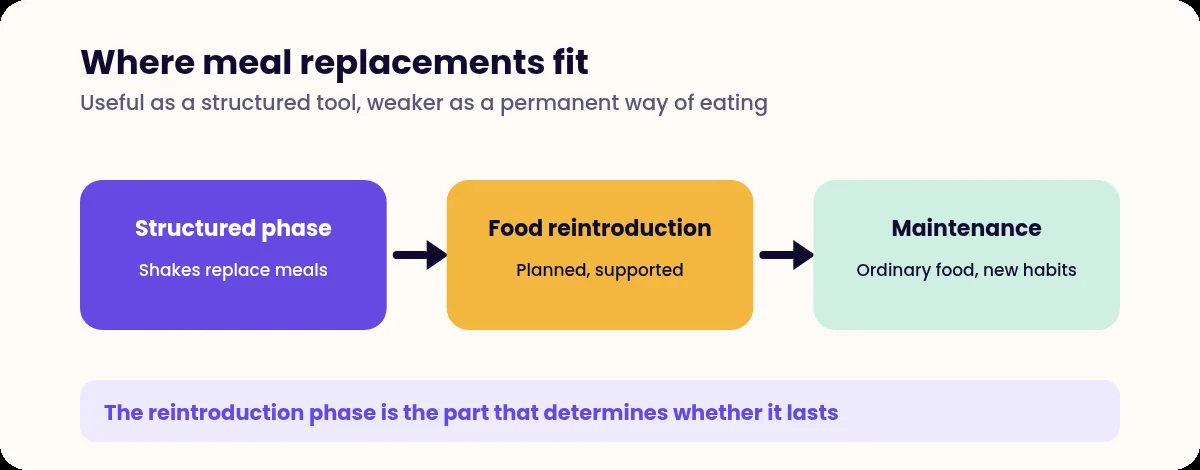
The NHS Type 2 Diabetes Path to Remission Programme provides 12 weeks of total diet replacement at 800–900 kcal a day, followed by structured food reintroduction, inside a 12-month behavioural programme. It is now available across England for adults aged 18–65 with type 2 diabetes diagnosed in the last six years and a BMI above 27 (above 25 for Black, Asian and other minority ethnic groups) [2].
Published results from the national evaluation: mean weight loss of 8.3%, about 9.4 kg, among everyone who started; 27% of starters with the necessary blood results were in remission at one year. Around 55% completed [2].
Those numbers are lower than the DiRECT trial that inspired it — 46% remission at 12 months — which is what usually happens when a trial meets the real world [3]. They are still substantial.
Where they do very little
Buying shakes and using them as an occasional meal without changing anything else. The portion control only helps for the meals it replaces, and it is easy to compensate later in the day.
If you are going to use them, use them deliberately: replace the meal you consistently get wrong, every day, and plan what happens at the other meals.
What NICE says about the low-calorie versions
NICE is specific about the structured versions [1]:
- Low-energy diets (800–1,200 kcal/day) — consider only within a multicomponent strategy with long-term support, in a specialist service, for people with obesity or with overweight and type 2 diabetes
- Very-low-energy diets (under 800 kcal/day) — only within a specialist service, and only where there is a clinically assessed need for rapid weight loss
- Neither should be used as a long-term strategy
- They must be nutritionally complete, last no more than 12 weeks, and include access to a registered dietitian or nutritionist
- Before starting, the risks must be explained — including weight cycling, likely regain, and for the very low calorie versions specifically constipation, fatigue and hair loss
That last point is worth repeating because it rarely appears on packaging.
Reading the label
If you are buying over the counter:
- Products marketed as meal replacements in the UK must meet compositional requirements for protein, vitamins and minerals — that is what distinguishes them from a protein shake
- Check protein per serving; 15–20 g is a reasonable floor
- Check fibre, which is often low and contributes to the constipation problem
- Total daily intake across all products and food is what matters, not the number on one sachet
The failure mode
You lose weight for twelve weeks and learn nothing about food.
Every structured programme with good outcomes includes a reintroduction phase, because that is where the result is actually determined. If you are doing this yourself, plan the reintroduction before you start: what a normal day looks like afterwards, what portions look like, what happens at restaurants.
When to speak to a clinician
Speak to a clinician before using low-calorie or total diet replacement if you:
- have type 1 or type 2 diabetes, particularly on insulin or a sulfonylurea, where doses will need adjusting
- take medicines that need adjusting with rapid weight loss, including some blood pressure medicines
- are pregnant or breastfeeding — these approaches are not appropriate
- have a history of an eating disorder
- have gout, gallstones, or kidney or liver disease
- have a BMI in the healthy range
Ask your GP about the NHS Type 2 Diabetes Path to Remission Programme if you have type 2 diabetes diagnosed within the last six years — it is free and it is the supervised version of this.
Frequently asked questions
Do meal replacement shakes actually work?
They work to the extent that they reduce calorie intake, which they do well because the portion is fixed and the decision is removed. They have no metabolic advantage over food of the same calorie content.
Are they safe?
Products sold as meal replacements in the UK must meet compositional rules for vitamins, minerals and protein. Used as one or two meals a day alongside ordinary food they are generally fine. Very low calorie total replacement should be done under clinical supervision.
What is the difference between shop-bought shakes and the NHS programme?
The NHS Type 2 Diabetes Path to Remission Programme uses total diet replacement at 800–900 kcal a day for 12 weeks, with structured food reintroduction and a year of behavioural support. The products are similar; the supervision and structure are what make the difference.
Will I put the weight back on when I stop?
Often, unless something has been put in place first. Shakes do not teach you how to eat ordinary food, so the reintroduction phase is where the outcome is decided. Any programme without a reintroduction plan is incomplete.
References
- NICE. Overweight and obesity management. NG246. January 2025. www.nice.org.uk/guidance/ng246
- NHS England. Type 2 Diabetes Path to Remission Programme. www.england.nhs.uk/diabetes/treatment-care/diabetes-remission/
- Lean MEJ, Leslie WS, Barnes AC, et al. Primary care-led weight management for remission of type 2 diabetes (DiRECT). The Lancet. 2018;391(10120):541-551. doi.org/10.1016/S0140-6736(17)33102-1
- Astbury NM, Piernas C, Hartmann-Boyce J, Lapworth S, Aveyard P, Jebb SA. A systematic review and meta-analysis of the effectiveness of meal replacements for weight loss. Obesity Reviews. 2019;20(4):569-587. doi.org/10.1111/obr.12816
Medical reviewer
Naeem Teni
Clinical Lead at Manova. Registered pharmacist and independent prescriber, GPhC 2215591. Reviews Manova’s clinical content for accuracy and safety.
Written by
Manova Editorial Team
Researched and written to our editorial policy, using NICE, NHS, MHRA and peer-reviewed sources.
This article is for general information and isn’t a substitute for advice from your own clinician. If you feel unwell, contact your GP or NHS 111. In an emergency, call 999.