

Key takeaways
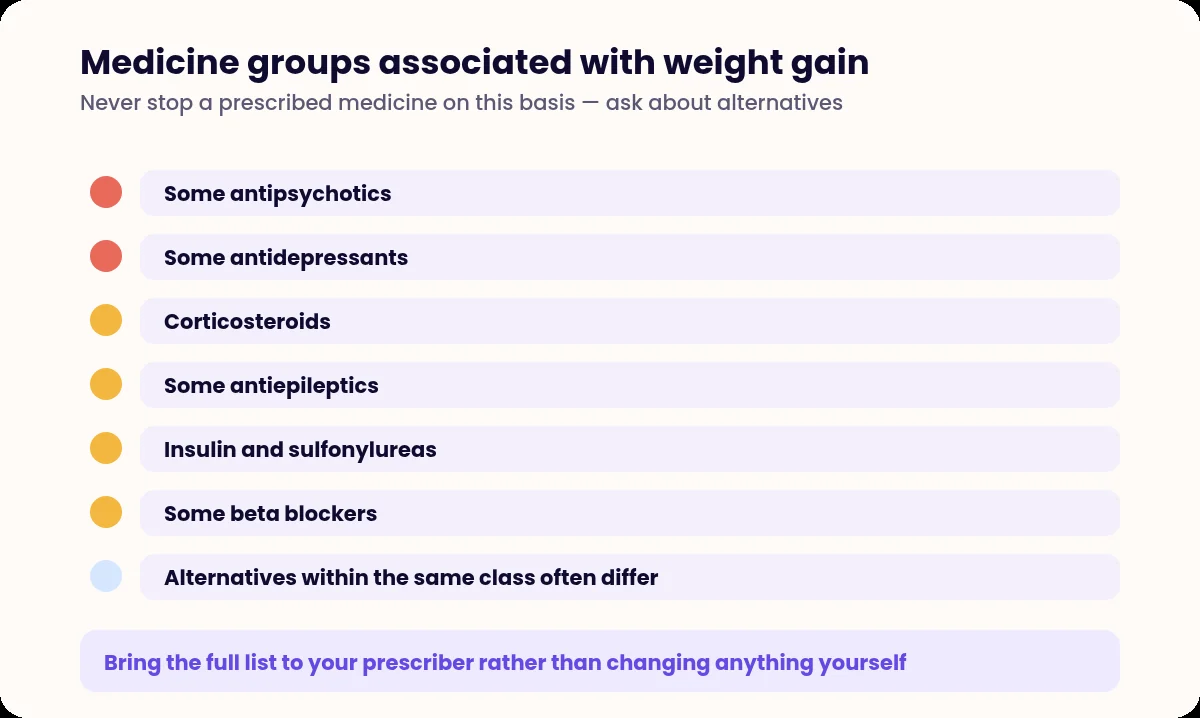
- Antipsychotics, some antidepressants, sodium valproate, lithium, steroids, insulin and sulfonylureas are the main culprits.
- Clozapine and olanzapine have the largest effects among antipsychotics; haloperidol has little.
- Combined pills, progestogen-only pills, implants and coils are not associated with significant weight gain — the depot injection is the exception.
- Never stop or switch a prescribed medicine because of weight without speaking to the prescriber.
Weight gain caused by a medicine is one of the few explanations for stalled weight loss that is both common and genuinely outside your control. It is also one of the most under-discussed, partly because raising it can feel like complaining about treatment that is helping you.
It is worth raising anyway. Sometimes there is an alternative. When there is not, knowing the cause changes how you plan.
The main categories
Antipsychotics
The largest and best-quantified effects. A network meta-analysis of 100 trials and nearly 26,000 patients found, against placebo [1]:
- Clozapine — the largest weight gain, about +3.0 kg
- Olanzapine — the largest rise in BMI, and the largest increase in LDL cholesterol
- Quetiapine and risperidone — intermediate, and classified elsewhere as capable of more than 5 kg a year
- Haloperidol — essentially no significant gain
- Amisulpride, aripiprazole, lurasidone and several others sit at the milder end
An important caveat: most of those trials ran for about six weeks. Long-term gain is considerably larger than those figures suggest. It is also not reliably fixed by lowering the dose — the dose-response curves often flatten out.
Antidepressants
Mirtazapine is the clearest, described as capable of more than 5 kg a year. Paroxetine shows the greatest long-term gain among SSRIs, and amitriptyline the greatest among tricyclics [2].
Most SSRIs are fairly weight-neutral in the short term, with modest gain over longer treatment. Individual variation is wide.
Mood stabilisers and anticonvulsants
Sodium valproate — around 71% of patients gain weight, mostly within the first year. Lithium — around 60% gain more than 5% of their body weight [2]. Gabapentin and pregabalin can cause gain in susceptible people.
A specific note on valproate: it is now under MHRA restrictions relating to pregnancy and new initiation. Weight is a minor consideration beside those, and valproate changes are not a weight decision.
Corticosteroids
Prolonged oral steroid treatment produces more than 10 kg of gain in about one in five people in the first year [2], along with a characteristic redistribution towards the face and trunk. Short courses do not do this.
Diabetes medicines
Sulfonylureas — around 4 kg in the first year. Pioglitazone — 1.5 to 4 kg. Insulin — well-established dose-related gain.
The contrast is useful: metformin, GLP-1 receptor agonists and SGLT2 inhibitors are weight-neutral or weight-reducing. If weight is a problem on a sulfonylurea or insulin, there is genuinely something to discuss.
Beta blockers
A mean gain of about 1.2 kg against controls, occurring early and then plateauing rather than continuing indefinitely [5].
Contraception: the myth and the exception
The most persistent belief in this whole area is that the pill causes weight gain. UK guidance from the Faculty of Sexual and Reproductive Healthcare states there is no evidence that intrauterine contraception, the implant, the progestogen-only pill or combined hormonal contraception causes significant weight gain [3].
The exception is the depot injection (DMPA), which is associated with real gain, particularly in women under 18 with a BMI of 30 or above. Users gained around 3 kg more than copper coil users over three years, and gaining more than 5% of body weight in the first six months predicts continued gain.
How to raise it
Not by stopping anything.
Ask for a medication review, and say specifically that weight is the reason. It gives the prescriber a frame.
Ask two questions. Is there an alternative with a smaller weight effect that would work as well for me? And if not, what should I be monitoring?
Expect monitoring rather than switching in some cases. For antipsychotics in particular, weight, blood glucose and lipids should be tracked as routine, and a rising trajectory is a reason to review.
Do not assume the medicine explains everything. It may explain five kilograms of twelve. The rest still responds to the usual levers.
NICE guidance asks prescribers to review medicines before someone starts a low-energy diet [4], which is a reasonable prompt to have the conversation.
When to speak to a clinician
Book a medication review if you:
- have gained weight since starting a new medicine, particularly in the first year
- are on an antipsychotic and have not had weight, blood glucose and lipids checked recently
- take a sulfonylurea or insulin and are struggling with weight
- have been on oral steroids for more than a few weeks
- are considering stopping a medicine because of weight — this is the conversation to have first
Never stop antipsychotics, antidepressants, anticonvulsants, lithium or steroids abruptly. Several cause withdrawal effects, and steroids in particular need a planned reduction.
Frequently asked questions
Which medicines cause the most weight gain?
Among commonly prescribed UK medicines, clozapine and olanzapine have the largest documented effects, followed by mirtazapine, sodium valproate, lithium, long-term corticosteroids, insulin and sulfonylureas.
Does the contraceptive pill make you put on weight?
UK guidance from the Faculty of Sexual and Reproductive Healthcare says there is no evidence that the combined pill, progestogen-only pill, implant or intrauterine contraception causes significant weight gain. The depot injection is the exception, particularly in women under 18 with a BMI of 30 or above.
Can I ask to switch to something that doesn't cause weight gain?
You can ask, and for some conditions an equally effective alternative with a smaller weight burden exists. For others it does not, and the original medicine is still the right choice. That is a conversation with the prescriber, not a decision to make alone.
Will the weight come off if I stop the medicine?
Often partly, but not always, and not immediately. Stopping a medicine that is controlling a serious condition to lose weight is rarely a good trade. Ask for a medication review instead.
References
- Pillinger T, McCutcheon RA, Vano L, et al. Comparative effects of 18 antipsychotics on metabolic function. The Lancet Psychiatry. 2020;7(1):64-77. doi.org/10.1016/S2215-0366(19)30416-X
- Drugs that affect body weight, body fat distribution, and metabolism. Endotext. www.ncbi.nlm.nih.gov/books/NBK537590/
- Faculty of Sexual and Reproductive Healthcare. CEU statement: contraception and weight gain. August 2019. www.fsrh.org/standards-and-guidance/
- NICE. Overweight and obesity management. NG246. January 2025. www.nice.org.uk/guidance/ng246
- Sharma AM, Pischon T, Hardt S, Kunz I, Luft FC. Beta-adrenergic receptor blockers and weight gain: a systematic analysis. Hypertension. 2001;37(2):250-254. doi.org/10.1161/01.HYP.37.2.250
Medical reviewer
Naeem Teni
Clinical Lead at Manova. Registered pharmacist and independent prescriber, GPhC 2215591. Reviews Manova’s clinical content for accuracy and safety.
Written by
Manova Editorial Team
Researched and written to our editorial policy, using NICE, NHS, MHRA and peer-reviewed sources.
This article is for general information and isn’t a substitute for advice from your own clinician. If you feel unwell, contact your GP or NHS 111. In an emergency, call 999.