

Key takeaways
- PREDIMED found around a 30% relative reduction in major cardiovascular events, without calorie restriction.
- As a weight-loss diet on its own it is unremarkable; as a long-term eating pattern it has the strongest outcome evidence.
- It is a pattern, not a recipe list, and adapts to UK ingredients and budgets.
- Olive oil, legumes, nuts, fish, vegetables and whole grains do the work; it is not about pasta.
Almost every diet is tested against weight, because weight is cheap to measure. The Mediterranean pattern is unusual in having been tested against heart attacks and strokes.
That changes what it is for.
What the trial found
PREDIMED enrolled around 7,400 adults in Spain at high cardiovascular risk and randomised them to a Mediterranean diet supplemented with extra virgin olive oil, the same diet supplemented with mixed nuts, or a control diet advised to reduce fat [1].
Crucially, no calorie restriction was imposed in any arm.
Over a median of roughly five years, the Mediterranean arms had about a 30% relative reduction in major cardiovascular events — heart attack, stroke or cardiovascular death.
As a weight-loss result, PREDIMED is unremarkable. As a hard-outcome result, it is the strongest evidence any eating pattern has.
What the pattern actually is
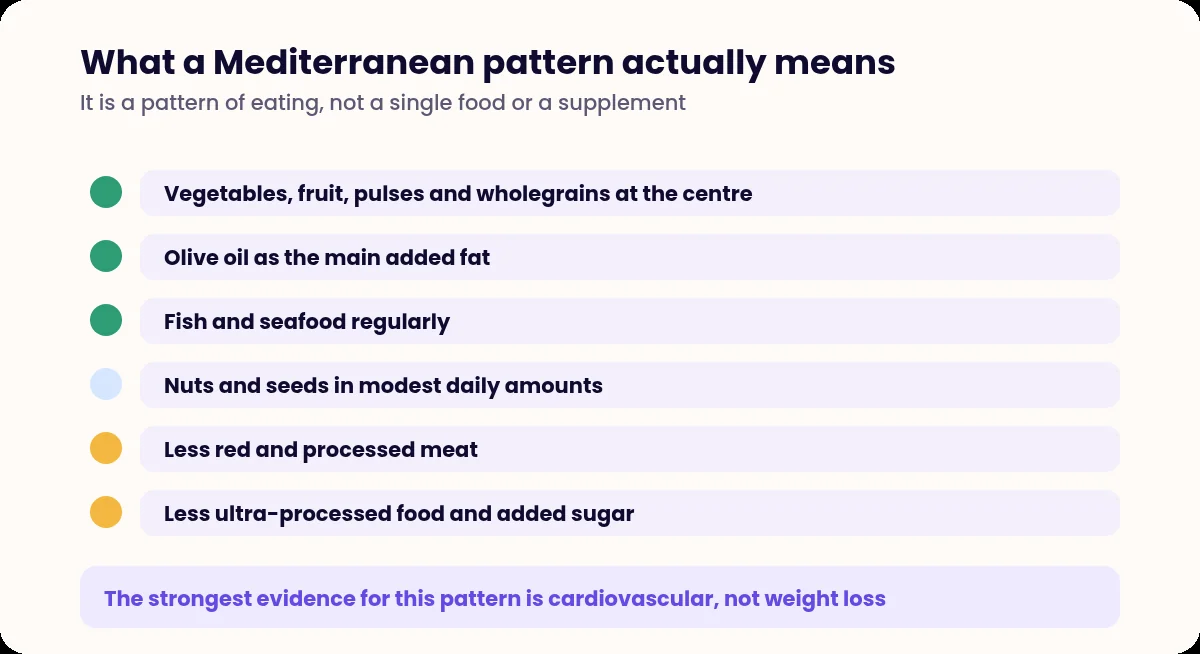
Not pizza and pasta. The elements that carry the evidence:
Olive oil as the main fat. Extra virgin, used generously — in PREDIMED the supplemented group received about a litre a week for the household.
Vegetables at most meals, in quantity rather than as garnish.
Legumes several times a week. Chickpeas, lentils, beans. This is the element UK versions most often drop and the one doing the most work.
Nuts daily. A small handful, around 30 g.
Fish, especially oily fish, a couple of times a week.
Whole grains rather than refined.
Fruit as the default sweet thing.
Limited red and processed meat, limited confectionery, limited sugary drinks.
Moderate dairy, mostly yoghurt and cheese.
Wine with meals appears in descriptions of the traditional pattern. It is not a health recommendation, and UK guidance remains 14 units a week as a maximum for everyone.
Why it works for weight, when it does
Not through any special mechanism. High fibre, high volume, reasonable protein, and slow food that takes time to eat. Those things reduce intake without requiring arithmetic.
But it is worth being honest: a Mediterranean pattern eaten without attention to quantity will not produce weight loss. Olive oil and nuts are energy-dense. PREDIMED did not produce dramatic weight change and was not trying to.
If you want it to do both, keep the pattern and add portion awareness — particularly to the oil, nuts and cheese.
The UK version, affordably
| Expensive version | Affordable version |
|---|---|
| Fresh sea bass | Tinned sardines, mackerel, frozen white fish |
| Imported fresh produce | Frozen vegetables, seasonal UK produce |
| Artisan sourdough | Own-brand wholemeal |
| Premium olive oil for everything | Own-brand olive oil for cooking, better oil for dressing |
| Pine nuts | Peanuts, sunflower seeds |
| Fresh beans | Dried or tinned pulses |
A tin of chickpeas is one of the cheapest sources of fibre and protein in a UK supermarket, and it is the most Mediterranean thing in the aisle.
Where it fits
NICE does not name diets, and says only that energy intake should be below expenditure by whatever method suits the person [3]. Within that, the Mediterranean pattern has the advantage of being something people continue doing — which is the property that determines whether any of this matters in ten years.
The NHS Eatwell Guide [2] is not in conflict with it. The main differences are the emphasis on olive oil rather than lower-fat approaches, and the prominence of legumes and nuts.
When to speak to a clinician
Worth a conversation if you:
- take warfarin, as changes in vegetable and vitamin K intake affect control
- have chronic kidney disease, where potassium and protein intake may need limiting
- have had pancreatitis or gallbladder problems, where a sharp increase in fat intake needs care
- have a nut allergy, which changes a core component
- have established cardiovascular disease and want to know how diet fits alongside your medicines
Dietary change complements cholesterol and blood pressure medicines rather than replacing them. Do not stop either on the strength of a diet.
Frequently asked questions
Does the Mediterranean diet help you lose weight?
Modestly, and not more than other approaches. It was not designed as a weight-loss diet and the landmark trial did not restrict calories at all. Its strength is what it does to cardiovascular risk over years.
What does PREDIMED actually show?
In around 7,400 adults at high cardiovascular risk, a Mediterranean diet supplemented with extra virgin olive oil or nuts reduced major cardiovascular events by roughly 30% relative to a control diet, over a median of about five years.
Is it expensive in the UK?
It need not be. The costly version is fresh fish and imported produce. The affordable version is tinned oily fish, dried or tinned pulses, frozen vegetables, porridge oats, own-brand olive oil and seasonal fruit.
Can I follow it as a vegetarian?
Yes, and easily. Legumes, nuts, olive oil, vegetables, whole grains and dairy carry most of the pattern. Replace fish with more pulses, and consider how you are covering omega-3, iodine and vitamin B12.
References
- Estruch R, Ros E, Salas-Salvadó J, et al. Primary prevention of cardiovascular disease with a Mediterranean diet supplemented with extra-virgin olive oil or nuts. New England Journal of Medicine. 2018;378(25):e34. doi.org/10.1056/NEJMoa1800389
- NHS. The Eatwell Guide. www.nhs.uk/live-well/eat-well/food-guidelines-and-food-labels/the-eatw
- NICE. Overweight and obesity management. NG246. January 2025. www.nice.org.uk/guidance/ng246
- British Heart Foundation. The Mediterranean diet. www.bhf.org.uk/informationsupport/support/healthy-living/healthy-eatin
Medical reviewer
Naeem Teni
Clinical Lead at Manova. Registered pharmacist and independent prescriber, GPhC 2215591. Reviews Manova’s clinical content for accuracy and safety.
Written by
Manova Editorial Team
Researched and written to our editorial policy, using NICE, NHS, MHRA and peer-reviewed sources.
This article is for general information and isn’t a substitute for advice from your own clinician. If you feel unwell, contact your GP or NHS 111. In an emergency, call 999.