

Key takeaways
- Tirzepatide (Mounjaro) starts at 2.5 mg once weekly for four weeks. That starting dose is for tolerability, not for effect.
- The dose then increases to 5 mg, and can rise by 2.5 mg at a time after a minimum of four weeks at the current dose.
- The recommended maintenance doses for weight management are 5, 10 and 15 mg once weekly, and 15 mg is the maximum.
- If a dose is missed it can be taken within four days. After that, skip it and take the next dose on the normal day.
Tirzepatide, sold in the UK as Mounjaro, is a prescription-only medicine. Dosing is set out in its Summary of Product Characteristics (SmPC), the regulated document that accompanies the marketing authorisation, and is a matter for the prescriber rather than the person taking it.
This page explains what that document says. It is information, not advice about whether any medicine is appropriate for you, and it does not replace the instructions you are given by your own prescriber.
The licensed schedule
The SmPC sets out a stepped schedule [1]:
| Step | Dose | Minimum time at this dose |
|---|---|---|
| Starting dose | 2.5 mg once weekly | 4 weeks |
| First increase | 5 mg once weekly | 4 weeks before any further increase |
| Subsequent increases | in steps of 2.5 mg | minimum 4 weeks at the current dose |
| Maximum | 15 mg once weekly | — |
For weight management, the SmPC gives the recommended maintenance doses as 5 mg, 10 mg and 15 mg once weekly, with 15 mg the maximum. A person may remain at a lower maintenance dose if that is what suits them.
The 2.5 mg starting dose is explicitly described as a treatment-initiation dose, not one intended to produce a therapeutic effect. The gradual escalation exists because gastrointestinal side effects are most common when a dose is first increased, and stepping up slowly is how that is managed.
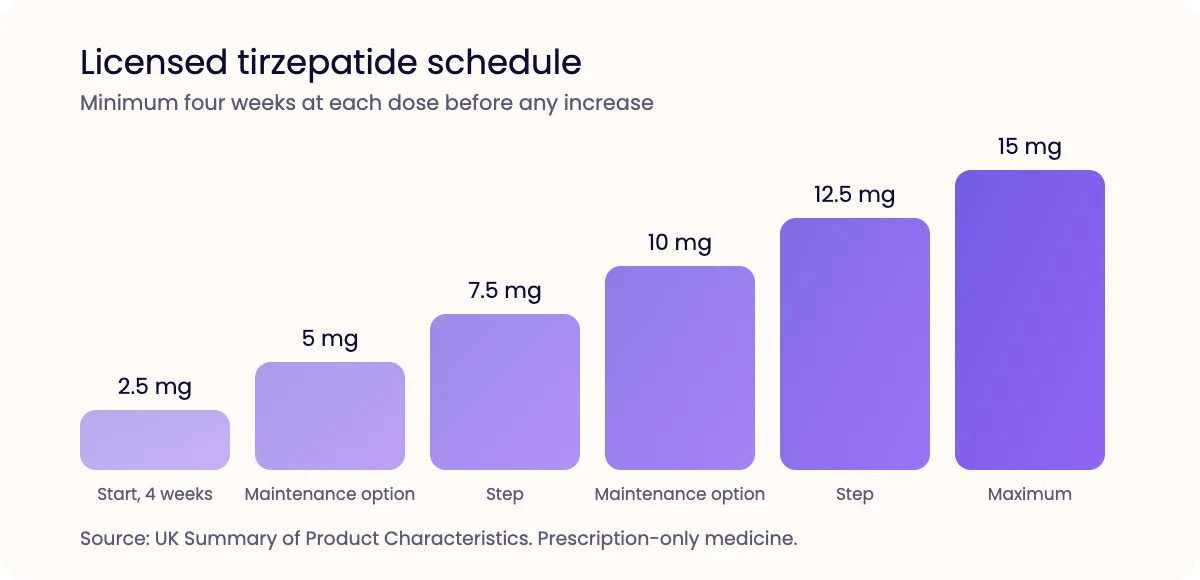
The six pen strengths
In the UK the medicine is supplied in six strengths: 2.5 mg, 5 mg, 7.5 mg, 10 mg, 12.5 mg and 15 mg [1]. Each is a separate product, so a dose change means a different pen rather than a different amount drawn from the same one.
The marketing authorisation holder is Eli Lilly and Company Limited.
Missed doses
The SmPC instruction is specific [1]:
- If a dose is missed, it should be administered as soon as possible within four days after the missed dose.
- If more than four days have passed, the missed dose should be skipped and the next dose administered on the regularly scheduled day.
Doses should not be doubled up to compensate.
The SmPC also allows the day of weekly administration to be changed where necessary, provided the interval between two doses is at least three days.
What the SmPC says about stopping
For weight management, the SmPC states that if a person has not lost at least 5% of their initial body weight six months after titrating to the highest tolerated dose, a decision is required on whether to continue treatment, taking into account the individual’s benefit and risk [1].
Separately, NICE’s technology appraisal sets out the circumstances in which tirzepatide is recommended within NHS services, along with stopping rules for that setting [3]. NHS access criteria are narrower than the terms of the licence.
Safety information a prescriber should be discussing with you
These are current MHRA positions rather than an exhaustive list. The full list of warnings, contraindications and side effects is in the SmPC and the patient information leaflet [1][2].
Pancreatitis. In January 2026 the MHRA strengthened warnings for GLP-1 receptor agonists and dual GIP/GLP-1 agonists, including tirzepatide, following reports of necrotising and fatal pancreatitis. Advice includes discontinuing immediately if pancreatitis is suspected, and not restarting if it is confirmed [4]. Severe, persistent abdominal pain, particularly if it radiates to the back and comes with vomiting, needs urgent medical attention.
Contraception. In June 2025 the MHRA advised women of childbearing potential taking these medicines for weight management to use effective contraception [5]. These medicines are not for use in pregnancy.
Anaesthesia and sedation. In January 2025 the MHRA highlighted a risk of pulmonary aspiration during general anaesthesia or deep sedation, related to delayed gastric emptying. No fixed pause period was mandated; an individual anaesthetic risk assessment is advised [6]. Tell any anaesthetist, surgeon or dentist that you are taking this medicine.
Other medicines. Delayed gastric emptying can affect the absorption of other oral medicines. This should be reviewed by your prescriber or pharmacist.
Reporting side effects
Suspected side effects can be reported directly through the MHRA Yellow Card scheme [7]. Reporting helps with the ongoing monitoring of medicine safety.
Where this information comes from
Everything above is drawn from the UK SmPC and patient information leaflet for Mounjaro, NICE technology appraisal guidance, and MHRA Drug Safety Updates. Product information can change; the SmPC on the electronic Medicines Compendium is the current version and should be treated as the authority [1].
Any decision about whether this medicine is suitable, at what dose, and for how long, is one for a qualified prescriber who knows your medical history.
Frequently asked questions
What is the starting dose of Mounjaro?
The UK Summary of Product Characteristics states the starting dose is 2.5 mg once weekly, taken for four weeks before increasing to 5 mg once weekly. The 2.5 mg dose is intended for treatment initiation and tolerability rather than for therapeutic effect.
How quickly can the dose be increased?
After the first four weeks at 2.5 mg the dose moves to 5 mg. Further increases, in steps of 2.5 mg, can be made after a minimum of four weeks at the current dose. The maximum is 15 mg once weekly.
What pen strengths are available in the UK?
Six: 2.5 mg, 5 mg, 7.5 mg, 10 mg, 12.5 mg and 15 mg.
What should I do if I miss a dose?
The SmPC says a missed dose should be taken as soon as possible within four days of the missed dose. If more than four days have passed, skip that dose and take the next one on the regularly scheduled day. Do not take two doses to make up for a missed one.
Can the day of the week be changed?
The SmPC allows the day of weekly administration to be changed if necessary, provided the interval between two doses is at least three days. Any change should be discussed with your prescriber.
What happens if the medicine is not working?
For weight management, the SmPC states that if a person has not lost at least 5% of their initial body weight six months after titrating to the highest tolerated dose, a decision is required on whether to continue treatment, taking the individual benefit and risk into account.
References
- Eli Lilly and Company Limited. Mounjaro KwikPen 2.5-15 mg solution for injection: Summary of Product Characteristics. Electronic Medicines Compendium. www.medicines.org.uk/emc/product/15484/smpc
- Eli Lilly and Company Limited. Mounjaro KwikPen: Patient Information Leaflet. Electronic Medicines Compendium. www.medicines.org.uk/emc/product/15484/pil
- National Institute for Health and Care Excellence. Tirzepatide for managing overweight and obesity (TA1026). www.nice.org.uk/guidance/ta1026/chapter/1-Recommendations
- MHRA. GLP-1 receptor agonists and dual GLP-1/GIP receptor agonists: strengthened warnings on acute pancreatitis, including necrotising and fatal cases. Drug Safety Update, 29 January 2026. www.gov.uk/drug-safety-update/glp-1-receptor-agonists-and-dual-glp-1-s
- The Pharmaceutical Journal. MHRA urges women taking weight-loss drugs to use effective contraception. 5 June 2025. pharmaceutical-journal.com/article/news/mhra-urges-women-taking-weight
- The Pharmaceutical Journal. MHRA warns of pulmonary aspiration risk for GLP-1 receptor agonists during general anaesthesia or deep sedation. 31 January 2025. pharmaceutical-journal.com/article/news/mhra-warns-of-pulmonary-aspira
- MHRA. Yellow Card: report a suspected side effect. yellowcard.mhra.gov.uk/
Medical reviewer
Naeem Teni
Clinical Lead at Manova. Registered pharmacist and independent prescriber, GPhC 2215591. Reviews Manova’s clinical content for accuracy and safety.
Written by
Manova Editorial Team
Researched and written to our editorial policy, using NICE, NHS, MHRA and peer-reviewed sources.
This article is for general information and isn’t a substitute for advice from your own clinician. If you feel unwell, contact your GP or NHS 111. In an emergency, call 999.