

Key takeaways
- Nausea is listed as a very common side effect of both tirzepatide and semaglutide, and clusters around dose increases.
- It is caused mainly by slowed stomach emptying, so it responds to smaller, lower-fat meals more than to anything else.
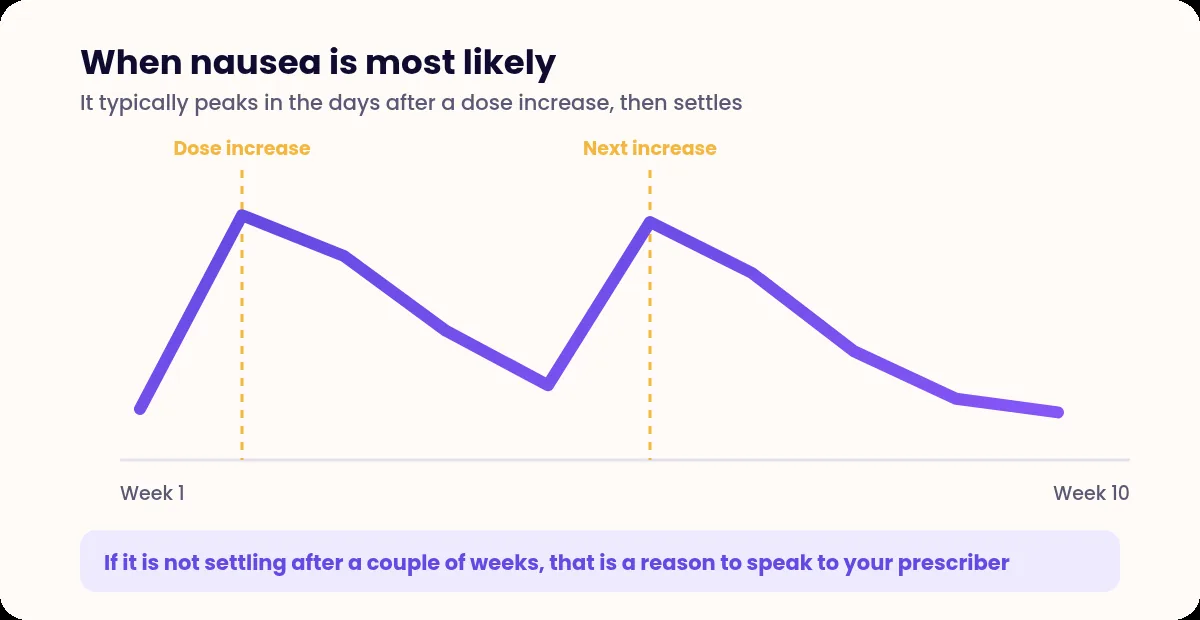
- It usually settles within days to a few weeks at a given dose. If it does not, staying longer at the current dose is a legitimate option.
- Vomiting and diarrhoea can cause dehydration, which in rare cases affects kidney function. Severe, persistent abdominal pain needs urgent assessment.
Nausea is the single most common reason people stop taking GLP-1 weight-management medicines, and most of it is predictable and manageable. Both the tirzepatide and semaglutide product information list nausea, vomiting, diarrhoea and constipation as very common — meaning more than one in ten people [1][2].
This page explains why it happens and what the product information and NHS guidance say about managing it. It is information, not personal medical advice.
Why these medicines make you feel sick
Two mechanisms, both intended.
Slowed stomach emptying. These medicines delay the rate at which the stomach passes food to the intestine. That is part of how they make you feel full for longer — and it is also why a normal-sized meal can now feel like too much, and why fatty food, which empties slowest of all, is the most reliable trigger.
Direct effects on appetite centres. GLP-1 receptors in the brain influence appetite and, at higher levels of stimulation, nausea. The two effects are hard to separate: the mechanism that reduces hunger is related to the one that can make you feel queasy.
Both explain the clearest pattern in the data: side effects cluster around dose increases, which is exactly why every medicine in this class escalates slowly over months.
What the numbers look like
From the Mounjaro SmPC, in weight-management trials, nausea affected roughly 25 to 29% of people against 8.5% on placebo, and diarrhoea roughly 19 to 23% against 7.8% [1]. For semaglutide, nausea, vomiting, diarrhoea, constipation, indigestion and abdominal pain are all listed as very common [2].
The more useful number is the discontinuation rate. Across these trials, the proportion of people who stopped because of side effects has generally been under one in ten — far smaller than the proportion who experienced them. Most people who feel sick carry on and come out the other side.
What actually helps
The advice that works follows from the mechanism rather than from folklore.
Eat less at a sitting. The stomach is emptying more slowly. A portion that was comfortable before treatment may not be now. Smaller plates, slower eating, and stopping at the first sign of fullness rather than at the end of the plate.
Cut the fat in trigger meals. Fat leaves the stomach slowest. Fried food, creamy sauces, pastry and takeaways are the commonest culprits.
Separate drinking from eating. Sipping fluids between meals rather than washing food down reduces the volume sitting in the stomach at once.
Bland and dry beats rich and wet in the first days after a dose increase — toast, crackers, rice, plain potatoes.
Watch the timing. Some people find the day after an injection is the worst, and adjust when they take it so that day falls somewhere convenient.
Stay at the dose you are on. This is the most effective intervention and the most underused. There is no obligation to climb to the maximum dose on schedule. Staying at the current dose for an extra month, with your prescriber’s agreement, gives the gut time to adapt.
Constipation, the other half
Slowed gut transit also causes constipation, which is very common and less discussed. NHS advice is more fluid, more fibre, and regular movement [6]. If those are not enough, a pharmacist can advise on a suitable laxative — worth doing rather than leaving it, because prolonged constipation is genuinely miserable and is another reason people stop.
The warning signs
Most sickness on these medicines is a nuisance. Some is not.
Seek urgent medical attention for severe abdominal pain that does not go away, particularly if it radiates through to your back and comes with vomiting. In January 2026 the MHRA strengthened warnings across this class following reports of severe and fatal pancreatitis, and advises stopping the medicine immediately if pancreatitis is suspected [4].
Get assessed if you cannot keep fluids down, if vomiting or diarrhoea continues for more than a day or two, or if you have signs of dehydration such as dark urine, dizziness or passing very little urine [5]. Both SmPCs note that dehydration from vomiting and diarrhoea can, in rare cases, worsen kidney function [1][2].
Tell your prescriber about any sickness that is stopping you eating properly, rather than simply eating less and less.
A note on pushing through
There is a version of this medicine’s use where people treat severe nausea as evidence it is working, and eat almost nothing for weeks. That is not how it is meant to work, it makes muscle loss more likely, and it makes nutritional deficiency more likely. Feeling moderately less hungry is the intended effect. Feeling too unwell to eat properly is a reason to talk to your prescriber.
Suspected side effects can be reported through the Yellow Card scheme [7].
Frequently asked questions
How long does nausea last on weight loss injections?
For most people it is worst in the first few days after a dose increase and settles over the following one to three weeks at that dose. It tends to return, more mildly, with each subsequent increase.
What helps with nausea on Mounjaro or Wegovy?
Smaller portions, eating more slowly, stopping at the first sign of fullness, and avoiding high-fat and very greasy foods. Fat is the slowest thing to leave the stomach, and the stomach is already emptying slowly. Bland, drier foods and sipping fluids between rather than with meals also help many people.
Should I stop the medicine if I feel sick?
That is a decision for your prescriber, not something to do abruptly on your own. A common approach is to stay at the current dose for longer rather than increasing, which gives the gut time to adapt.
When is sickness a warning sign?
Severe abdominal pain that persists, particularly radiating to the back and accompanied by vomiting, needs urgent medical attention because of the risk of pancreatitis. Vomiting that stops you keeping fluids down also needs assessment because of dehydration.
Do anti-sickness tablets work?
Anti-emetics are sometimes prescribed but they are not a routine part of treatment, and they do not address the underlying cause. Discuss it with your prescriber rather than buying something to push through.
References
- Eli Lilly and Company Limited. Mounjaro KwikPen: Summary of Product Characteristics. Electronic Medicines Compendium. www.medicines.org.uk/emc/product/15484/smpc
- Novo Nordisk Limited. Wegovy: Summary of Product Characteristics. Electronic Medicines Compendium. www.medicines.org.uk/emc/product/13803/smpc
- Novo Nordisk Limited. Wegovy: Patient Information Leaflet. Electronic Medicines Compendium. www.medicines.org.uk/emc/files/pil.13800.pdf
- MHRA. GLP-1 receptor agonists and dual GLP-1/GIP receptor agonists: strengthened warnings on acute pancreatitis. Drug Safety Update, 29 January 2026. www.gov.uk/drug-safety-update/glp-1-receptor-agonists-and-dual-glp-1-s
- NHS. Dehydration. www.nhs.uk/conditions/dehydration/
- NHS. Constipation. www.nhs.uk/conditions/constipation/
- MHRA. Yellow Card: report a suspected side effect. yellowcard.mhra.gov.uk/
Medical reviewer
Naeem Teni
Clinical Lead at Manova. Registered pharmacist and independent prescriber, GPhC 2215591. Reviews Manova’s clinical content for accuracy and safety.
Written by
Manova Editorial Team
Researched and written to our editorial policy, using NICE, NHS, MHRA and peer-reviewed sources.
This article is for general information and isn’t a substitute for advice from your own clinician. If you feel unwell, contact your GP or NHS 111. In an emergency, call 999.