

Key takeaways
- NHS weight management is organised in tiers, from GP advice through to specialist services and surgery.
- Access to specialist NHS services and to weight-loss medication through them is limited by eligibility criteria and local capacity.
- A regulated private service can usually start sooner, but costs are ongoing and the quality varies widely.
- Whichever route you take, the things that predict success are the same: clinical assessment, follow-up and a plan for maintenance.
If you have decided to do something about your weight with clinical support, there are two routes in the UK. They are not really competing with each other — they answer different questions, and which one fits depends on your circumstances more than on your preferences.
What the NHS offers
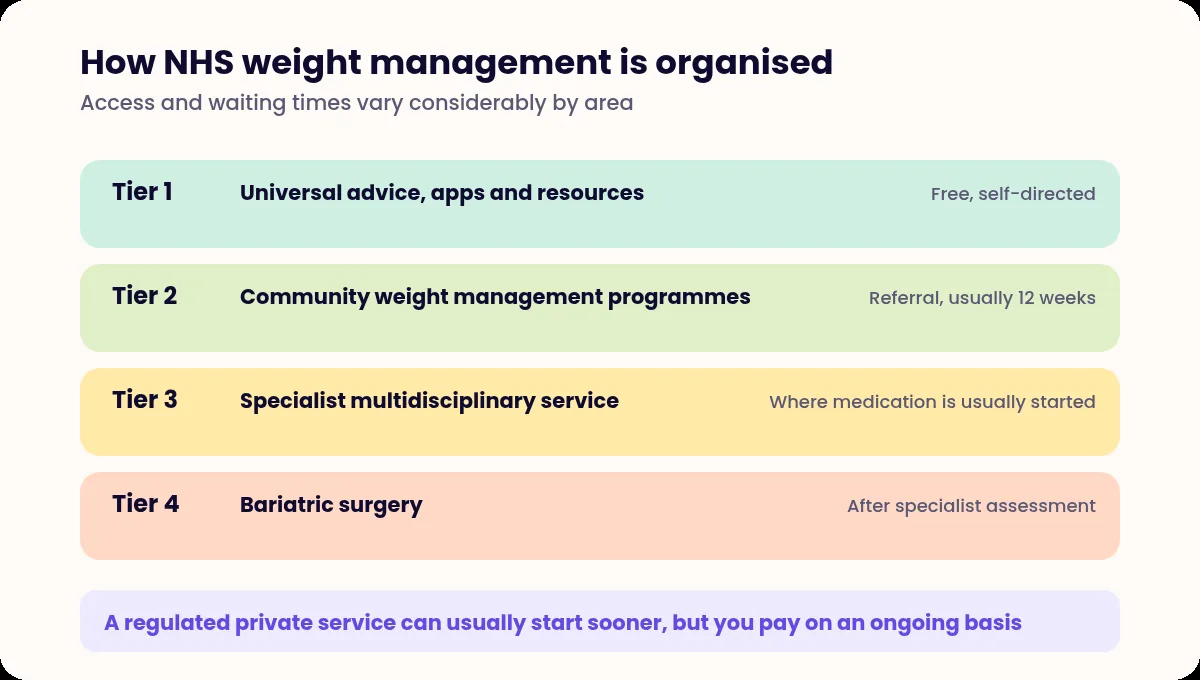
NHS weight management is usually described in tiers.
Tier 1 — universal. Public health messaging, NHS Better Health resources, the NHS Weight Loss Plan app. Free, self-directed, and genuinely useful for some people.
Tier 2 — community weight management. Referral-based group or digital programmes, typically 12 weeks, run by local authorities or commissioned providers. Availability varies substantially by area.
Tier 3 — specialist weight management. A multidisciplinary service: clinician, dietitian, and usually psychological input. This is where medication is most often initiated on the NHS, and where assessment for surgery happens.
Tier 4 — bariatric surgery.
What you should know about access
Two things. First, eligibility criteria are real and they are applied: BMI thresholds, related health conditions, and often a requirement to have engaged with earlier tiers. Second, capacity is the binding constraint. Waits for Tier 3 services of a year or more are common in many areas, and some areas have very limited provision at all.
This is not a criticism of the services, which are generally good. It is a description of the queue.
What it does well
- It is free
- It is integrated with your medical record and your GP
- Specialist services provide dietetic and psychological input that is hard to buy well privately
- Surgical pathways exist and are properly supported
What a private service offers
A regulated private provider can typically assess and, where clinically appropriate, begin treatment within days rather than months. You pay for the consultation, any medication, and follow-up.
What it does well
- Speed of access
- Continuity of appointments
- Flexibility around your schedule
What varies enormously
Quality. The private weight-management market in the UK expanded very fast, and it contains excellent regulated services alongside operations that amount to an online order form.
How to check a private provider properly
Before paying anything, confirm:
- A named UK-registered prescriber. You should be able to look them up on the GMC, NMC or GPhC register.
- A registered pharmacy. UK online pharmacies must display their GPhC registration number, and you can check it on the GPhC register [3].
- Regulator registration where applicable. Services providing clinical consultations in England should generally be registered with the CQC [4].
- A real consultation. Height, weight, medical history, current medicines, contraindications. A form with no follow-up questions is a warning sign.
- Follow-up built in. What happens at week 4? Who do you contact about side effects?
- Clarity about what you are buying. Monthly cost, what is included, what happens if you stop.
Two warning signs worth taking seriously: a service that will prescribe without any way of verifying your weight, and one that sells prescription medicines through social media or a marketplace listing.
Cost, honestly
Private treatment is an ongoing cost, not a one-off. Before starting, work out what twelve months looks like, not what the first month costs. Introductory pricing is common and the second-month price is the real one.
Can you use both?
Often, yes, and it is worth telling each about the other. If you are being treated privately, your GP should know — it belongs in your record, it affects other prescribing, and it matters if you become unwell. Equally, a private provider should want to know about your NHS care.
When to speak to a clinician
Start with your GP if you:
- have a BMI of 30 or above, or 27 or above with a related health condition
- have type 2 diabetes, high blood pressure, sleep apnoea or fatty liver
- are taking medicines that may be contributing to weight gain
- have tried to lose weight repeatedly without lasting success
- are considering buying weight-loss medication online and want to know whether it is appropriate for you
Your GP can also tell you exactly what is commissioned in your area, which is the single most useful piece of information for deciding between these routes.
Frequently asked questions
Can I get weight loss medication on the NHS?
Some people can, but availability is restricted. Eligibility depends on BMI, other health conditions and NICE criteria, and in many areas access runs through specialist weight management services with long waits. Your GP can tell you what is commissioned locally.
How do I get referred to an NHS weight management service?
Through your GP practice. Referral criteria vary by area and usually take into account BMI, related health conditions and previous attempts at weight management. Ask specifically what is available in your integrated care board area.
Is a private weight loss service safe?
It can be, if it is properly regulated. In the UK, look for registration with the Care Quality Commission or equivalent, a registered pharmacy displaying its GPhC number, prescribing by a named UK-registered clinician, and a proper consultation rather than a tick-box form.
Which is better, NHS or private?
They answer different questions. The NHS route is free and integrated with your medical record, but access is restricted and waits can be long. A private route is faster and more flexible, but you pay ongoing and you need to choose the provider carefully.
References
- NICE. Overweight and obesity management. NG246. www.nice.org.uk/guidance/ng246
- NHS. NHS weight management services. www.nhs.uk/better-health/lose-weight/
- General Pharmaceutical Council. Registers. www.pharmacyregulation.org/registers
- Care Quality Commission. Find and compare services. www.cqc.org.uk/
- NHS England. Specialist weight management services. www.england.nhs.uk/
Medical reviewer
Naeem Teni
Clinical Lead at Manova. Registered pharmacist and independent prescriber, GPhC 2215591. Reviews Manova’s clinical content for accuracy and safety.
Written by
Manova Editorial Team
Researched and written to our editorial policy, using NICE, NHS, MHRA and peer-reviewed sources.
This article is for general information and isn’t a substitute for advice from your own clinician. If you feel unwell, contact your GP or NHS 111. In an emergency, call 999.