

Key takeaways
- The MHRA authorised orforglipron, brand name Foundayo, on 10 August 2026 — the first country in Europe to do so.
- It is a once-daily tablet, taken at any time of day, with no food or water restrictions.
- Licensed for adults with a BMI of 30 or above, or 27 to 30 with a weight-related condition, and separately for type 2 diabetes.
- It is not available on the NHS. NICE is evaluating it, with guidance expected later in 2026.
Until 2026, every licensed weight-management medicine in the UK that worked on the GLP-1 system had to be injected, or — in the case of oral semaglutide — taken under fairly demanding conditions. Orforglipron changes that, and the UK was the first country in Europe to license it.
This page sets out what was approved and what the evidence behind it shows. It is information about a prescription-only medicine, not advice about whether it is right for you.
What was approved, and when
The MHRA authorised orforglipron, sold under the brand name Foundayo, on 10 August 2026 [1]. Two indications were granted:
- Weight management in adults with a BMI of 30 or above, or a BMI of 27 to 30 with at least one weight-related condition, alongside a reduced-calorie diet and increased physical activity
- Type 2 diabetes, to improve blood glucose control where it is insufficiently controlled
It is a prescription-only medicine. The MHRA’s announcement is explicit that GLP-1 medicines “can only be obtained from a registered pharmacy” [1].
Why a tablet is technically interesting
Semaglutide and tirzepatide are peptides — large, fragile molecules that the digestive system breaks down, which is why they are normally injected. The oral semaglutide tablet gets round this with an absorption enhancer, but it has to be taken on an empty stomach after at least eight hours of fasting, with a sip of water and nothing else for thirty minutes afterwards.
Orforglipron is a small molecule, not a peptide. That means it survives digestion on its own. The MHRA’s announcement states it is taken once daily with no food or water restrictions [1], which is a meaningful practical difference for anyone who has tried to build a morning fast around a tablet.
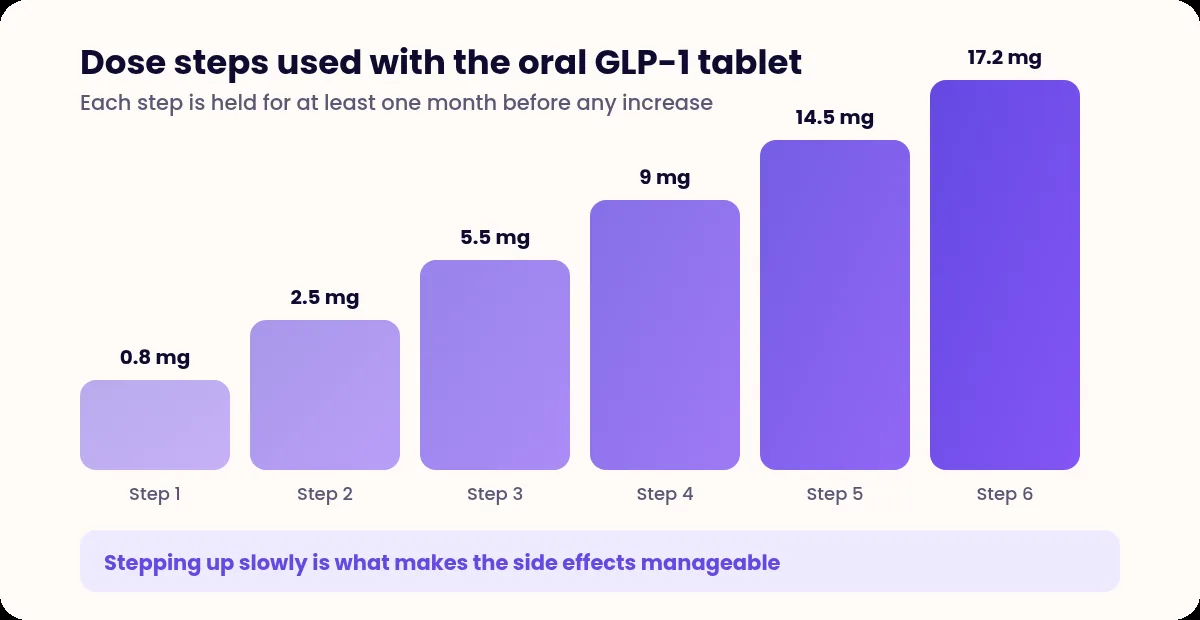
The dose schedule
From the MHRA announcement [1]:
| Step | Dose | Minimum time before increasing |
|---|---|---|
| Start | 0.8 mg once daily | 1 month |
| 2 | 2.5 mg | 1 month |
| 3 | 5.5 mg | 1 month |
| 4 | 9 mg | 1 month |
| 5 | 14.5 mg | 1 month |
| 6 | 17.2 mg | — |
As with the injections, the slow escalation exists because gastrointestinal side effects are commonest when a dose goes up.
What the trials found
ATTAIN-1 studied 3,127 adults with obesity and without diabetes over 72 weeks. At the highest dose, average weight loss was about 12.4%, with 59.6% of participants losing 10% or more of their body weight and 39.6% losing 15% or more [2].
ATTAIN-2, in people with obesity and type 2 diabetes, reported average weight loss of about 10.5% against 2.2% on placebo [2]. Weight loss is consistently smaller in people with type 2 diabetes across this whole class of medicines.
ACHIEVE-1 looked at blood glucose rather than weight, and found HbA1c reductions of roughly 1.2 to 1.5 percentage points against 0.4 on placebo [3].
Side effects in the trials were dominated by the gut. At the highest dose in ATTAIN-1, nausea affected about a third of participants and vomiting about a quarter, against much lower rates on placebo. Discontinuation because of side effects rose with dose, reaching around 10% at 36 mg [2]. The MHRA lists the common side effects as nausea, constipation, diarrhoea, vomiting, indigestion and abdominal pain [1].
What it does not mean
It is not on the NHS. The MHRA is clear: “Whilst this tablet is approved for use in the UK, it is not available currently via the NHS” [1]. NICE is evaluating it, with guidance expected in late 2026 [4].
Approval is not a recommendation for any individual. Whether any weight-management medicine is appropriate, and which one, depends on your health history, other medicines and circumstances — a decision for a qualified prescriber.
A tablet is not automatically gentler. The side-effect profile in the trials is recognisably the same family of effects as the injections.
A note on how this medicine is being talked about
On 18 June 2026 the MHRA, the Advertising Standards Authority and the General Pharmaceutical Council issued a joint warning about the promotion of newly licensed and unlicensed weight-management medicines [5]. Prescription-only medicines cannot be advertised to the public, and the warning states that referring to them “by name or using language such as ‘GLP-1 tablets’, ‘oral GLP-1s’ or ‘the new weight-loss tablets’ is likely to breach the Code”, including where waiting lists are being advertised.
If you see a company advertising this medicine to you, or inviting you to join a waiting list for it, that is a signal about the company rather than about the medicine.
Safety information
The full list of warnings, contraindications and side effects sits in the product’s Summary of Product Characteristics and patient information leaflet. Class-wide MHRA positions that apply here include the strengthened warnings on acute pancreatitis issued in January 2026 [6] — severe, persistent abdominal pain needs urgent medical attention — and the general advice that these medicines are not for use in pregnancy.
Suspected side effects can be reported through the MHRA Yellow Card scheme [7].
Where this information comes from
The regulatory position is taken from the MHRA’s own announcement, the trial results from the manufacturer’s published phase 3 results, and the NICE position from NICE’s in-development guidance page. This is a fast-moving area and all three can change.
Frequently asked questions
What is orforglipron?
Orforglipron is a GLP-1 receptor agonist taken as a daily tablet rather than an injection. Unlike semaglutide, it is a small molecule rather than a peptide, which is why it can be taken without the fasting and water restrictions that oral semaglutide requires.
Is orforglipron available in the UK?
It was authorised by the MHRA on 10 August 2026 under the brand name Foundayo. Regulatory approval and actual supply are different things, so whether it can be obtained at any given moment is a question for a prescriber or pharmacy. It is not available on the NHS.
How much weight did people lose in the trials?
In ATTAIN-1, a 72-week trial in 3,127 adults with obesity and without diabetes, the highest dose produced an average weight loss of about 12.4%, with 59.6% of participants losing 10% or more. In ATTAIN-2, in people with obesity and type 2 diabetes, the average was about 10.5% against 2.2% on placebo.
How is it dosed?
Treatment starts at 0.8 mg once daily and steps up through 2.5 mg, 5.5 mg, 9 mg, 14.5 mg and 17.2 mg, with a minimum of one month at each level. The escalation exists to manage side effects.
Is a tablet as effective as the injections?
On the trial averages published so far, the weight loss reported for orforglipron is lower than that reported for tirzepatide and for higher-dose semaglutide. Those are separate trials in different populations, not head-to-head comparisons, so they cannot be read as a direct ranking. Which medicine suits a person is a clinical judgement.
References
- MHRA. UK first in Europe to authorise orforglipron for weight management and type 2 diabetes. 10 August 2026. www.gov.uk/government/news/uk-first-in-europe-to-authorise-orforglipro
- Eli Lilly and Company. ATTAIN-1: orforglipron in adults with obesity, 72-week phase 3 results. September 2025. lilly.gcs-web.com/news-releases/news-release-details/lillys-oral-glp-1
- ACHIEVE-1: orforglipron monotherapy in type 2 diabetes. New England Journal of Medicine. June 2025. pubmed.ncbi.nlm.nih.gov/?term=orforglipron+ACHIEVE-1
- National Institute for Health and Care Excellence. Orforglipron for managing overweight and obesity (in development, GID-TA11650). www.nice.org.uk/guidance/indevelopment/gid-ta11650
- MHRA, ASA and GPhC. Warning on promoting newly licensed prescription only medicines and unlicensed medicines for weight management. 18 June 2026. www.gov.uk/government/news/warning-on-promoting-newly-licensed-prescri
- MHRA. GLP-1 receptor agonists and dual GLP-1/GIP receptor agonists: strengthened warnings on acute pancreatitis. Drug Safety Update, 29 January 2026. www.gov.uk/drug-safety-update/glp-1-receptor-agonists-and-dual-glp-1-s
- MHRA. Yellow Card: report a suspected side effect. yellowcard.mhra.gov.uk/
Medical reviewer
Naeem Teni
Clinical Lead at Manova. Registered pharmacist and independent prescriber, GPhC 2215591. Reviews Manova’s clinical content for accuracy and safety.
Written by
Manova Editorial Team
Researched and written to our editorial policy, using NICE, NHS, MHRA and peer-reviewed sources.
This article is for general information and isn’t a substitute for advice from your own clinician. If you feel unwell, contact your GP or NHS 111. In an emergency, call 999.