

Key takeaways
- Orlistat inhibits the enzyme that digests dietary fat, so roughly a third of the fat you eat passes through unabsorbed.
- The 120 mg version is prescription-only. A 60 mg version can be supplied by a pharmacist.
- In the four-year XENDOS trial it produced 5.8 kg of weight loss against 3.0 kg on placebo, and reduced progression to type 2 diabetes.
- Its side effects come directly from the mechanism and get worse the more fat you eat.
Orlistat has been available in the UK since the late 1990s. It is unfashionable, produces less weight loss than the newer injections and tablets, and has a reputation built almost entirely on one category of side effect. It is also cheap, well understood, has four-year safety data, and is the only weight-loss medicine you can obtain without a prescription.
This page explains what it does. It is information about a medicine, not advice about whether it suits you.
How it works
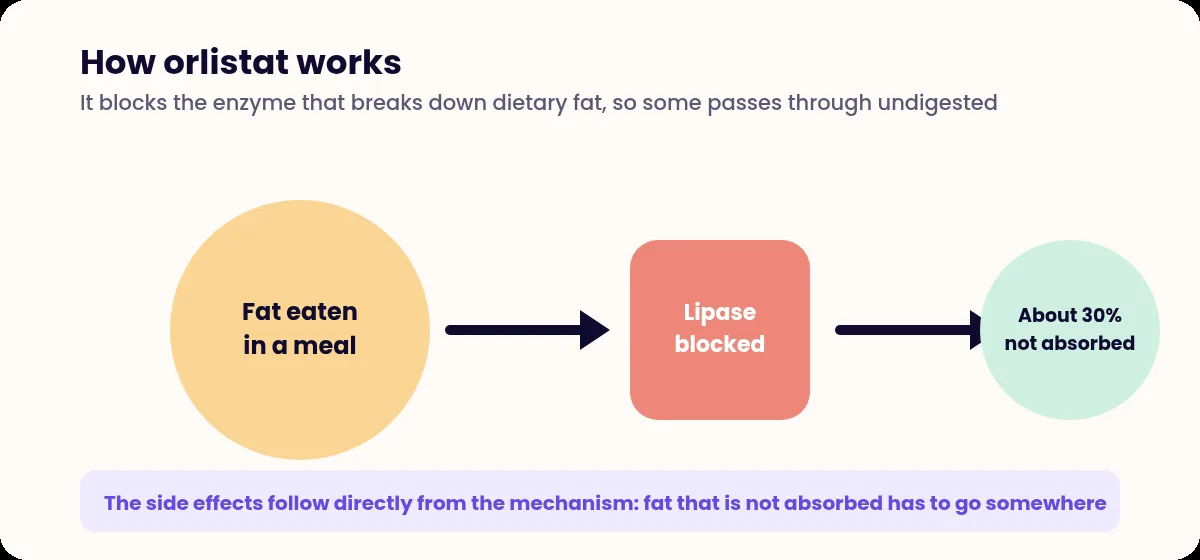
Dietary fat is too large to be absorbed as it arrives. An enzyme called lipase breaks it down first. Orlistat inhibits lipase, so roughly a third of the fat in a meal is never broken down and passes out of the body in the stool [1].
That mechanism has two consequences worth understanding before starting.
It is entirely local. Orlistat is barely absorbed into the bloodstream; it works in the gut and leaves. That is why it does not affect appetite, mood or energy, and why it does not interact with most medicines the way a systemic drug would.
And it is proportional to what you eat. Take orlistat with a low-fat meal and little happens. Take it with a takeaway and a third of a large amount of fat arrives in your lower bowel undigested.
Doses and how it is taken
| Version | Dose | Availability |
|---|---|---|
| Xenical and generics | 120 mg | Prescription only |
| Alli and generics | 60 mg | Pharmacy supply |
A capsule is taken with, or up to an hour after, each main meal containing fat — up to three times a day. If a meal is skipped, or contains no fat, the dose is skipped too [1]. Doses are not doubled to catch up.
The NHS prescribes the 120 mg version for people with a BMI of 30 or above, or 28 or above with a weight-related condition such as type 2 diabetes [1].
What the evidence shows
XENDOS is the trial that matters here, because it ran for four years — far longer than most weight-loss trials [2]. It followed 3,305 adults with obesity.
| Outcome at 4 years | Orlistat | Placebo |
|---|---|---|
| Weight loss | 5.8 kg | 3.0 kg |
| New type 2 diabetes | 6.2% | 9.0% |
That second row is the more interesting one. A 37% relative reduction in progression to type 2 diabetes over four years is a meaningful clinical outcome, not just a number on a scale.
For context, the newer GLP-1 medicines produce averages of 12% to 20% of body weight in their trials. Orlistat’s 5.8 kg is roughly 5-6% for a typical participant. It is a smaller effect, and it is a real one.
The side effects, plainly
They are the reason people stop, and they follow directly from the mechanism [1]:
- Oily or fatty stools
- Oily spotting from the rectum
- Urgent need to open the bowels
- Wind, sometimes with discharge
- Abdominal pain or discomfort
These are worst in the first weeks and worst after fatty meals. Many people find they act as an unusually direct feedback loop: eat the fatty meal, get the consequence. Whether that counts as a side effect or a behavioural intervention rather depends on your temperament.
Vitamins. Because fat absorption is reduced, absorption of the fat-soluble vitamins A, D, E and K falls too. A multivitamin taken at bedtime, at least two hours from a dose, is commonly advised.
Who it may suit
It is worth considering when the newer medicines are unsuitable, unaffordable or unavailable; when someone specifically wants to avoid an appetite-acting medicine; when cost matters, since it is a fraction of the price; or where a person’s eating pattern is high in fat and they are willing to use the feedback.
It suits people less well if they have chronic malabsorption or cholestasis, are pregnant or breastfeeding, or take medicines whose absorption matters critically — ciclosporin, levothyroxine, some epilepsy medicines and warfarin all need care, and that is a conversation with a pharmacist.
Getting the best from it
The diet does most of the work. UK guidance is a reduced-calorie diet with roughly 30% of energy from fat, spread across meals rather than concentrated in one [1][5]. A single very fatty meal is where the side effects come from.
When to speak to a clinician
Speak to your GP or pharmacist if side effects are severe or not settling after a few weeks, if you develop persistent abdominal pain, or if you take any of the medicines above whose absorption could be affected. Suspected side effects can be reported through the Yellow Card scheme [6].
Frequently asked questions
How does orlistat work?
It blocks lipase, the enzyme that breaks dietary fat into a form the gut can absorb. About a third of the fat in a meal then passes through undigested and leaves in the stool. It does not affect appetite and does not act on the brain.
Can you buy orlistat over the counter in the UK?
A 60 mg version is available from pharmacies under a pharmacist's supervision, for adults who meet the criteria. The 120 mg version requires a prescription.
How much weight do people lose on orlistat?
Less than with the GLP-1 medicines. In the four-year XENDOS trial average weight loss was 5.8 kg against 3.0 kg on placebo. It also reduced the four-year incidence of type 2 diabetes from 9.0% to 6.2%.
What are the side effects?
Oily or fatty stools, urgent bowel movements, wind with discharge, and abdominal discomfort. They are caused by the unabsorbed fat itself, so they are worst after high-fat meals and improve when fat intake comes down.
Does it stop vitamins being absorbed?
It can reduce absorption of fat-soluble vitamins A, D, E and K. A multivitamin taken at bedtime, at least two hours away from an orlistat dose, is commonly advised for that reason.
References
- NHS. Orlistat. Page last reviewed 6 May 2026. www.nhs.uk/medicines/orlistat/
- Torgerson JS, Hauptman J, Boldrin MN, Sjostrom L. XENDOS: a randomized study of orlistat as an adjunct to lifestyle changes for the prevention of type 2 diabetes in obese patients. Diabetes Care. 2004;27(1):155-161. doi.org/10.2337/diacare.27.1.155
- National Institute for Health and Care Excellence. Overweight and obesity management (NG246). Published 14 January 2025. www.nice.org.uk/guidance/ng246
- Joint Formulary Committee. Orlistat. British National Formulary. bnf.nice.org.uk/drugs/orlistat/
- NHS. The Eatwell Guide. www.nhs.uk/live-well/eat-well/food-guidelines-and-food-labels/the-eatw
- MHRA. Yellow Card: report a suspected side effect. yellowcard.mhra.gov.uk/
Medical reviewer
Naeem Teni
Clinical Lead at Manova. Registered pharmacist and independent prescriber, GPhC 2215591. Reviews Manova’s clinical content for accuracy and safety.
Written by
Manova Editorial Team
Researched and written to our editorial policy, using NICE, NHS, MHRA and peer-reviewed sources.
This article is for general information and isn’t a substitute for advice from your own clinician. If you feel unwell, contact your GP or NHS 111. In an emergency, call 999.