

Key takeaways
- Hand-based measures travel with you and need no equipment.
- Energy-dense foods — oils, nuts, cheese, nut butter, cereal — are the ones people misjudge most.
- Plate structure does most of the work: half vegetables, a quarter protein, a quarter starch.
- Serving from the pan rather than the table reduces second helpings without any rule.
Portion size is the lever that needs no app, no arithmetic and no special foods. It is also the one where intuition has been quietly recalibrated upwards over several decades, so that a normal-looking plate is a larger plate than it was.
A Cochrane review found that larger portions, packages and tableware consistently increase how much people consume [3]. The reverse is also usable.
The hand guide
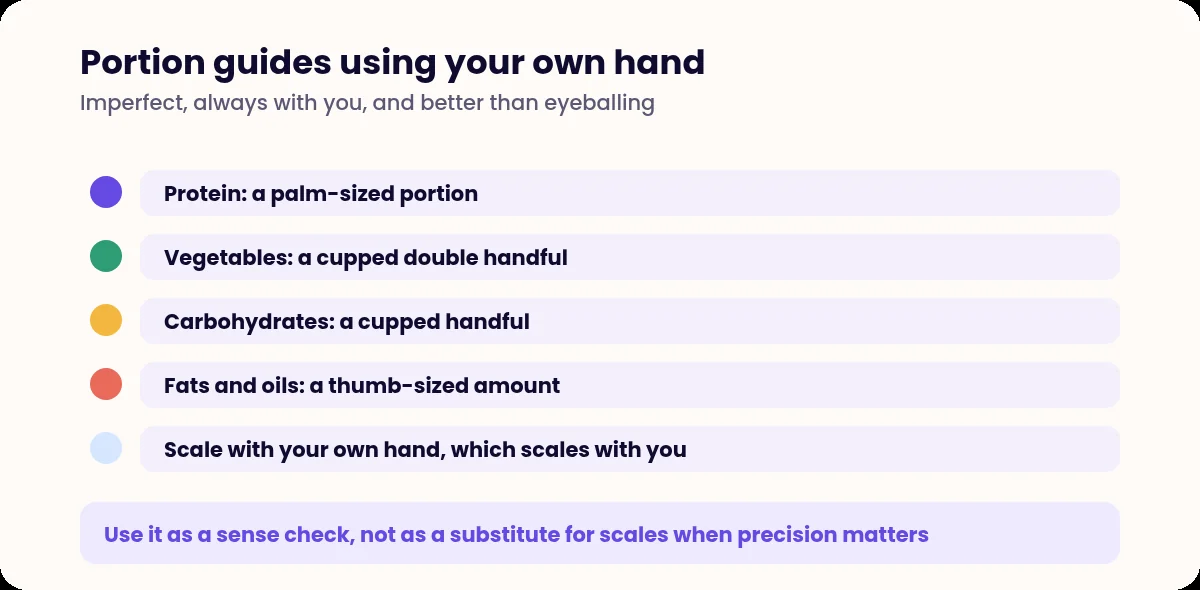
It scales to your own body, it is always with you, and it is accurate enough.
| Food group | Portion | Roughly |
|---|---|---|
| Protein — meat, fish, tofu | One palm | 100–150 g cooked |
| Carbohydrate — rice, pasta, potato | One cupped hand | 150–200 g cooked |
| Vegetables and salad | One or two fists | as much as you like |
| Fats — oil, butter, nuts, cheese | One thumb | 10–15 g |
For most people, one of each per meal is a reasonable starting structure. Larger or more active people scale up; the proportions hold.
Plate structure does more than measurement
Before measuring anything, change the layout:
- Half the plate: vegetables or salad. This is the single change with the most impact, because it displaces energy-dense food by volume.
- A quarter: protein. Roughly a palm.
- A quarter: starchy carbohydrate. Roughly a cupped hand.
- Fats: deliberate rather than incidental. Measured into the pan, not poured.
You have now controlled most of the meal without weighing anything.
The five foods you cannot eyeball
Estimation errors matter in proportion to energy density. These are where small volume errors become large calorie errors:
- Oil. A tablespoon is about 120 calories. “A drizzle” is often two.
- Nuts and nut butter. A handful of almonds is around 180 calories; a heaped tablespoon of peanut butter about 100.
- Cheese. 30 g is a matchbox, and most people serve considerably more.
- Granola and cereal. The stated portion is usually 30–45 g, which looks meagre in a bowl. Actual servings are frequently double.
- Cooking sauces and dressings. Energy-dense and rarely measured.
Weigh these five for two weeks and you will not need to again. Everything else can be estimated.
Environment beats willpower
Serve from the kitchen. Leaving pans and serving dishes on the table is the most reliable predictor of a second helping.
Use the packet’s portion, once. Pour the stated portion of cereal or crisps into a bowl and look at it. The recalibration is the point.
Decant from large packs. Larger packages increase consumption regardless of intention.
Put it on a plate. Eating from the bag removes the only natural stopping cue there is.
Slow down. Fullness signals take around 20 minutes to arrive. A meal eaten in eight minutes finishes before they do.
Portions that have genuinely changed
Bread slices, bagels, muffins, chocolate bars, crisp packets, wine glasses and restaurant plates are all larger than they were a generation ago. Your sense of a normal portion was formed against a moving reference.
Wine is a good example. A 250 ml glass — common in pubs and increasingly at home — is a third of a bottle and about 210 calories.
What not to do
Do not shrink every portion. Under-eating at lunch is one of the most reliable causes of losing control at eight in the evening, and cutting protein or vegetables is counterproductive in both directions.
The target is not less food. It is less energy-dense food, and the same volume.
When to speak to a clinician
Speak to a clinician or dietitian if you:
- have diabetes and need carbohydrate portions matched to medication
- have had bariatric surgery, where portion guidance is specific and different
- are losing weight without trying, or struggling to eat enough
- find portion rules become rigid or distressing, or have a history of an eating disorder
- have swallowing difficulties, or have been advised on a texture-modified diet
Frequently asked questions
What is a normal portion size?
There is no single answer, but useful anchors are a palm of protein, a cupped hand of carbohydrate, a fist of vegetables and a thumb of fats per meal, scaled to your own hands and appetite.
Which foods do people most often get wrong?
Oils, nuts, nut butter, cheese, granola and cereal. All are energy-dense, so a small error in volume is a large error in calories. These are the ones worth weighing even if you weigh nothing else.
Do smaller plates help?
The effect is smaller and less consistent than the popular version suggests, but serving from the kitchen rather than the table, and not leaving serving dishes within reach, reliably reduces second helpings.
How do I judge portions when eating out?
Assume restaurant portions are larger than home portions and that the cooking uses more fat. Where calorie information is displayed, use it; otherwise, share a starter or dessert rather than having both, and swap one side.
References
- NHS. Portion sizes. www.nhs.uk/live-well/eat-well/food-guidelines-and-food-labels/the-eatw
- British Nutrition Foundation. Find your balance: portion sizes. www.nutrition.org.uk/
- Hollands GJ, Shemilt I, Marteau TM, et al. Portion, package or tableware size for changing selection and consumption of food, alcohol and tobacco. Cochrane Database of Systematic Reviews. 2015;(9):CD011045. doi.org/10.1002/14651858.CD011045.pub2
- Food Standards Agency. Front of pack nutrition labelling guidance. www.food.gov.uk/sites/default/files/media/document/fop-guidance_0.pdf
Medical reviewer
Naeem Teni
Clinical Lead at Manova. Registered pharmacist and independent prescriber, GPhC 2215591. Reviews Manova’s clinical content for accuracy and safety.
Written by
Manova Editorial Team
Researched and written to our editorial policy, using NICE, NHS, MHRA and peer-reviewed sources.
This article is for general information and isn’t a substitute for advice from your own clinician. If you feel unwell, contact your GP or NHS 111. In an emergency, call 999.