

Key takeaways
- In the UK, prediabetes is usually defined as an HbA1c of 42–47 mmol/mol.
- Around 6.3 million people in the UK are estimated to have non-diabetic hyperglycaemia.
- Losing 5–7% of body weight substantially reduces the chance of progressing to type 2 diabetes.
- Prediabetes causes no symptoms in most people, so it is usually found on a routine blood test.
Prediabetes is an odd diagnosis. It has no symptoms, no treatment in the usual sense, and a name that sounds provisional. Most people find out about it from a letter after a routine blood test.
It is also one of the clearest examples in medicine of weight loss changing an outcome.
What the numbers mean
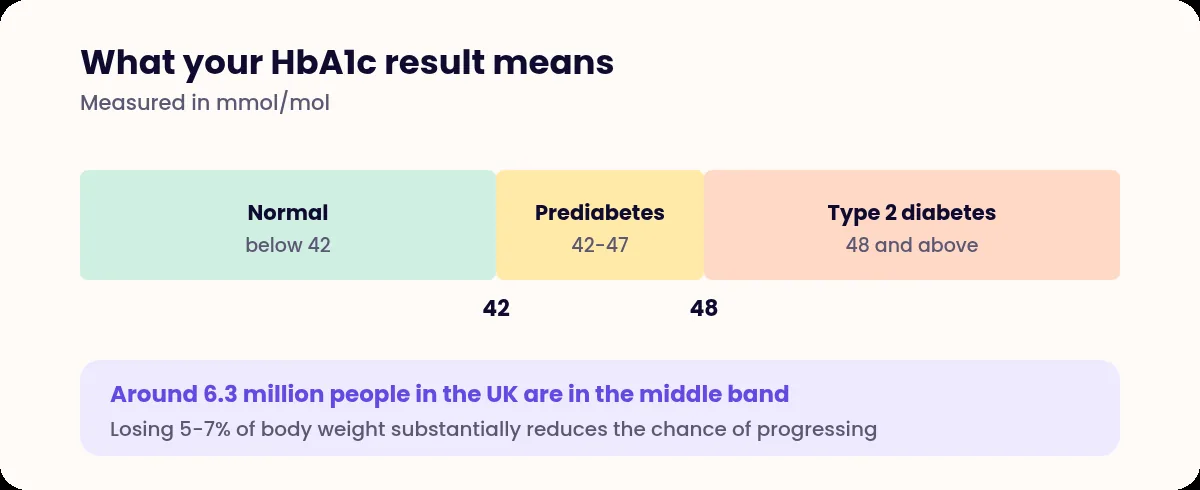
The standard UK test is HbA1c, which reflects average blood glucose over the previous two to three months.
| HbA1c | What it means |
|---|---|
| Below 42 mmol/mol | Normal |
| 42–47 mmol/mol | Non-diabetic hyperglycaemia (“prediabetes”) |
| 48 mmol/mol or above | Type 2 diabetes (usually confirmed on a repeat test) |
An estimated 6.3 million people in the UK fall into that middle band [1]. Most of them do not know it.
Why weight matters here specifically
Excess fat, particularly around the abdomen and inside the liver, makes the body’s tissues less responsive to insulin. The pancreas compensates by producing more. Prediabetes is the stage at which that compensation is starting to fail but has not failed completely.
Take some of the fat away and insulin sensitivity improves. That is the whole mechanism, and it is why the effect of weight loss here is larger than in almost any other condition.
How much weight loss, and how much does it help?
The landmark evidence comes from the US Diabetes Prevention Program. More than 3,000 adults with impaired glucose tolerance were randomised to intensive lifestyle change (a 7% weight-loss goal plus 150 minutes of activity a week), metformin, or placebo. The lifestyle group cut their risk of developing type 2 diabetes by 58% over about three years — substantially better than metformin’s 31% [2].
For most people that translates to:
- 5% of body weight — a meaningful reduction in risk
- 7% of body weight — the target used in the trials that worked best
- 10% or more — further improvement, and relevant if you have already crossed into type 2 diabetes, where the DiRECT trial found 46% remission at 12 months [3]
For a 95 kg adult, 7% is about 6.5 kg. That is a realistic number, not a transformation.
What to actually change
Move the activity dial first. 150 minutes a week of moderate activity improves insulin sensitivity partly independently of weight. Walking counts.
Add resistance training. Muscle is where most dietary glucose ends up. Twice a week.
Look at liquid sugar before solid food. Sugary drinks, juices and sweetened coffees raise glucose quickly and satisfy little.
Raise fibre. Fibre slows glucose absorption and improves satiety. Most UK adults eat around 18 g a day against a 30 g recommendation.
Do not ignore sleep and alcohol. Both affect glucose control directly.
The NHS route
If your HbA1c is in the 42–47 range, you may be eligible for the NHS Diabetes Prevention Programme, a free nine-month programme of group or digital sessions on diet, activity and weight [5]. Ask your GP practice — referral is usually straightforward and the evidence for it is good.
Where medication fits
Weight-loss medicines are licensed for weight management rather than for prediabetes as such, and prescribing depends on BMI and other health conditions. Metformin is sometimes considered where lifestyle change has not worked and risk is high. Any of this is a conversation with a clinician who can see your results.
When to speak to a clinician
Book an appointment if you:
- have been told your HbA1c is 42 mmol/mol or higher
- are thirstier than usual, passing urine more often, or unusually tired
- have blurred vision, or cuts healing slowly
- have a family history of type 2 diabetes and have never been tested
- had gestational diabetes in a previous pregnancy
Repeat testing is usually recommended at least annually once prediabetes has been identified.
Frequently asked questions
What HbA1c counts as prediabetes in the UK?
An HbA1c of 42 to 47 mmol/mol (6.0 to 6.4%) is generally classed as non-diabetic hyperglycaemia, sometimes called prediabetes. 48 mmol/mol or above, confirmed on a second test, indicates type 2 diabetes.
Can prediabetes be reversed?
In many people, yes. Weight loss, increased activity and dietary change can return HbA1c to the normal range. The evidence is strongest for programmes achieving around 5 to 7% weight loss with regular physical activity.
How much weight do I need to lose?
Diabetes prevention trials that reduced risk most used a target of 7% of starting body weight. For someone weighing 95 kg that is about 6.5 kg. Even 5% is worthwhile.
Does prediabetes always become diabetes?
No. A substantial proportion of people with prediabetes never progress, and some return to normal blood glucose. Risk is higher with a higher HbA1c, a larger waist, a family history and increasing age.
References
- NICE. Type 2 diabetes: prevention in people at high risk. PH38. www.nice.org.uk/guidance/ph38
- Knowler WC, Barrett-Connor E, Fowler SE, et al. Reduction in the incidence of type 2 diabetes with lifestyle intervention or metformin. New England Journal of Medicine. 2002;346(6):393-403. doi.org/10.1056/NEJMoa012512
- Lean MEJ, Leslie WS, Barnes AC, et al. Primary care-led weight management for remission of type 2 diabetes (DiRECT): an open-label, cluster-randomised trial. The Lancet. 2018;391(10120):541-551. doi.org/10.1016/S0140-6736(17)33102-1
- NHS. Type 2 diabetes. www.nhs.uk/conditions/type-2-diabetes/
- NHS England. NHS Diabetes Prevention Programme. www.england.nhs.uk/diabetes/diabetes-prevention/
Medical reviewer
Naeem Teni
Clinical Lead at Manova. Registered pharmacist and independent prescriber, GPhC 2215591. Reviews Manova’s clinical content for accuracy and safety.
Written by
Manova Editorial Team
Researched and written to our editorial policy, using NICE, NHS, MHRA and peer-reviewed sources.
This article is for general information and isn’t a substitute for advice from your own clinician. If you feel unwell, contact your GP or NHS 111. In an emergency, call 999.