

Key takeaways
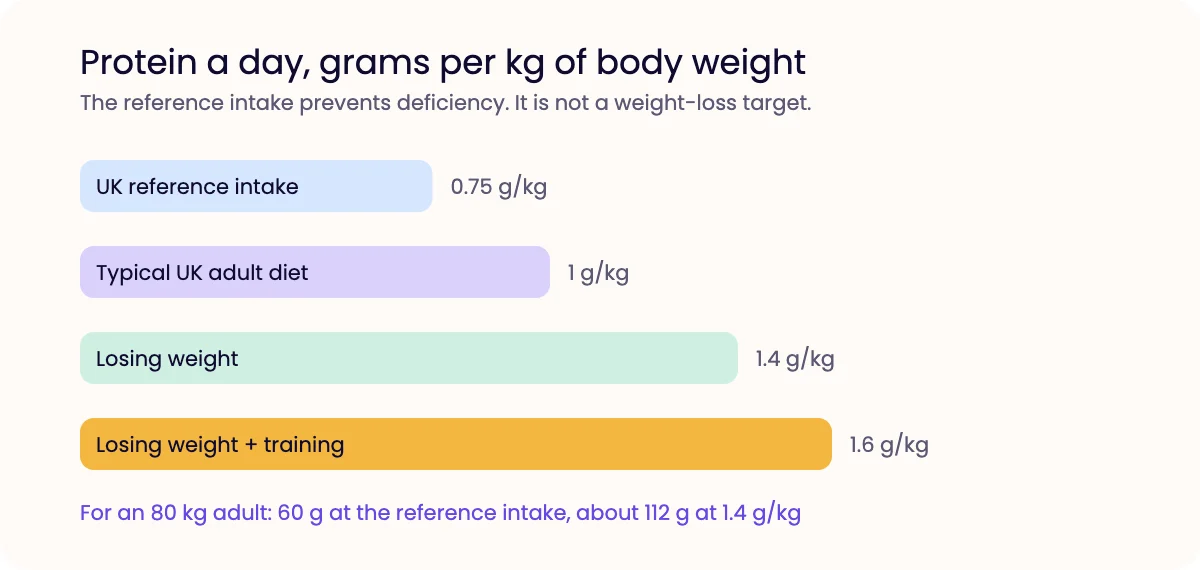
- The UK reference intake is 0.75 g of protein per kg of body weight a day. That is a floor for avoiding deficiency, not a target for someone losing weight.
- Most people dieting do better somewhere around 1.2–1.6 g per kg, spread across the day rather than piled into one meal.
- Protein helps in two ways: it is the most filling of the three macronutrients, and it gives your body the raw material to hold on to muscle.
- The evidence is strongest when higher protein is paired with strength training. Protein alone is not a substitute for lifting something heavy twice a week.
If you only change one thing about how you eat while losing weight, protein is the thing worth changing. Not because it burns fat, which it doesn’t, but because it makes a calorie deficit easier to live with and protects the muscle you’d otherwise lose along the way.
Here is how much you need, where the official numbers come from, and what it looks like on an actual plate.
The official UK number, and why it isn’t your target
The UK reference nutrient intake for protein is 0.75 g per kg of body weight a day [1]. For an 80 kg adult that’s 60 g.
That figure answers a specific question: how little protein can a healthy adult eat without developing a deficiency? It was never designed to answer the question you’re asking, which is how much protein helps when you’re eating less food overall and want to keep your muscle.
What the research suggests when you’re dieting
Two things happen when you cut calories. Your body starts breaking down tissue for fuel, and some of that tissue is muscle rather than fat. And you get hungry.
Higher protein intakes address both, though the evidence is more nuanced than the internet suggests.
On fullness, the evidence is fairly clear. In a controlled feeding study where people were switched to a high-protein diet and then allowed to eat freely, they spontaneously ate several hundred calories a day less and lost weight without being asked to restrict anything [4]. Protein is simply harder to overeat than fat or refined carbohydrate.
On muscle, it’s more conditional. A large meta-analysis found that protein intakes up to about 1.6 g per kg a day were associated with greater gains in lean mass — but that analysis was in people doing resistance training, and it specifically excluded diets designed for weight loss [2]. Meanwhile, a trial in overweight older adults found that raising protein from 0.9 to 1.7 g per kg during a 25% calorie restriction did not significantly preserve lean mass compared with the lower intake [3].
Read together, the honest summary is this: protein helps most when you give your body a reason to keep muscle. That reason is strength training. Protein is the material; training is the signal.
A sensible working range
- 1.2–1.6 g per kg of body weight a day while losing weight
- If you’re a long way above a healthy weight, calculate from a target weight instead of your current one, or you’ll end up with an unrealistic number
- Spread it out: roughly 25–40 g at each main meal
For a 75 kg person, that’s about 90–120 g a day, or around 30 g three times.
What 30 g of protein actually looks like
Most people badly underestimate this. Portion sizes below are approximate and based on UK food composition data [5].
| Food | Protein per 100 g | Roughly 30 g of protein |
|---|---|---|
| Chicken breast, cooked | 30 g | 1 small breast (100 g) |
| Tinned tuna, drained | 24 g | 1 large tin (125 g) |
| Salmon fillet, cooked | 24 g | 1 fillet (125 g) |
| Beef mince, 5% fat, cooked | 26 g | 115 g |
| Cottage cheese | 12 g | 1 large pot (250 g) |
| Greek yoghurt, 0% fat | 10 g | 1 large pot (300 g) |
| Eggs | 13 g | 4 medium eggs |
| Firm tofu | 14 g | 215 g |
| Red lentils, cooked | 9 g | 330 g |
| Baked beans | 5 g | Most of two tins |
| Semi-skimmed milk | 3.5 g | Just under a litre |
Two things jump out of that table. Animal proteins get you there in one modest portion. Plant sources mostly don’t, which is why vegetarian and vegan diets need either larger portions, more frequent protein-containing meals, or concentrated sources such as tofu, seitan, soya milk and pulses at most meals.
The breakfast problem
A typical British breakfast — toast, cereal, a banana, coffee — delivers perhaps 8–10 g. That leaves 80 g to find in two meals, which is why so many people fall short without ever noticing.
Swaps that cost nothing in time:
- Greek yoghurt with fruit instead of cereal: +15 g
- Two eggs on the toast instead of jam: +13 g
- A pint of milk in coffees through the day rather than a splash: +10 g
- Cottage cheese on the toast: +12 g
Do this alongside it, or you’re wasting the effort
The muscle evidence keeps pointing back to the same place: resistance training. UK physical activity guidelines already recommend muscle-strengthening activity on at least two days a week for all adults [7], and if you’re losing weight it stops being optional and becomes the thing that determines what you lose.
It doesn’t have to be a gym. Bodyweight work, resistance bands, a couple of kettlebells and progressively harder sessions all count.
Who should be careful
- Reduced kidney function. Higher protein intakes should be discussed with your clinician first, not adopted independently.
- Gout. Some high-purine protein sources can be a trigger. The relationship is with specific foods rather than protein as a whole, so it’s worth individual advice.
- Older adults. Protein needs are, if anything, higher with age because muscle is harder to maintain — but appetite is often lower, so this usually means smaller, more frequent protein-containing meals rather than bigger ones.
When to speak to a clinician
If you’re losing weight quickly without trying, losing strength, or losing weight alongside symptoms such as fatigue, a change in bowel habit or persistent pain, that needs looking at rather than a diet change. Speak to your GP or a Manova clinician.
Frequently asked questions
How much protein should I eat a day to lose weight?
A practical range for most adults losing weight is 1.2 to 1.6 g per kg of body weight a day. For an 80 kg person that is roughly 96–128 g. If you are well above a healthy weight, calculating from a target weight rather than current weight gives a more sensible number. Anyone with kidney disease should ask their clinician before increasing protein.
Can you eat too much protein?
For healthy adults, intakes in the range used in weight-loss research have not been shown to cause harm. Very high intakes tend to crowd out other foods, including the fibre and vegetables you also need. If you have reduced kidney function, protein intake should be discussed with your clinician rather than increased on your own.
Is it better to spread protein through the day?
Probably, and it is certainly easier. Most UK diets are light on protein at breakfast and heavy at dinner. Getting 25–40 g at each main meal is a reasonable pattern, and it tends to blunt afternoon snacking more effectively than one large evening portion.
Do I need protein powder?
No. Powder is convenient, not magic, and it is simply a concentrated food. If you can reach your target with meals, that is generally cheaper and more filling. Powder earns its place when you are busy, travelling or struggling to hit the number with food alone.
Does protein help with hunger on its own?
It helps. Protein has a stronger effect on fullness than fat or carbohydrate at the same number of calories, and it slightly increases the energy your body spends on digestion. It is not an appetite switch, but most people notice meals keep them going longer.
References
- Department of Health. Dietary Reference Values for Food Energy and Nutrients for the United Kingdom. Report of the Panel on Dietary Reference Values (COMA). 1991. assets.publishing.service.gov.uk/government/uploads/system/uploads/att
- Nunes EA, Colenso-Semple L, McKellar SR, et al. Systematic review and meta-analysis of protein intake to support muscle mass and function in healthy adults. Journal of Cachexia, Sarcopenia and Muscle. 2022;13(2):795-810. doi.org/10.1002/jcsm.12922
- Backx EMP, Tieland M, Borgonjen-van den Berg KJ, et al. Protein intake and lean body mass preservation during energy intake restriction in overweight older adults. International Journal of Obesity. 2016;40(2):299-304. doi.org/10.1038/ijo.2015.182
- Weigle DS, Breen PA, Matthys CC, et al. A high-protein diet induces sustained reductions in appetite, ad libitum caloric intake, and body weight despite compensatory changes in diurnal plasma leptin and ghrelin concentrations. American Journal of Clinical Nutrition. 2005;82(1):41-48. doi.org/10.1093/ajcn/82.1.41
- Public Health England. McCance and Widdowson's The Composition of Foods Integrated Dataset (CoFID). 2021. www.gov.uk/government/publications/composition-of-foods-integrated-dat
- NHS. The Eatwell Guide. www.nhs.uk/live-well/eat-well/food-guidelines-and-food-labels/the-eatw
- Department of Health and Social Care. UK Chief Medical Officers' physical activity guidelines. Updated 10 July 2026. www.gov.uk/government/collections/physical-activity-guidelines
Medical reviewer
Naeem Teni
Clinical Lead at Manova. Registered pharmacist and independent prescriber, GPhC 2215591. Reviews Manova’s clinical content for accuracy and safety.
Written by
Manova Editorial Team
Researched and written to our editorial policy, using NICE, NHS, MHRA and peer-reviewed sources.
This article is for general information and isn’t a substitute for advice from your own clinician. If you feel unwell, contact your GP or NHS 111. In an emergency, call 999.