

Key takeaways
- Shift work is associated with around 17% higher odds of obesity and 25% higher odds of overweight.
- Night and rotating shifts show the strongest associations, though the evidence is observational.
- Extending short sleep by about an hour reduced spontaneous calorie intake by 270 kcal a day in a randomised trial.
- Planning the night's food in advance matters more than any specific food choice.
Most weight-loss advice assumes you eat three meals in daylight and sleep at night. If you work shifts, that advice is not wrong so much as irrelevant.
What the evidence shows
A systematic review with meta-analysis covering more than 311,000 participants found [2]:
- Overweight: 25% higher odds among shift workers (RR 1.25)
- Obesity: 17% higher odds (RR 1.17)
- By shift type, night shifts showed the strongest association with overweight and rotating shifts with obesity
A second meta-analysis found roughly 23% higher risk of overweight or obesity overall, and about 35% higher risk of abdominal obesity — the type most linked to metabolic risk [1].
Two honest caveats. These are observational studies with high heterogeneity, confounded by occupation, income and diet quality. And the effect sizes, while consistent, are moderate rather than dramatic.
Why it happens
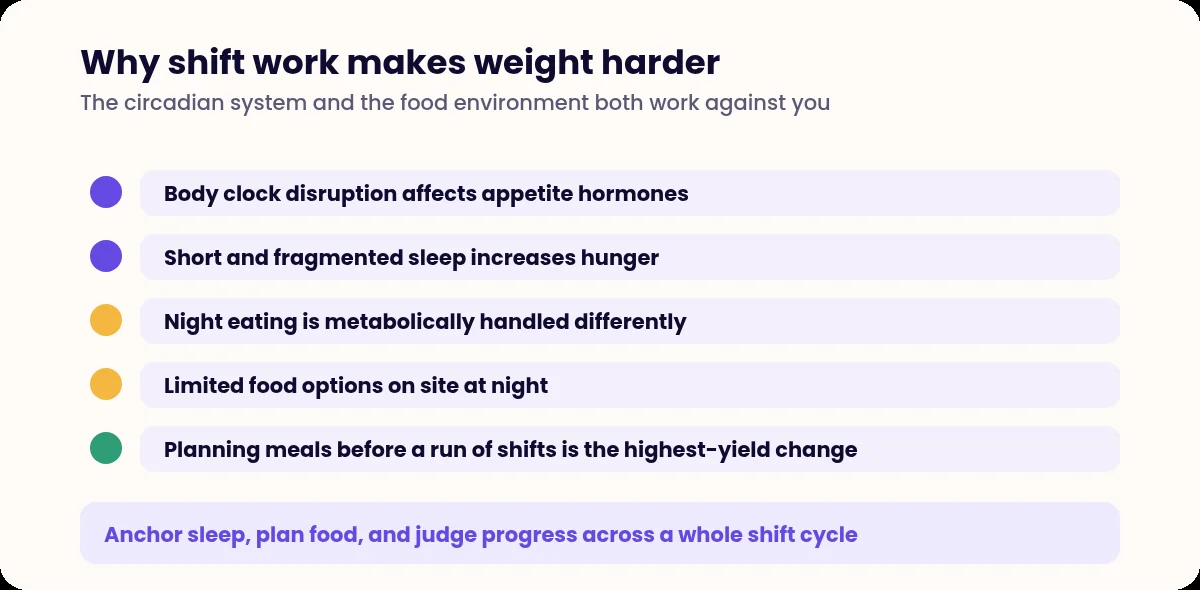
Circadian misalignment. Eating at times when the body is metabolically primed for sleep produces worse glucose and lipid handling than the same food eaten during the day.
Sleep loss. Shift workers sleep less and more poorly. Short sleep raises appetite and shifts food choice towards energy-dense options.
Food availability. At 3am the options are a vending machine, what somebody brought in, or nothing.
Disrupted structure. Meal timing loses its anchors, and grazing replaces meals.
Less activity. Fatigue reduces exercise, and rotating patterns make routines hard to hold.
What actually helps
Plan the night’s food before the shift
The highest-value change, and the least glamorous. Whatever you bring is what you will eat. Whatever you do not bring will be decided at 4am by a tired version of you standing in front of a vending machine.
A container with protein, vegetables and some starch, plus fruit and nuts, removes most of the problem. See meal prep for weight loss.
Eat a proper meal earlier in the shift
Rather than a large meal at the end. Many shift workers eat little through the night and then eat heavily before sleeping, which is the worst combination for both sleep and glucose control.
A reasonable structure: a proper meal in the first half, something light later, and avoiding a large meal in the last hour before sleep.
Protect the sleep window
- Blackout blinds — and check for light leaks, which are what usually wakes people
- Sunglasses on the journey home, particularly in summer, to limit the light signal telling your body it is morning
- A consistent sleep window, even on days off, as far as the rota allows
- Ear plugs or white noise
- Treat daytime sleep as protected rather than negotiable
The randomised evidence on sleep is strong enough to act on: adults who extended habitually short sleep by about 1.2 hours a night ate 270 fewer calories a day, with no dietary instruction [3].
Get the caffeine timing right
Caffeine helps in the first part of a night shift and ruins the sleep at the end of it. A cut-off several hours before the end of the shift is the usual compromise.
Keep some movement in
Even a short walk at the start or end of a shift helps, and resistance training twice a week matters more than the timing of it.
Rotating shifts specifically
Forward rotation — days, then evenings, then nights — is generally better tolerated than backward rotation. Where you have any say over the rota, that is the thing to ask for.
Health checks worth having
Shift work is associated with raised risk of type 2 diabetes and cardiovascular disease, which is a reason for monitoring rather than alarm. A periodic check of blood pressure, HbA1c and lipids is sensible, and worth mentioning shift work when it is arranged.
When to speak to a clinician
Speak to a clinician if you:
- fall asleep unintentionally, particularly while driving — this needs addressing promptly
- have persistent insomnia despite good sleep practices
- snore loudly with daytime sleepiness, which needs assessment for sleep apnoea
- have palpitations, chest pain or breathlessness on shifts
- have diabetes and shift work is making glucose control or medication timing difficult
- have low mood or anxiety that is worsening with the rota
If you are excessively sleepy, do not drive. Some conditions affecting alertness must be reported to the DVLA.
Frequently asked questions
Does shift work cause weight gain?
Shift work is consistently associated with higher rates of overweight and obesity — around 25% higher odds of overweight and 17% higher odds of obesity in pooled analyses. The evidence is observational, so association rather than proven causation, but it is consistent.
Should I eat during a night shift?
Most people function better with something. The practical approach is a planned, moderate meal in the earlier part of the shift and a lighter option later, rather than grazing continuously or eating nothing and then eating heavily at the end.
How do I sleep better after a night shift?
Blackout blinds, a consistent sleep window, sunglasses on the journey home to limit light exposure, caffeine cut-off several hours before the end of the shift, and treating daytime sleep as protected time rather than what is left over.
Is shift work bad for you beyond weight?
It is associated with raised risks of type 2 diabetes, cardiovascular disease and some cancers, and with sleep disorders. Those risks are reasons for good monitoring rather than for alarm, and many are modifiable.
References
- Sun M, Feng W, Wang F, et al. Meta-analysis on shift work and risks of specific obesity types. Obesity Reviews. 2018;19(1):28-40. doi.org/10.1111/obr.12621
- Shift work and overweight or obesity: systematic review with meta-analysis. International Journal of Epidemiology. 2018;47(6):1956. academic.oup.com/ije/article/47/6/1956/5020797
- Tasali E, Wroblewski K, Kahn E, Kilkus J, Schoeller DA. Effect of sleep extension on objectively assessed energy intake among adults with overweight in real-life settings. JAMA Internal Medicine. 2022;182(4):365-374. doi.org/10.1001/jamainternmed.2021.8098
- Health and Safety Executive. Shift work and fatigue. www.hse.gov.uk/humanfactors/topics/fatigue.htm
Medical reviewer
Naeem Teni
Clinical Lead at Manova. Registered pharmacist and independent prescriber, GPhC 2215591. Reviews Manova’s clinical content for accuracy and safety.
Written by
Manova Editorial Team
Researched and written to our editorial policy, using NICE, NHS, MHRA and peer-reviewed sources.
This article is for general information and isn’t a substitute for advice from your own clinician. If you feel unwell, contact your GP or NHS 111. In an emergency, call 999.