
Key takeaways
- Obstructive sleep apnoea causes repeated airway closure during sleep, fragmenting sleep and lowering oxygen levels.
- Excess weight, particularly around the neck and abdomen, is the strongest modifiable risk factor.
- Untreated apnoea worsens daytime sleepiness and appetite regulation, making weight loss harder.
- In a trial of tirzepatide in people with obesity and moderate-to-severe OSA, apnoea events fell by around 25 to 29 per hour and resolved in roughly half.
Obstructive sleep apnoea (OSA) and excess weight feed each other. Fat around the neck and upper airway narrows the space available to breathe through at night. The resulting broken sleep raises appetite, lowers energy and makes losing weight harder. Round it goes.
The useful thing about a loop is that you can break it at either end.
What happens during an apnoea
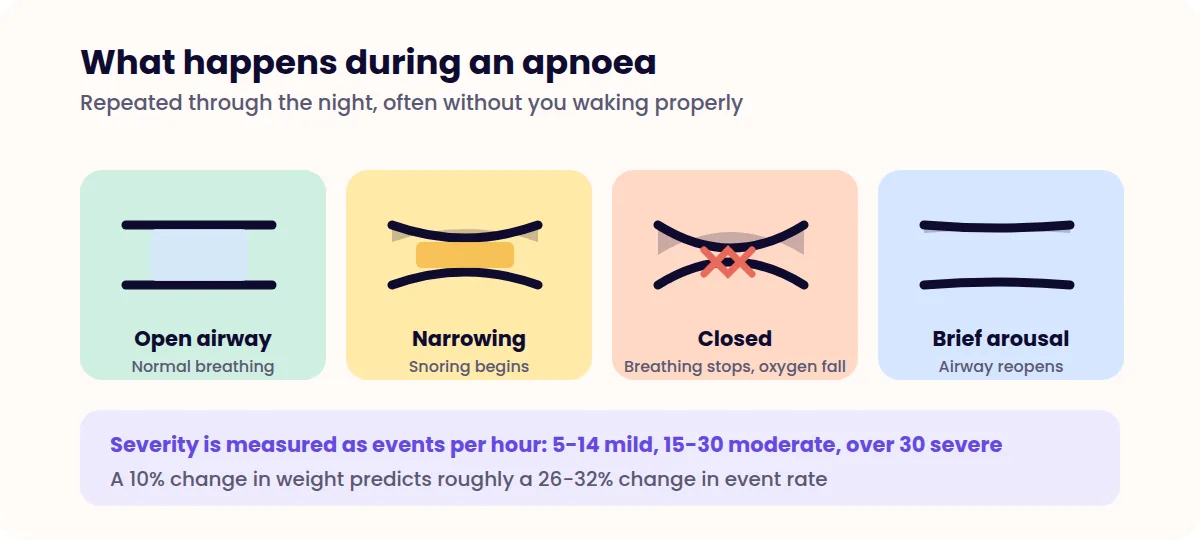
During sleep, the muscles holding the upper airway open relax. In OSA the airway narrows or closes completely, breathing stops for ten seconds or more, oxygen falls, and the brain briefly wakes you enough to reopen it. You usually have no memory of this.
It can happen five times an hour. It can happen sixty. Severity is measured by the apnoea-hypopnoea index (AHI) — events per hour of sleep:
- 5–14: mild
- 15–30: moderate
- over 30: severe
The signs
- loud, habitual snoring
- pauses in breathing, gasping or choking, usually noticed by a partner
- waking unrefreshed however long you were in bed
- heavy daytime sleepiness, particularly when sitting still or driving
- morning headaches, dry mouth
- needing to pass urine several times a night
The last one surprises people. It is common enough to be a useful clue.
How much does weight matter?
A lot. A long-running cohort study found that a 10% gain in weight predicted a 32% increase in AHI, and a 10% loss predicted a 26% decrease [3]. Few relationships in medicine are that linear.
More recently, the SURMOUNT-OSA trials tested tirzepatide in adults with obesity and moderate-to-severe OSA. Apnoea events fell by around 25 to 29 per hour, against roughly 5 per hour on placebo, and around half of participants reached the point where their apnoea was considered resolved or minimal [2]. That is a large effect for a drug not designed for the airway.
It is worth being clear about what that does and does not mean. It shows that weight loss of that magnitude changes OSA substantially. It does not mean medication replaces diagnosis and treatment — you still need a sleep study, and CPAP remains the first-line treatment for moderate to severe disease.
Treatment, briefly
CPAP — a mask delivering gentle positive pressure that splints the airway open. Highly effective when used consistently. It treats the apnoea, not the weight; trials have not shown it causes weight loss by itself. What it often does is return enough energy to make other changes possible.
Mandibular advancement devices — a custom dental appliance that holds the lower jaw forward. An option in mild to moderate disease or where CPAP is not tolerated.
Positional measures — some people’s apnoea is far worse on their back.
Weight loss — reduces severity, and in some people resolves it.
Alcohol and sedatives — both relax the airway muscles further. Reducing them helps.
Driving
This matters legally as well as medically. If you have excessive sleepiness that is likely to impair driving, you must not drive, and OSA syndrome causing excessive sleepiness is notifiable to the DVLA [5]. Most people can return to driving once treated and symptoms are controlled.
When to speak to a clinician
Ask for assessment if you:
- snore loudly and someone has witnessed you stop breathing, gasp or choke
- fall asleep unintentionally during the day, particularly while driving
- wake with headaches or a very dry mouth most mornings
- have high blood pressure that is hard to control
- have a collar size of 17 inches or more with any of the above
Do not drive if you are excessively sleepy. Referral is usually to a sleep clinic for a home sleep study.
Frequently asked questions
Can losing weight cure sleep apnoea?
Weight loss reliably reduces the severity of obstructive sleep apnoea and in a proportion of people it resolves entirely. How much improvement you get depends on the starting severity and on anatomy, which weight loss does not change.
How do I know if I have sleep apnoea?
Common signs are loud snoring, pauses in breathing witnessed by a partner, gasping or choking at night, waking unrefreshed, morning headaches and heavy daytime sleepiness. Diagnosis needs a sleep study, usually a home test.
Does CPAP help you lose weight?
CPAP treats the apnoea rather than the weight, and trials have not found that it causes weight loss on its own. What it often does is restore enough daytime energy and sleep quality to make diet and activity changes feasible.
Is sleep apnoea dangerous?
Untreated moderate to severe sleep apnoea is associated with high blood pressure, heart disease, stroke and type 2 diabetes, and it substantially increases road traffic accident risk through daytime sleepiness.
References
- NICE. Obstructive sleep apnoea/hypopnoea syndrome and obesity hypoventilation syndrome in over 16s. NG202. www.nice.org.uk/guidance/ng202
- Malhotra A, Grunstein RR, Fietze I, et al. Tirzepatide for the treatment of obstructive sleep apnea and obesity. New England Journal of Medicine. 2024;391(13):1193-1205. doi.org/10.1056/NEJMoa2404881
- Peppard PE, Young T, Palta M, Dempsey J, Skatrud J. Longitudinal study of moderate weight change and sleep-disordered breathing. JAMA. 2000;284(23):3015-3021. doi.org/10.1001/jama.284.23.3015
- NHS. Obstructive sleep apnoea. www.nhs.uk/conditions/obstructive-sleep-apnoea/
- DVLA. Excessive sleepiness and driving. www.gov.uk/excessive-sleepiness-and-driving
Medical reviewer
Naeem Teni
Clinical Lead at Manova. Registered pharmacist and independent prescriber, GPhC 2215591. Reviews Manova’s clinical content for accuracy and safety.
Written by
Manova Editorial Team
Researched and written to our editorial policy, using NICE, NHS, MHRA and peer-reviewed sources.
This article is for general information and isn’t a substitute for advice from your own clinician. If you feel unwell, contact your GP or NHS 111. In an emergency, call 999.