

Key takeaways
- There is no NICE or MHRA guidance on how to switch between tirzepatide and semaglutide, and no validated dose-equivalence table.
- The SmPCs cover how to start each medicine, not how to convert from another one.
- In the absence of guidance, restarting at the licensed starting dose of the new medicine is the cautious approach — but that is clinical opinion, not regulation.
- Switching is a prescriber's decision. Doing it yourself, or stockpiling to bridge a gap, is where harm happens.
This is one of the most common questions asked about weight-management medicines, and it has an uncomfortable answer: there is no official guidance.
Not “the guidance is complicated”. There isn’t any. The Pharmaceutical Journal states plainly that no NICE or MHRA guidance specifies how to switch between tirzepatide and semaglutide [1], and the Summaries of Product Characteristics for both medicines describe how to start them, not how to convert from something else [2][3].
This page explains what that gap means. It is information, not advice, and any switch is a decision for a prescriber.
Why there is no conversion chart
Dose-equivalence tables exist for medicines where the pharmacology makes them comparable — different opioids, different steroids. Semaglutide and tirzepatide do not sit in that relationship.
Semaglutide acts on the GLP-1 receptor. Tirzepatide acts on GLP-1 and GIP receptors. The doses are not on the same scale (15 mg of tirzepatide is not “more” than 2.4 mg of semaglutide in any meaningful sense), the trials were never designed to establish equivalence, and tolerating one at a high dose does not guarantee tolerating the other.
What clinicians generally do
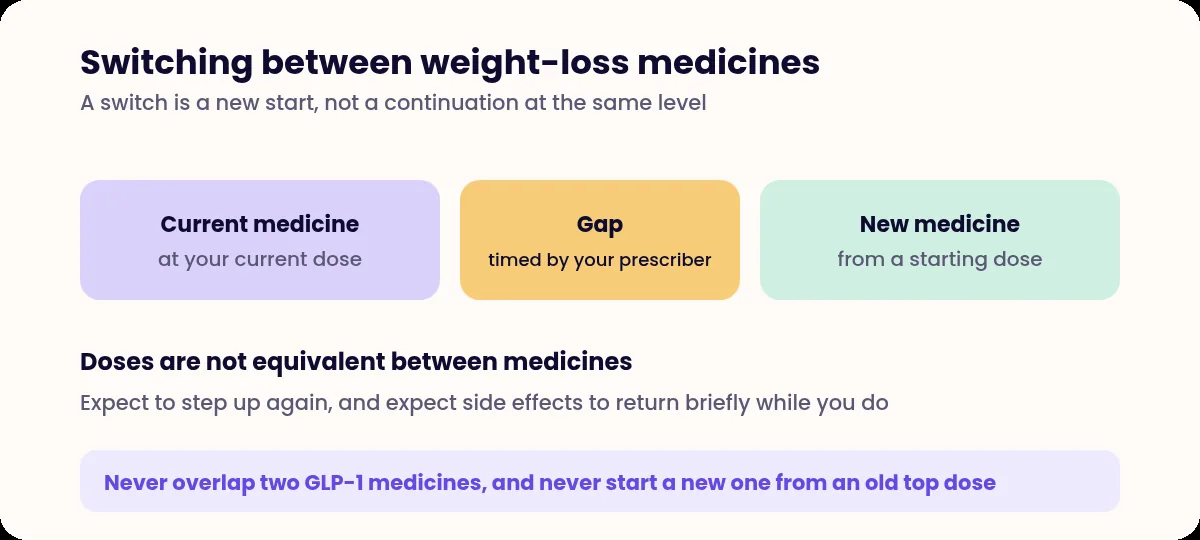
In the absence of guidance, published clinical opinion converges on a cautious default: start the new medicine at its licensed starting dose and escalate normally [1].
That feels frustrating if you have spent four months climbing to a maintenance dose. The reasoning is that the gastrointestinal side effects of these medicines cluster at initiation and dose increases, and there is no evidence that tolerance transfers between them. Starting high risks a level of nausea and vomiting that would have been avoidable.
Be clear that this is expert opinion, not regulation. A prescriber who knows your history may reasonably do something different and should be able to explain why.
Reasons a switch might be considered
- Side effects that have not settled after a fair period at a tolerable dose
- Inadequate response — the SmPCs contain review points, such as reconsidering tirzepatide if less than 5% of body weight has been lost six months after reaching the highest tolerated dose [2]
- Supply problems, which have affected every medicine in this class at some point
- Cost, where one option becomes unaffordable
- A change in clinical circumstances — a new diagnosis, a new medicine, a plan to conceive
Wanting to try the newest thing is not a clinical reason, and a prescriber who agrees to it without discussion is not doing their job.
The gap in the middle
Both weekly injections stay in the body for some time after the last dose, then fade. The new medicine then starts at a low dose and builds over months.
So there is usually a period — weeks, not days — when appetite suppression is weaker than you have become used to. People are often caught out by this and read it as the new medicine “not working”. It is worth expecting:
- Hunger returning noticeably before the new medicine takes effect
- A short-term stall or small regain on the scales
- The same early side effects you had the first time, as the new medicine escalates
Planning meals and structure for that window matters more than it does at any other point in treatment.
What not to do
Do not switch yourself. Buying a different medicine online to change over without a prescriber involved removes the one person who has your history in front of them.
Do not overlap doses. Taking the old and new medicine together is not a smoother transition; it is a double dose of the same physiological effect.
Do not stockpile to bridge a gap. Using someone else’s pen, or a pen bought outside a registered pharmacy, is where counterfeit products enter the picture.
Do not assume your old dose transfers. This is the mistake with the clearest consequences.
Questions worth asking your prescriber
- What dose will I start on, and how quickly will it go up?
- How long should I leave between the last dose of one and the first of the other?
- What should I expect in the gap?
- What are we measuring to decide whether this switch worked, and by when?
- If this one does not suit me either, what happens next?
Safety information
The warnings that apply to each medicine apply through a switch: severe, persistent abdominal pain needs urgent attention because of the pancreatitis risk highlighted by the MHRA in January 2026 [6]; these medicines are not for use in pregnancy; and delayed gastric emptying can affect other oral medicines, including contraceptives. Suspected side effects can be reported through the Yellow Card scheme [7].
Where this information comes from
The absence of official guidance is documented in The Pharmaceutical Journal [1] and confirmed by the SmPCs themselves. Review points come from the products’ SmPCs, and the NHS access position from the NICE technology appraisals.
Frequently asked questions
Can you switch from Mounjaro to Wegovy?
A prescriber can decide to change you from one to the other. What does not exist is official guidance on how to do it — there is no NICE or MHRA protocol and no validated dose-equivalence between the two.
Do you have to start again at the lowest dose?
The Summaries of Product Characteristics describe how to initiate each medicine, and they do not contain instructions for converting from a different one. Published clinical opinion generally favours starting the new medicine at its licensed starting dose and escalating normally, on the basis that tolerance to one GLP-1 medicine cannot be assumed to transfer to another.
Why would someone switch?
Common reasons are side effects that have not settled, an inadequate response after a fair trial at the highest tolerated dose, supply problems, cost, or a change in what is clinically appropriate. Curiosity about a newer medicine is not on its own a clinical reason.
How long should there be between the last dose of one and the first of the other?
There is no official answer. Both weekly injections have long half-lives, so the previous medicine is still present for some time after the last dose. This is exactly the kind of detail a prescriber should be deciding, with your dosing history in front of them.
Will I regain weight during a switch?
Appetite effects fade as the previous medicine clears and build again as the new one escalates, so there can be a window where hunger returns. Planning for that window — rather than being surprised by it — is the practical part.
References
- The Pharmaceutical Journal. Switching between weight-loss medications. pharmaceutical-journal.com/article/ld/switching-between-weight-loss-me
- Eli Lilly and Company Limited. Mounjaro KwikPen: Summary of Product Characteristics. Electronic Medicines Compendium. www.medicines.org.uk/emc/product/15484/smpc
- Novo Nordisk Limited. Wegovy: Summary of Product Characteristics. Electronic Medicines Compendium. www.medicines.org.uk/emc/product/13803/smpc
- National Institute for Health and Care Excellence. Semaglutide for managing overweight and obesity (TA875). www.nice.org.uk/guidance/ta875/chapter/1-Recommendations
- National Institute for Health and Care Excellence. Tirzepatide for managing overweight and obesity (TA1026). www.nice.org.uk/guidance/ta1026/chapter/1-Recommendations
- MHRA. GLP-1 receptor agonists and dual GLP-1/GIP receptor agonists: strengthened warnings on acute pancreatitis. Drug Safety Update, 29 January 2026. www.gov.uk/drug-safety-update/glp-1-receptor-agonists-and-dual-glp-1-s
- MHRA. Yellow Card: report a suspected side effect. yellowcard.mhra.gov.uk/
Medical reviewer
Naeem Teni
Clinical Lead at Manova. Registered pharmacist and independent prescriber, GPhC 2215591. Reviews Manova’s clinical content for accuracy and safety.
Written by
Manova Editorial Team
Researched and written to our editorial policy, using NICE, NHS, MHRA and peer-reviewed sources.
This article is for general information and isn’t a substitute for advice from your own clinician. If you feel unwell, contact your GP or NHS 111. In an emergency, call 999.