

Key takeaways
- Book for weight specifically rather than raising it at the end of another appointment.
- Bring a weight history, a medicine list and the specific thing you want.
- Ask what is commissioned locally — provision varies enormously between areas.
- Referral criteria for surgery are more generous than most people believe.
Ten minutes is not long, and weight is a subject that tends to get raised in the last ninety seconds of an appointment about something else. A small amount of preparation changes what comes out of it considerably.
Book for it specifically
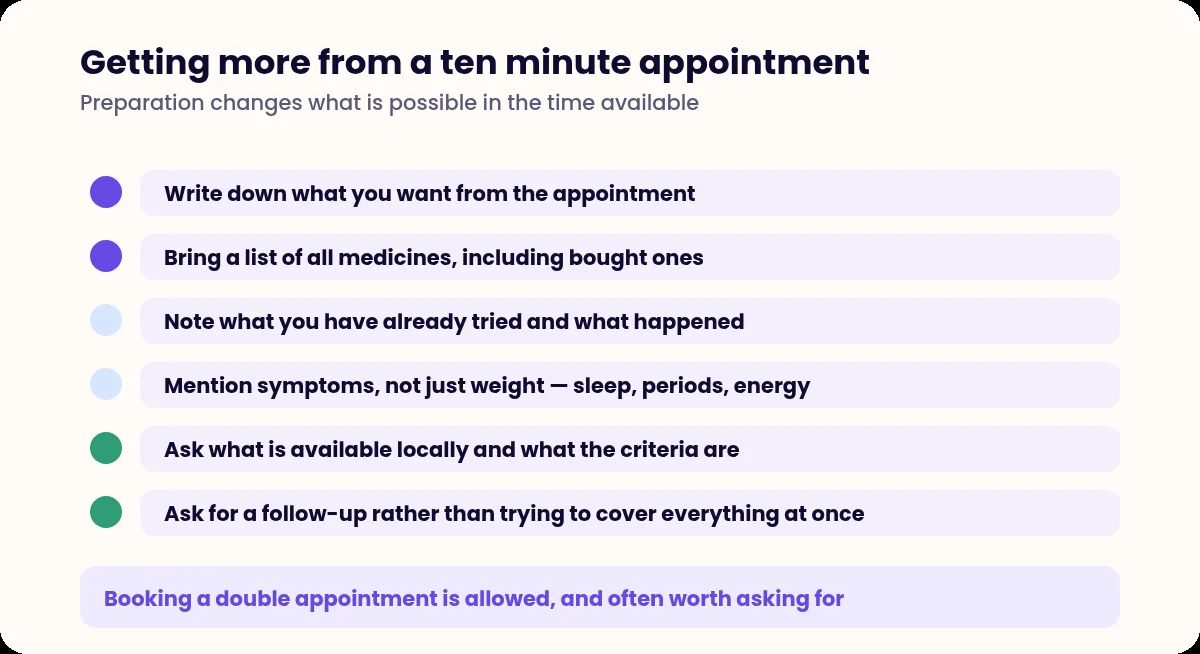
Raising weight as a “while I’m here” at the end of a consultation about your knee guarantees a rushed answer. Book an appointment and say when booking that it is about weight, so the time is allocated.
If your practice offers longer appointments for complex issues, this qualifies.
What to bring
A weight history. Roughly what you have weighed at different points, what you have tried, what worked and for how long, and what happened afterwards. This is genuinely useful clinical information and almost nobody arrives with it.
Your current weight, height and waist measurement. Measured at home, honestly.
A full list of medicines, including anything bought over the counter and any supplements. Several prescribed medicines cause weight gain, and this is the appointment to check that.
Other symptoms. Snoring and daytime sleepiness, thirst, fatigue, low mood, joint pain, irregular periods. These change what gets investigated.
One specific ask. See below.
Ask for something specific
“I need to lose weight” produces general advice. A specific request produces a specific answer. Reasonable things to ask for by name:
- A referral to the local weight management service — ask what tier is available and what the wait is
- A medication review, if you take anything that may be contributing
- Blood tests — thyroid function, HbA1c, lipids, liver function
- An assessment for sleep apnoea, if you snore heavily and are tired in the day
- A discussion about weight-loss medication, and specifically what is commissioned locally
- A referral for bariatric assessment, if you meet the criteria
- The NHS Type 2 Diabetes Path to Remission Programme, if you have type 2 diabetes diagnosed in the last six years
The question that saves the most time
“What is actually commissioned in this area?”
NICE recommends things. Integrated care boards fund things. They are not the same, and provision varies enormously across England. A GP may well agree you meet NICE criteria and still not be able to prescribe or refer, because of local policy rather than clinical judgement.
Knowing which of the two you are up against tells you whether to push, wait, or look elsewhere.
What the routes look like
Tier 1 — self-directed. The NHS Weight Loss Plan app and Better Health resources [3].
Tier 2 — community programmes, usually 12 weeks, referral-based. Availability varies.
Tier 3 — specialist multidisciplinary service: clinician, dietitian, psychological input. Where NHS medication is usually started and where surgical assessment happens. Waits of a year or more are common in many areas.
Tier 4 — bariatric surgery.
Worth knowing: NICE does not require you to complete tier 3 before being referred for surgery. The committee explicitly rejected that, calling it an unjustified barrier [1]. Some local policies still impose it, and it is reasonable to ask to see the policy.
If the conversation goes badly
It happens. Weight is one of the areas where people most often report feeling dismissed or blamed.
If that occurs, two things are reasonable. Ask to see a different clinician at the practice — a normal request that does not require justification. And ask for what you wanted in writing, specifically whether a referral was declined and why.
You can also ask that your weight is recorded along with what has been tried, so the history is in the notes for next time.
What not to do
Do not stop a prescribed medicine because you suspect it is causing weight gain. Raise it instead.
Do not buy prescription medicines from anywhere that will supply them without a proper consultation. See buying weight-loss medicines safely.
Do not present weight as the only problem if there are others. Low mood, poor sleep, pain and alcohol are all relevant, and all change the plan.
When to speak to a clinician
Book an appointment if you:
- have a BMI of 30 or above, or 27.5 or above with a South Asian, Chinese, Black African or African-Caribbean background
- have weight-related symptoms — breathlessness, joint pain, snoring with daytime sleepiness, thirst, fatigue
- have gained weight since starting a medicine
- have type 2 diabetes, high blood pressure, fatty liver, sleep apnoea or PMOS
- are losing weight without trying — this always needs assessment
- have tried repeatedly without lasting success and want to know what support exists
Frequently asked questions
How do I ask my GP about weight loss medication?
Ask directly, and ask what is commissioned in your area. NICE criteria and local funding are different things, and the honest answer is often that the medicine is recommended by NICE but not available locally without a specialist referral.
What is tier 3 weight management?
A specialist multidisciplinary service with clinician, dietitian and usually psychological input. It is where NHS medication is most often started and where assessment for surgery happens. Availability and waiting times vary a lot by area.
Will my GP judge me?
Most will not, and the good ones will be relieved you raised it. If you have a poor experience, you can ask to see a different clinician at the practice — that is a normal request, not a complaint.
What if I'm told to just eat less and move more?
It is reasonable to ask what specifically is available: a referral, a programme, medication, a review of medicines that may be contributing, or tests for causes. Asking for something specific tends to produce a more specific answer.
References
- NICE. Overweight and obesity management. NG246. January 2025. www.nice.org.uk/guidance/ng246
- NHS. Weight management services. www.nhs.uk/better-health/lose-weight/
- NHS. Better Health: Lose weight. www.nhs.uk/better-health/lose-weight/
- Obesity UK. Support and information. www.obesityuk.org.uk/
Medical reviewer
Naeem Teni
Clinical Lead at Manova. Registered pharmacist and independent prescriber, GPhC 2215591. Reviews Manova’s clinical content for accuracy and safety.
Written by
Manova Editorial Team
Researched and written to our editorial policy, using NICE, NHS, MHRA and peer-reviewed sources.
This article is for general information and isn’t a substitute for advice from your own clinician. If you feel unwell, contact your GP or NHS 111. In an emergency, call 999.