

Key takeaways
- Under-reporting of intake is well documented and is usually unintentional.
- Fitness tracker calorie-burn estimates have been found to be off by 27–93%.
- Oils, spreads, sauces, drinks and unlogged bites account for most missed calories.
- Tracking accurately for two weeks is more useful than tracking approximately forever.
Calorie tracking has a reputation for being either essential or pointless. It is neither. It is a measuring instrument with known, predictable errors, and knowing where they are makes it far more useful.
The four places errors hide
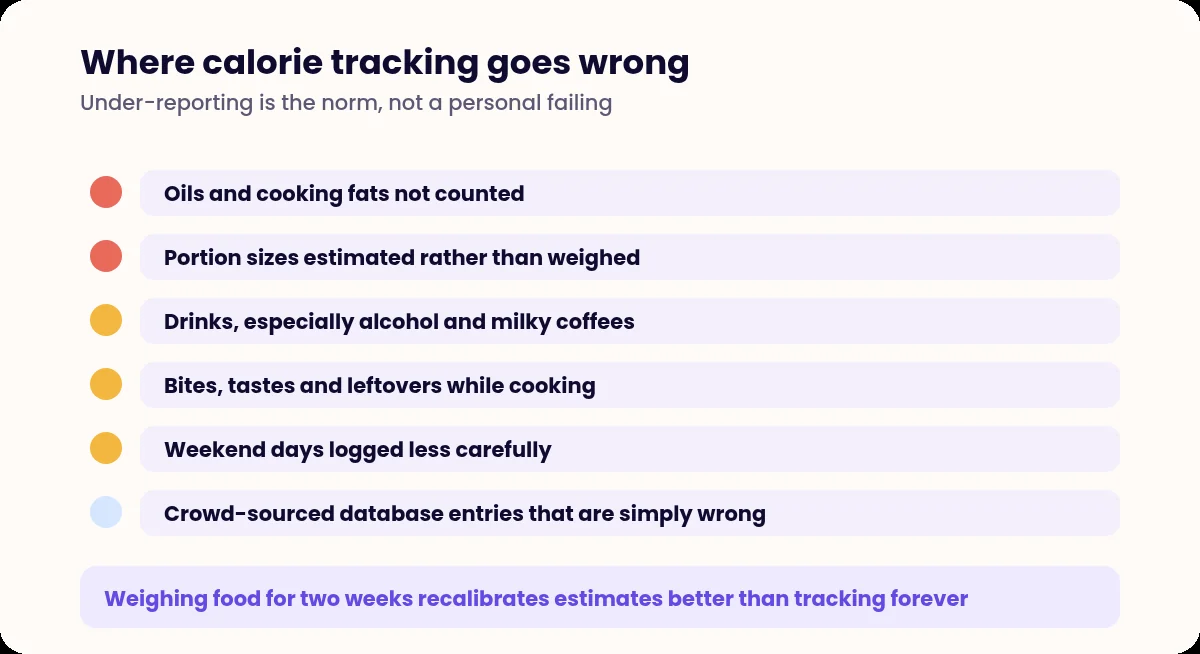
1. Cooking fats
The largest single omission. A tablespoon of olive oil is around 120 calories, and “a drizzle” is frequently two tablespoons. Butter on vegetables, oil in a pan, oil on a salad.
Fix: measure oil into the pan with a spoon rather than pouring, for a fortnight. It recalibrates your eye permanently.
2. Drinks
Milk in coffee across a day, juice, soft drinks, and alcohol. These rarely feel like eating, so they rarely get logged.
Fix: log every drink for a week, including tap water, purely to build the habit of noticing.
3. Bites, tastes and leftovers
The cheese while cooking, the corner of a child’s fish finger, three chips from someone else’s plate. Individually trivial and collectively substantial.
Fix: log them with a rough estimate rather than accurately, because the alternative is not logging them at all.
4. Weekends
Weekday logging is usually careful and weekend logging is usually absent. Two days of unlogged eating across a month is a quarter of the month.
Fix: log weekends first if you log nothing else.
Under-reporting is normal
This is not about honesty. A classic study of people who reported being unable to lose weight on stated intakes of around 1,200 calories found that actual intake was substantially higher — under-reported by around 47% — while activity was over-reported [2].
The people in that study were not lying. Self-report of food intake is simply unreliable in a consistent direction, which is a reason to measure for a while rather than to estimate forever.
The burn figure is worse
Fitness tracker energy expenditure estimates are the least reliable number in the whole exercise. A Stanford evaluation of seven wrist-worn devices found heart rate measured reasonably well but energy expenditure off by between 27% and 93% [1].
The practical consequence: do not eat back calories a device says you burned. If you use an activity allowance at all, use a fraction of it.
Making the database work
- Prefer entries with a verified or green tick where the app offers one
- Prefer the manufacturer’s own entry over a user-created one
- Check the entry against the packet the first time you use it; if it looks implausible, it is
- Use the raw weight for meat and pasta consistently, or the cooked weight consistently — not a mix
- Save meals you eat repeatedly, which is where most of the time saving comes from
How long to do it
Not forever, for most people.
Two to four weeks of careful tracking does three things: it shows where your intake actually is, it calibrates portion estimation, and it usually identifies one or two specific items that were invisible. After that, many people do better with a lighter approach — tracking one meal, or tracking a couple of days a week, or not at all.
The exception is if you are stalled. Then a fortnight of genuinely careful tracking is the fastest diagnostic available.
When tracking is the wrong tool
If counting makes food anxious, if you find yourself restricting to hit a number regardless of hunger, or if you have a history of an eating disorder, tracking can make things worse rather than better. Structural changes — regular meals, protein at each one, fewer liquid calories, a consistent pattern — get you most of the way without numbers.
When to speak to a clinician
Speak to a clinician if you:
- have tracked carefully for a month at a genuine deficit and lost nothing
- find that counting makes you anxious or preoccupied, or you have a history of disordered eating
- are losing weight without trying
- take medicines that may affect weight, or have symptoms of thyroid disease
- are eating very little and still not losing, which occasionally has a medical explanation and always deserves a proper look
Frequently asked questions
Are calorie tracking apps accurate?
The food database entries are variable, and user-created entries are often wrong. The larger problem is what gets left out rather than what gets entered incorrectly. Used carefully for a couple of weeks, an app gives a genuinely useful picture.
How accurate are fitness trackers for calories burned?
Poor. A Stanford evaluation found energy expenditure estimates off by between 27% and 93% depending on the device, even where heart rate was measured well. Do not eat back calories a tracker says you burned.
Do I have to weigh everything?
Not forever. Weighing for two weeks calibrates your eye, after which estimating becomes much more accurate. The foods worth continuing to weigh are the energy-dense ones — oils, nuts, cheese, nut butters, cereal.
Why am I tracking and not losing weight?
Most commonly, unlogged extras — cooking oil, sauces, drinks, tastes while cooking, a colleague's biscuits — plus weekends logged less carefully than weekdays. The gap is rarely a metabolic problem.
References
- Shcherbina A, Mattsson CM, Waggott D, et al. Accuracy in wrist-worn, sensor-based measurements of heart rate and energy expenditure in a diverse cohort. Journal of Personalized Medicine. 2017;7(2):3. doi.org/10.3390/jpm7020003
- Lichtman SW, Pestone K, Berman ER, et al. Discrepancy between self-reported and actual caloric intake and exercise in obese subjects. New England Journal of Medicine. 1992;327(27):1893-1898. doi.org/10.1056/NEJM199212313272701
- NHS. Understanding calories. www.nhs.uk/live-well/healthy-weight/managing-your-weight/understanding
- Food Standards Agency. Front of pack nutrition labelling guidance. www.food.gov.uk/business-guidance/packaging-and-labelling
Medical reviewer
Naeem Teni
Clinical Lead at Manova. Registered pharmacist and independent prescriber, GPhC 2215591. Reviews Manova’s clinical content for accuracy and safety.
Written by
Manova Editorial Team
Researched and written to our editorial policy, using NICE, NHS, MHRA and peer-reviewed sources.
This article is for general information and isn’t a substitute for advice from your own clinician. If you feel unwell, contact your GP or NHS 111. In an emergency, call 999.