

Key takeaways
- In the only tightly controlled inpatient trial, people ate around 500 more calories a day on an ultra-processed diet and gained weight.
- Ultra-processed foods make up roughly half of the average UK diet by energy.
- The NOVA classification is broad and groups together foods with very different nutritional profiles.
- The practical lever is usually energy density, fibre and protein, not the word 'processed' itself.
Ultra-processed food has become the explanation for almost everything. Some of that is justified. Some of it has run ahead of the evidence, and it is worth separating the two, because the practical advice that follows is different.
The one study that really matters
Most research on this topic is observational: it asks what people eat and what happens to them, and cannot easily separate ultra-processed food from income, activity, smoking and everything else that travels with it.
One study got round that. In 2019, researchers admitted 20 adults to a metabolic ward for four weeks. For two weeks they ate an ultra-processed diet; for the other two, an unprocessed one. The two diets were matched for calories presented, sugar, fat, fibre and macronutrients. Participants were told to eat as much or as little as they wanted [1].
On the ultra-processed diet they ate around 500 more calories a day and gained about 0.9 kg over two weeks. On the unprocessed diet they lost about the same amount.
That is a genuinely striking result. The diets were nutritionally matched, so the difference came from something about the food itself — most plausibly how quickly it was eaten, how energy-dense it was, and how little it demanded of the eater.
It is also 20 people for four weeks. It demonstrates that the effect is real. It does not, on its own, tell us how large the effect is across a population over years.
Where the definition gets awkward
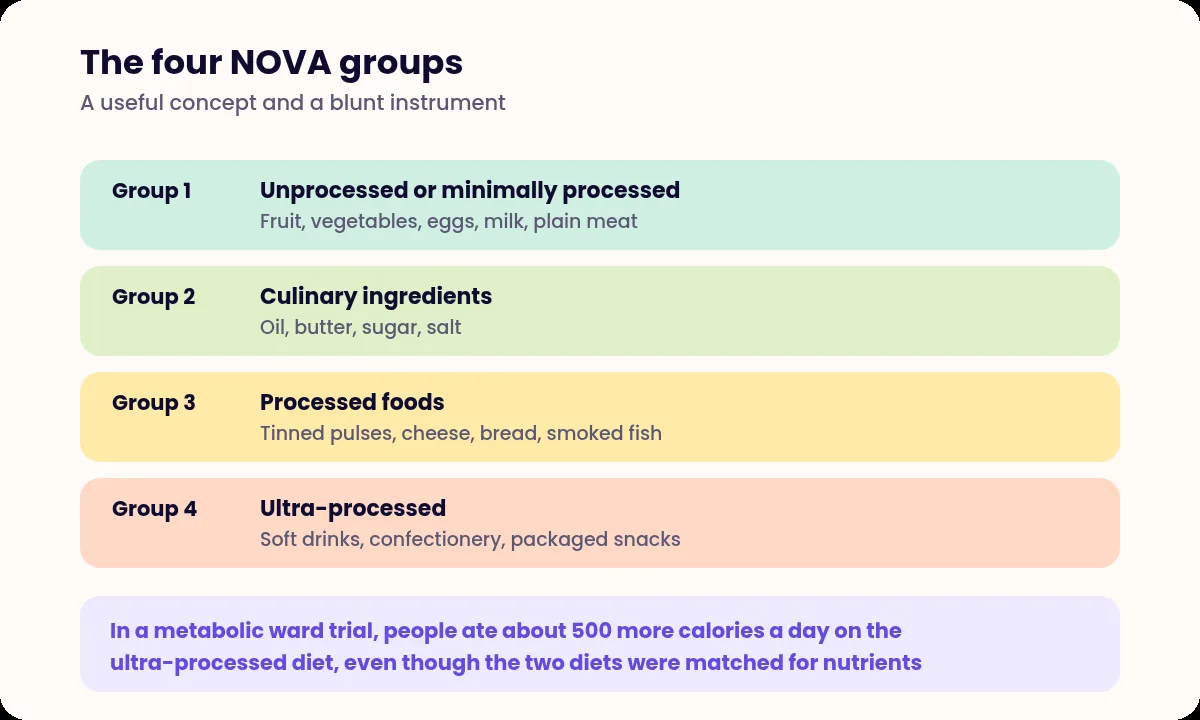
The NOVA classification sorts food into four groups by degree of processing, with group 4 being ultra-processed [2]. It is a useful concept and a blunt instrument.
Group 4 contains crisps, soft drinks, confectionery and reconstituted meat products. It also contains supermarket wholemeal bread, baked beans, most plain yoghurts with added fibre or sweetener, and some high-protein products. Grouping a sliced wholemeal loaf with a bag of sweets as equivalent risks is not obviously sound.
The UK’s Scientific Advisory Committee on Nutrition reviewed the evidence and concluded that the observed associations are concerning, but that the NOVA classification’s limitations and the risk of confounding mean it does not currently support a specific recommendation beyond existing dietary guidance [4].
What is probably doing the work
Rather than “processed”, the useful characteristics are:
Energy density. Calories per gram. Ultra-processed foods are often twice as energy-dense as whole foods, so the same volume delivers far more energy.
Eating rate. Soft, low-fibre food is eaten faster. Fullness signals take about 20 minutes to arrive, so speed matters.
Low fibre and low protein. Both blunt appetite. Many UPFs are low in both relative to their calories.
Hyper-palatability. Specific combinations of fat, salt, sugar and texture that are engineered to be easy to keep eating.
Any of those can be addressed without learning a classification system.
What to actually do
Not “cut out UPF”. For most people that is unrealistic, ignores cost and time constraints, and includes foods that are perfectly fine.
More useful:
- Target the liquid calories first. Soft drinks and sweetened coffees are the clearest case.
- Reduce the categories that are both energy-dense and easy to overeat — crisps, confectionery, biscuits, pastries. Not eliminate; reduce the frequency and the default availability.
- Add fibre and protein rather than subtracting. See fibre and weight loss.
- Keep the useful processed foods. Tinned pulses, frozen vegetables, plain yoghurt, tinned fish, wholemeal bread. Cheap, convenient, and part of a good diet.
- Slow down. A meal that takes 20 minutes rather than 8 ends differently.
A note about cost
Advice to cook everything from scratch assumes time, equipment, skill and money. Ultra-processed food is disproportionately eaten by people with less of all four, and telling them to stop is not a plan. Adding a tin of beans and a bag of frozen vegetables to what is already being cooked is.
When to speak to a clinician
Speak to a GP or dietitian if you:
- are finding it hard to afford or prepare food and it is affecting what you eat
- have a diagnosed condition requiring a specific diet
- feel a loss of control around particular foods, or eat in secret
- are considering a very restrictive elimination diet
Difficulty controlling eating is common and treatable, and it is worth raising rather than managing alone.
Frequently asked questions
What counts as ultra-processed food?
Under the NOVA classification, ultra-processed foods are industrial formulations made mostly from substances extracted from foods plus additives, typically with ingredients you would not find in a home kitchen. Examples include many packaged snacks, soft drinks, reconstituted meat products and mass-produced breads.
Does ultra-processed food cause weight gain?
A controlled inpatient trial found people ate about 500 more calories a day on an ultra-processed diet matched for nutrients, and gained around 0.9 kg over two weeks, while losing weight on the unprocessed diet. That is strong evidence of an effect, from a small study of 20 people.
Is all processed food bad?
No. Processing covers everything from freezing peas to making crisps. Tinned beans, frozen vegetables, plain yoghurt and wholemeal bread are processed and are perfectly good foods. The concern is with a specific subset.
How much UPF do people in the UK eat?
Estimates commonly put it around half of total energy intake for the average UK adult, and higher in younger people and in lower-income households.
References
- Hall KD, Ayuketah A, Brychta R, et al. Ultra-processed diets cause excess calorie intake and weight gain: an inpatient randomized controlled trial of ad libitum food intake. Cell Metabolism. 2019;30(1):67-77. doi.org/10.1016/j.cmet.2019.05.008
- Monteiro CA, Cannon G, Levy RB, et al. Ultra-processed foods: what they are and how to identify them. Public Health Nutrition. 2019;22(5):936-941. doi.org/10.1017/S1368980018003762
- Rauber F, Steele EM, Louzada MLC, Millett C, Monteiro CA, Levy RB. Ultra-processed food consumption and indicators of obesity in the United Kingdom population. PLoS One. 2020;15(5):e0232676. doi.org/10.1371/journal.pone.0232676
- Scientific Advisory Committee on Nutrition. SACN statement on processed foods and health. 2023. www.gov.uk/government/publications/sacn-statement-on-processed-foods-a
Medical reviewer
Naeem Teni
Clinical Lead at Manova. Registered pharmacist and independent prescriber, GPhC 2215591. Reviews Manova’s clinical content for accuracy and safety.
Written by
Manova Editorial Team
Researched and written to our editorial policy, using NICE, NHS, MHRA and peer-reviewed sources.
This article is for general information and isn’t a substitute for advice from your own clinician. If you feel unwell, contact your GP or NHS 111. In an emergency, call 999.