
Key takeaways
- Keep your waist to less than half your height. That is the whole rule, and it applies to adults of every ethnicity.
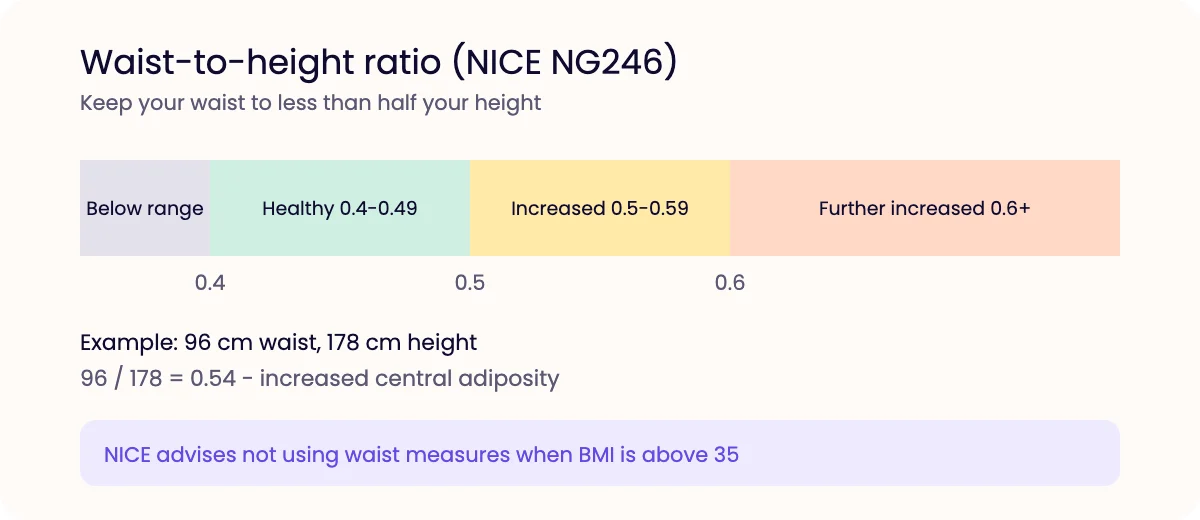
- NICE bands the ratio at 0.4–0.49 (healthy), 0.5–0.59 (increased risk) and 0.6 or above (further increased risk).
- It is designed to sit alongside BMI, not replace it — and NICE advises against using waist measures when BMI is above 35.
- Measure halfway between the bottom of your ribs and the top of your hips, breathing out normally. Not where your trousers sit.
There’s a health check that takes half a minute, costs nothing, needs no appointment, and tells you something the bathroom scales can’t. All it needs is a tape measure and the ability to halve a number.
Keep your waist to less than half your height. That’s it. That’s the rule.
Why where fat sits matters
Two people can weigh the same and carry that weight completely differently. Fat stored under the skin on hips and thighs behaves quite differently from fat packed around the organs inside the abdomen. The deeper sort is metabolically active, and it’s the pattern most strongly linked to type 2 diabetes, high blood pressure and heart disease.
BMI can’t see any of this. It’s a ratio of weight to height, so a rugby player and someone carrying a lot of abdominal fat can land in the same category. Waist-to-height ratio gets at the distribution, and in UK population data a simple 0.5 cut-off predicted early health risk at least as well as more complicated matrices combining BMI and waist size [3].
The UK thresholds
NICE’s 2025 guideline on overweight and obesity management sets out the bands for adults [1]:
| Waist-to-height ratio | What it means |
|---|---|
| 0.4 to 0.49 | Healthy central adiposity — no increased risk from this measure |
| 0.5 to 0.59 | Increased central adiposity, increased health risk |
| 0.6 or above | High central adiposity, further increased health risk |
NICE’s own plain-English version of the advice is to keep your waist to less than half your height, and the NHS has a calculator that does the sum for you [2].
Three things are worth knowing about how this is meant to be used:
It sits alongside BMI, not instead of it. NICE recommends measuring waist-to-height ratio as well as BMI in adults whose BMI is below 35.
Above a BMI of 35, don’t bother. Waist measurements become less accurate at higher BMIs and add little, so NICE advises against using them there.
The bands are the same for everyone. Unlike BMI, where NICE sets lower thresholds — overweight from 23 and obesity from 27.5 — for people of South Asian, Chinese, other Asian, Middle Eastern, Black African or African-Caribbean family background [5], the waist-to-height bands apply across all ethnic groups. Half your height is half your height.
How to measure, properly
This is where most people go wrong, usually by measuring where their trousers sit, which is generally somewhere more flattering than the right spot [4].
- Find the bottom of your ribs and the top of your hips.
- Wrap the tape around your middle at the halfway point between them — for most people, roughly level with the navel, but find the landmarks rather than assuming.
- Keep the tape snug but not digging in, and level all the way round.
- Breathe out normally. Don’t hold your breath, and don’t hold your stomach in.
- Measure against skin or one thin layer, not over a jumper.
Then divide by your height in the same units. A 96 cm waist and a 178 cm height gives 96 ÷ 178 = 0.54.
Do it at the same time of day
Waist measurement drifts a little through the day with meals and bloating. First thing in the morning, before breakfast, is the most consistent. As with weighing yourself, the trend over weeks is more useful than any single reading.
What to do if you’re over 0.5
Nothing about a number above 0.5 is a diagnosis. It’s a prompt.
It responds well to change. Abdominal fat is often the first to shift when people improve their diet and activity, which means the tape measure frequently moves before the scales do — a genuinely useful thing when you’re weeks into an effort and feeling like nothing’s happening.
The changes that help are unglamorous. Cutting liquid calories and ultra-processed snacks, getting protein and fibre at each meal, walking more, and strength training twice a week. There’s no exercise that targets abdominal fat specifically; sit-ups build the muscle underneath and leave the fat where it is.
Get the rest of the picture checked. If your ratio is 0.5 or above, it’s reasonable to ask your GP or pharmacist about a blood pressure check, a cholesterol test and an HbA1c (blood sugar) test, particularly if there’s type 2 diabetes or heart disease in your family. Those numbers tell you what the waist measurement is hinting at.
The one-line version
Take a tape measure. Halve your height. If your waist is under that, this particular measure says you’re fine. If it isn’t, you’ve learned something useful in thirty seconds, and it’s a number that tends to move when you start making changes.
Frequently asked questions
What is a healthy waist-to-height ratio?
Between 0.4 and 0.49. That means your waist measures less than half your height. NICE treats 0.5 to 0.59 as increased central adiposity and increased health risk, and 0.6 or above as further increased risk.
How do I measure my waist correctly?
Find the bottom of your ribs and the top of your hips, and measure around your middle at the halfway point between them. Keep the tape snug but not digging in, breathe out normally and don't hold your stomach in. Measure against skin or a thin layer, not over a jumper.
Is waist-to-height ratio better than BMI?
It answers a different question. BMI tells you about total weight relative to height; waist-to-height tells you about where fat sits, and fat around the middle carries more metabolic risk. NICE recommends using both in adults with a BMI below 35.
Does the 0.5 rule apply to children?
NICE applies the same bands to children and young people from the age of five, for both sexes and all ethnic groups. Some researchers have questioned how well the single cut-off performs in adolescents specifically, so a growing teenager's measurement is best interpreted by a clinician rather than on its own.
Why doesn't it work above a BMI of 35?
At higher BMIs, waist measurement becomes less accurate and adds little to what BMI already tells you, so NICE advises not measuring waist above that point and assessing risk another way.
References
- National Institute for Health and Care Excellence. Overweight and obesity management (NG246), section 1.9: Identifying and assessing overweight, obesity and central adiposity. Published 14 January 2025. www.nice.org.uk/guidance/ng246/chapter/Identifying-and-assessing-overw
- NHS. Calculate your waist-to-height ratio. Page last reviewed 25 February 2025. www.nhs.uk/health-assessment-tools/calculate-your-waist-to-height-rati
- Ashwell M, Gibson S. Waist-to-height ratio as an indicator of early health risk: simpler and more predictive than using a matrix based on BMI and waist circumference. BMJ Open. 2016;6(3):e010159. doi.org/10.1136/bmjopen-2015-010159
- British Heart Foundation. How to measure your waist. Last updated October 2024. www.bhf.org.uk/informationsupport/heart-matters-magazine/medical/measu
- National Institute for Health and Care Excellence. Overweight and obesity management (NG246), recommendation 1.9.11: lower BMI thresholds for some ethnic groups. www.nice.org.uk/guidance/ng246/chapter/Identifying-and-assessing-overw
- NHS. High cholesterol and cardiovascular disease risk. www.nhs.uk/conditions/high-cholesterol/
Medical reviewer
Naeem Teni
Clinical Lead at Manova. Registered pharmacist and independent prescriber, GPhC 2215591. Reviews Manova’s clinical content for accuracy and safety.
Written by
Manova Editorial Team
Researched and written to our editorial policy, using NICE, NHS, MHRA and peer-reviewed sources.
This article is for general information and isn’t a substitute for advice from your own clinician. If you feel unwell, contact your GP or NHS 111. In an emergency, call 999.