

Key takeaways
- UK guidelines ask for 150 minutes of moderate activity a week, plus strengthening twice a week — not a step count.
- Large cohort analyses show mortality risk falling as daily steps rise, with meaningful benefit appearing well below 10,000.
- Walking is a weak lever for burning calories and a strong one for appetite, mood, adherence and cardiovascular health.
- The 10,000 figure came from a 1960s Japanese pedometer marketing campaign, not from research.
The 10,000-step target has a specific origin, and it is not a laboratory. In the run-up to the 1964 Tokyo Olympics a Japanese company launched a pedometer called the manpo-kei — literally “10,000-step meter”. The number was chosen because it was memorable and because the character for 10,000 looks like a walking figure.
Sixty years later it is the default fitness goal of the English-speaking world. The research since has been kinder to it than it deserves, and also more interesting.
What the guidelines actually ask for
UK Chief Medical Officers’ guidelines do not mention steps at all. For adults aged 19 to 64 they ask for at least 150 minutes of moderate intensity activity a week, or 75 minutes of vigorous activity, plus muscle-strengthening activities on at least two days a week [1].
Brisk walking counts as moderate intensity. One hundred and fifty minutes is about 22 minutes a day, or three 50-minute walks a week.
What the step research shows
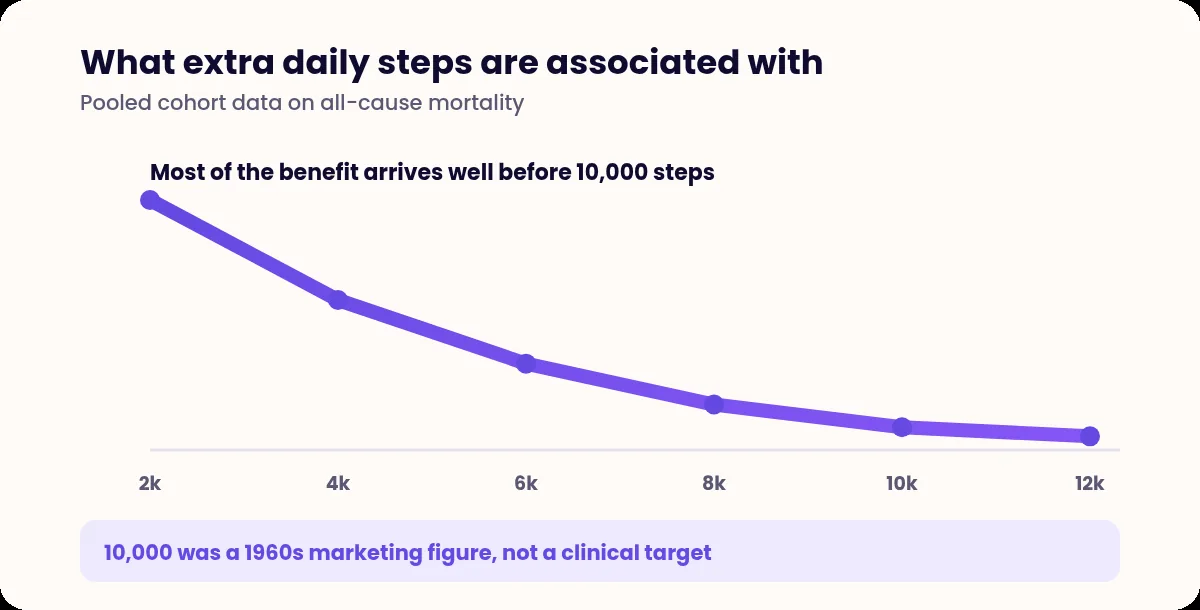
Large pooled analyses of cohort studies have looked at daily step counts against death rates, and the shape of the relationship is consistent: risk falls as steps rise, steeply at first and then more gently [2][3].
Three things follow from that shape.
The biggest gains are at the bottom. Going from very sedentary — 2,000 or 3,000 steps a day — to 5,000 or 6,000 produces a larger fall in risk than going from 8,000 to 12,000. If you are starting low, the first improvement is the valuable one.
Benefit appears well before 10,000. Meaningful reductions in risk appear in the 5,000 to 8,000 range. Ten thousand is not a threshold you must cross for anything to count.
More still helps, but with diminishing returns. The curve keeps going down; it just flattens.
The awkward truth about walking and weight
Walking is excellent for health and mediocre for calorie burning.
A rough figure is 40 to 50 kcal per 1,000 steps for an average adult, varying with body weight and pace. Ten thousand steps is therefore around 400 to 500 kcal — genuinely useful, and roughly equal to a large coffee and a pastry.
Two cautions follow. Do not eat the steps back: our guide to why the scales stall covers the research showing wrist-worn trackers overestimate energy expenditure substantially [5]. And do not expect walking alone to produce weight loss while eating is unchanged — the arithmetic rarely works.
Why walk anyway
Because the calorie count is the least interesting benefit.
It is the easiest activity to sustain. No membership, no kit, no learning curve, and the dropout rate is a fraction of structured exercise programmes.
It regulates appetite rather than stoking it. Unlike very hard exercise, walking does not tend to leave people ravenous.
Post-meal walks blunt blood glucose. A short walk after eating reduces the spike, which matters for anyone with prediabetes or type 2 diabetes.
It improves mood and sleep, both of which affect eating behaviour more than people credit.
It protects the loss you already have. Studies of people who have kept weight off long-term consistently find high levels of daily activity, most of it walking.
Making it happen
- Add 1,000 steps to your current average, not to someone else’s target. Check what you actually do for a week first.
- Attach it to something fixed — a walk after lunch, a stop earlier on the commute, a call taken on the move.
- Ten minutes three times beats an hour you never find.
- Walk after the biggest meal of the day, which is where the blood glucose benefit concentrates.
- Count the trend, not the day. A weekly average is far more informative than a daily number.
When to speak to a clinician
Speak to your GP before substantially increasing activity if you have a heart condition, chest pain on exertion, or breathlessness that is new. Walking is safe for almost everyone, but new exertional symptoms should be assessed rather than walked through.
Frequently asked questions
How many steps a day should I walk to lose weight?
There is no step count that causes weight loss on its own. In the research on health outcomes, risk falls progressively as steps rise, with clear benefit appearing in the 5,000 to 8,000 range and continuing above it. For weight specifically, what you eat does more of the work.
Is 10,000 steps a real target?
It originated as a marketing name for a Japanese pedometer in the 1960s, not from a study. It is a reasonable round number and there is nothing wrong with aiming for it, but there is no evidence of a threshold effect at exactly 10,000.
How many calories does walking burn?
Roughly 40 to 50 kcal per 1,000 steps for an average adult, varying with body weight and pace. That means 10,000 steps is around 400 to 500 kcal — real, but easily cancelled out by a modest snack, which is why walking works better alongside dietary change than instead of it.
Is walking as good as the gym?
For cardiovascular health and daily energy expenditure it is genuinely useful and far easier to sustain. It does not build or preserve muscle, which matters during weight loss, so it complements resistance training rather than replacing it.
Does walking after meals help?
Short walks after eating have been shown to reduce the rise in blood glucose after a meal. It is a small, easy habit with a measurable effect.
References
- Department of Health and Social Care. UK Chief Medical Officers' physical activity guidelines. Updated 10 July 2026. www.gov.uk/government/publications/physical-activity-guidelines-uk-chi
- Paluch AE, Bajpai S, Bassett DR, et al. Daily steps and all-cause mortality: a meta-analysis of 15 international cohorts. The Lancet Public Health. 2022;7(3):e219-e228. doi.org/10.1016/S2468-2667(21)00302-9
- Stens NA, Bakker EA, Manas A, et al. Relationship of daily step counts to all-cause mortality and cardiovascular events. Journal of the American College of Cardiology. 2023;82(15):1483-1494. doi.org/10.1016/j.jacc.2023.07.029
- NHS. Walking for health. www.nhs.uk/live-well/exercise/walking-for-health/
- Shcherbina A, Mattsson CM, Waggott D, et al. Accuracy in wrist-worn, sensor-based measurements of heart rate and energy expenditure in a diverse cohort. Journal of Personalized Medicine. 2017;7(2):3. doi.org/10.3390/jpm7020003
- NHS. Physical activity guidelines for adults aged 19 to 64. www.nhs.uk/live-well/exercise/exercise-guidelines/physical-activity-gu
Medical reviewer
Naeem Teni
Clinical Lead at Manova. Registered pharmacist and independent prescriber, GPhC 2215591. Reviews Manova’s clinical content for accuracy and safety.
Written by
Manova Editorial Team
Researched and written to our editorial policy, using NICE, NHS, MHRA and peer-reviewed sources.
This article is for general information and isn’t a substitute for advice from your own clinician. If you feel unwell, contact your GP or NHS 111. In an emergency, call 999.