

Key takeaways
- The MHRA approved a single-dose 7.2 mg semaglutide (Wegovy) pen on 14 April 2026, for adults with a BMI of 30 kg/m² or above.
- The higher maximum dose itself was authorised earlier in 2026; before the single pen, reaching it meant three separate 2.4 mg injections on the same day.
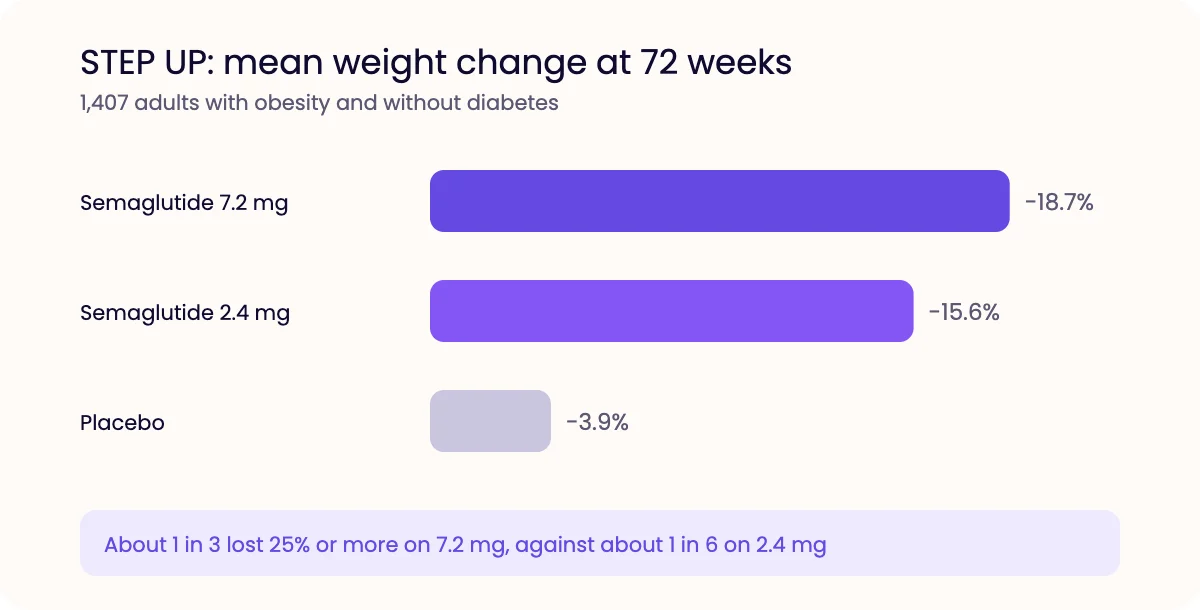
- In the STEP UP trial, mean weight loss at 72 weeks was 18.7% on 7.2 mg, 15.6% on 2.4 mg and 3.9% on placebo.
- Licensing is not the same as NHS availability. NHS access is set by NICE guidance, which appraised the 2.4 mg dose.
Semaglutide has been licensed in the UK for weight management at a maximum dose of 2.4 mg once weekly since 2021. In 2026 that ceiling moved.
This page sets out what was approved, what the trial behind it measured, and what the approval does and does not mean. It is information about a prescription-only medicine, not a recommendation, and it is not a substitute for advice from a prescriber who knows your history.
What the MHRA approved
On 14 April 2026 the MHRA approved a single-dose 7.2 mg semaglutide (Wegovy) pen for adults with obesity, defined in the announcement as a body mass index of 30 kg/m² or above [1].
Two points about that are easy to miss:
- The 7.2 mg maximum dose had been authorised earlier in 2026. Before the single-dose pen existed, reaching that dose meant administering three separate 2.4 mg injections on the same day. The April approval was about the delivery device as much as the dose.
- Treatment still starts at 0.25 mg once weekly, with gradual increases roughly every four weeks as prescribed [1]. Nobody begins at the top.
What the STEP UP trial found
The evidence submitted for the higher dose came principally from STEP UP, published in The Lancet Diabetes & Endocrinology in September 2025 [2].
Design. A randomised, double-blind, placebo-controlled phase 3b superiority trial in 1,407 adults with a BMI of 30 kg/m² or above and without diabetes, randomised 5:1:1 to semaglutide 7.2 mg (1,005 people), semaglutide 2.4 mg (201) or placebo (201), for 72 weeks, alongside lifestyle intervention.
Headline results at 72 weeks:
| Group | Mean weight change |
|---|---|
| Semaglutide 7.2 mg | −18.7% |
| Semaglutide 2.4 mg | −15.6% |
| Placebo | −3.9% |
The difference between 7.2 mg and both comparators was statistically significant. Around one in three people on 7.2 mg lost 25% or more of their body weight, compared with roughly one in six on 2.4 mg and none on placebo.
A companion trial, STEP UP T2D, studied the same doses in adults with obesity and type 2 diabetes, where weight loss was smaller in both arms — a pattern seen consistently with this class in people with diabetes [3].
Safety. The investigators described the higher dose as generally well tolerated. The most common adverse events were gastrointestinal — nausea and diarrhoea — along with sensory symptoms such as tingling, described as manageable and resolving over time. Exact rates by treatment arm are reported in the published paper.
What approval does not mean
It does not mean NHS availability. In England, NHS access to these medicines is governed by NICE technology appraisal guidance and local commissioning. NICE’s appraisal of semaglutide for weight management covers the 2.4 mg dose and predates this licence [5]. At the time of writing we are not aware of published NICE guidance specific to the 7.2 mg dose, so it should not be assumed to be available through the NHS.
It does not mean the higher dose is right for everyone. More weight loss on average does not mean more benefit for every individual. Tolerability, other conditions, other medicines and personal circumstances all bear on what dose, if any, is appropriate — which is a clinical judgement, not a consumer choice.
It does not change who the medicine is licensed for. The 7.2 mg approval covers adults with a BMI of 30 kg/m² or above.
Safety information
The full list of warnings, contraindications and side effects is in the Summary of Product Characteristics and patient information leaflet [4]. Current MHRA positions relevant to semaglutide include:
- Pancreatitis. Warnings were strengthened in January 2026 following reports of necrotising and fatal cases across this class of medicines. Severe, persistent abdominal pain needs urgent medical attention [6].
- NAION. In February 2026 the MHRA issued advice on a risk of non-arteritic anterior ischaemic optic neuropathy, a rare eye condition causing sudden loss of vision. Sudden visual disturbance should be assessed urgently [7].
- Anaesthesia and sedation. Delayed gastric emptying carries a risk of pulmonary aspiration during general anaesthesia or deep sedation. Tell any anaesthetist, surgeon or dentist that you take this medicine.
- Pregnancy and contraception. These medicines are not for use in pregnancy, and MHRA advice on effective contraception applies.
Suspected side effects can be reported through the MHRA Yellow Card scheme [8].
Where this information comes from
The regulatory position is taken from the MHRA’s own announcement, the trial results from the published Lancet Diabetes & Endocrinology papers, and the safety information from MHRA Drug Safety Updates and the product’s SmPC. This is a fast-moving area: licensing, supply and NICE guidance can all change, and the SmPC on the electronic Medicines Compendium is the current authority on any product’s licensed use.
Frequently asked questions
Is Wegovy 7.2 mg available in the UK?
The MHRA approved a single-dose 7.2 mg pen on 14 April 2026 for adults with obesity, defined as a BMI of 30 kg/m² or above. Regulatory approval and actual supply are separate things, so availability at any given time is a question for your prescriber or pharmacy.
How much more weight loss does 7.2 mg give than 2.4 mg?
In the STEP UP trial, mean weight loss at 72 weeks was 18.7% with 7.2 mg compared with 15.6% with 2.4 mg and 3.9% with placebo. Around a third of people on 7.2 mg lost 25% or more of their body weight, compared with about one in six on 2.4 mg.
Do you start on 7.2 mg?
No. The MHRA announcement describes starting at 0.25 mg once weekly, with the dose increased gradually every four weeks as prescribed. The escalation exists to manage side effects.
Is the higher dose available on the NHS?
NICE's technology appraisal for semaglutide in weight management covers the 2.4 mg dose and predates this licence. At the time of writing we are not aware of published NICE guidance specific to 7.2 mg, so NHS availability of the higher dose should not be assumed.
Are side effects worse at the higher dose?
The trial investigators described the 7.2 mg dose as generally well tolerated, with gastrointestinal effects such as nausea and diarrhoea the most common, alongside sensory symptoms such as tingling. Exact rates by dose are in the published paper, and any individual assessment is a matter for a prescriber.
References
- MHRA. Single-dose 7.2mg semaglutide (Wegovy) pen approved to treat adult patients with obesity. 14 April 2026. www.gov.uk/government/news/single-dose-72mg-semaglutide-wegovy-pen-app
- STEP UP trial. Semaglutide 7.2 mg in adults with obesity: a randomised, double-blind, placebo-controlled, phase 3b trial. The Lancet Diabetes & Endocrinology. Published online 14 September 2025. doi.org/10.1016/S2213-8587(25)00226-8
- STEP UP T2D trial. Semaglutide 7.2 mg in adults with obesity and type 2 diabetes. The Lancet Diabetes & Endocrinology. 2025. doi.org/10.1016/S2213-8587(25)00225-6
- Novo Nordisk Limited. Wegovy FlexTouch: Summary of Product Characteristics. Electronic Medicines Compendium. www.medicines.org.uk/emc/product/13803/smpc
- National Institute for Health and Care Excellence. Semaglutide for managing overweight and obesity (TA875). www.nice.org.uk/guidance/ta875/chapter/1-Recommendations
- MHRA. GLP-1 receptor agonists and dual GLP-1/GIP receptor agonists: strengthened warnings on acute pancreatitis, including necrotising and fatal cases. Drug Safety Update, 29 January 2026. www.gov.uk/drug-safety-update/glp-1-receptor-agonists-and-dual-glp-1-s
- MHRA. Semaglutide (Wegovy, Ozempic and Rybelsus): risk of non-arteritic anterior ischaemic optic neuropathy (NAION). Drug Safety Update, 5 February 2026. assets.publishing.service.gov.uk/media/69847cb7468d351e1406b4d2/DSU_-_
- MHRA. Yellow Card: report a suspected side effect. yellowcard.mhra.gov.uk/
Medical reviewer
Naeem Teni
Clinical Lead at Manova. Registered pharmacist and independent prescriber, GPhC 2215591. Reviews Manova’s clinical content for accuracy and safety.
Written by
Manova Editorial Team
Researched and written to our editorial policy, using NICE, NHS, MHRA and peer-reviewed sources.
This article is for general information and isn’t a substitute for advice from your own clinician. If you feel unwell, contact your GP or NHS 111. In an emergency, call 999.