

Key takeaways
- In women with PMOS, each 1% of body weight lost raised the odds of ovulating by about 5–6%.
- For IVF, obesity is associated with roughly a 15% relative reduction in live birth — and the effect was not significant in women without PCOS/PMOS.
- Weight loss in men with severe obesity improves sperm concentration, motility and DNA fragmentation.
- BMI limits for NHS-funded IVF are set by local commissioners, not by NICE.
This is a subject where accuracy matters more than usual, because the people reading it are often already anxious and have often been told something blunt in a short appointment.
Ovulation
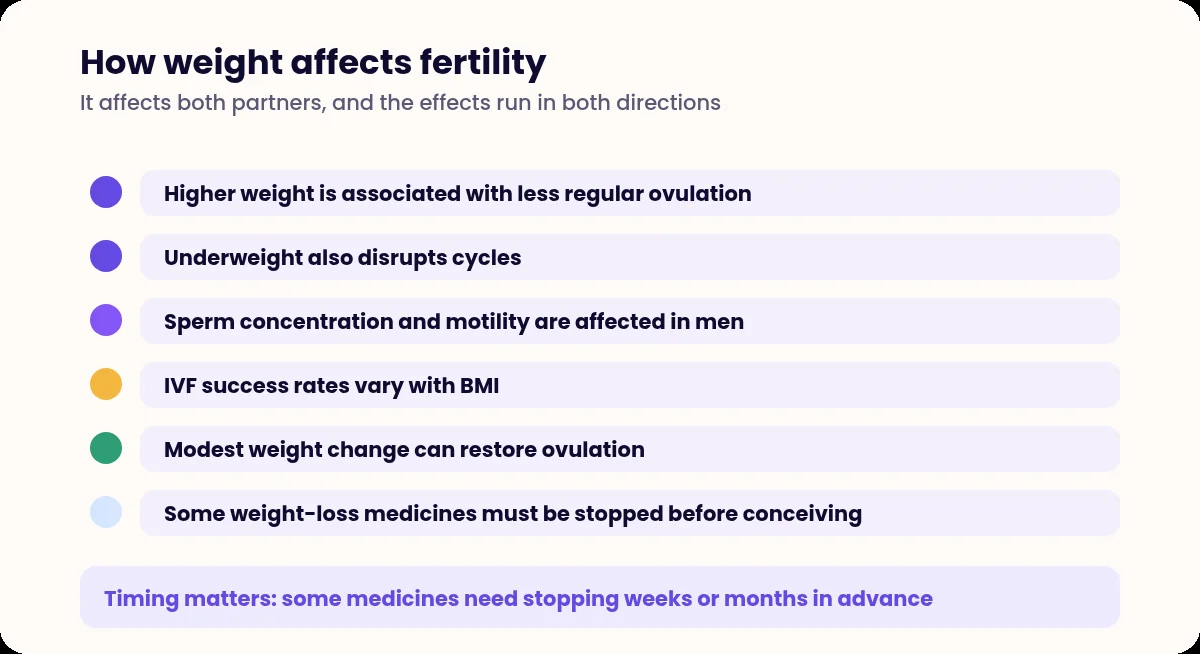
The clearest effect of weight on female fertility runs through ovulation, and it is most pronounced in PMOS — the condition renamed in 2026 from polycystic ovary syndrome.
The most useful UK data come from the BAMBINI trial. In women with PMOS, obesity and absent ovulation, each 1% of body weight lost was associated with a 5.6% increase in the odds of ovulatory recovery, with no threshold below which nothing happened [1].
That is a more encouraging framing than “lose 5% first”. Recovery rates were highest in the 10–15% weight-loss band, but the relationship was continuous throughout.
At the other end, being significantly underweight also disrupts ovulation. NICE advises that women with a BMI under 19 and irregular or absent periods are likely to benefit from gaining weight [4].
IVF: the claim that is overstated
A systematic review of 21 cohort studies covering 682,532 cycles found [2]:
- Obesity (BMI ≥30) vs normal weight: live birth relative risk 0.85 — about a 15% relative reduction
- Overweight (BMI 25–29.9) vs normal weight: RR 0.94
The crucial subgroup finding: the effect was driven almost entirely by women with PCOS/PMOS. In that group, RR 0.78. In women without it, RR 0.92 — not statistically significant.
So “obesity halves your IVF chances” is wrong, and in women without PMOS the pooled effect did not reach significance at all. That does not mean weight is irrelevant to fertility treatment — anaesthetic risk, egg collection technical difficulty and pregnancy complications all matter — but the live-birth figure is not what it is often presented as.
The NHS funding question
This is where most of the real-world pressure comes from, and it is worth being precise.
NICE does not set a BMI cap for NHS-funded IVF. CG156 advises informing women with a BMI of 30 or above that they are likely to take longer to conceive and that weight loss increases the chance [4]. That is clinical advice, not a funding rule.
The caps are set by integrated care boards. The Department of Health and Social Care’s own comparison states that most ICBs require a BMI between about 19 and 30 for the person conceiving [5]. Some use 30, some 35, and some apply criteria to partners too.
If you are up against a threshold, find your own ICB’s fertility policy rather than relying on a national figure. The variation is real, and so is the deadline pressure it creates.
Male fertility
Less discussed and genuinely relevant — roughly half of fertility problems involve a male factor.
Obesity is associated with lower total testosterone, and with poorer sperm concentration, motility and DNA integrity. A meta-analysis of 12 studies in men with a mean BMI of about 45 found that weight loss produced [3]:
- Increased sperm concentration
- Increased progressive motility
- Reduced sperm DNA fragmentation
Those men had severe obesity, so the findings should not be stretched to a BMI of 28. But the direction is consistent, and weight loss reliably raises testosterone in men with obesity.
Other male factors worth addressing at the same time: smoking, alcohol, anabolic steroid use — which suppresses sperm production, sometimes for many months — and heat exposure.
What to do, practically
Do not crash diet while trying to conceive. Very low calorie approaches are not appropriate in pregnancy, and pregnancy can happen sooner than expected once ovulation returns.
Do take folic acid, 400 micrograms daily before conception and for the first 12 weeks; a higher dose is advised in some circumstances, including a higher BMI in some guidance — check with your GP.
Note the medicine timings. If you take a weight-loss medicine, semaglutide should be stopped at least two months and tirzepatide at least one month before trying to conceive. Tirzepatide also reduces the absorption of oral contraception, so if you are not trying to conceive, additional cover is advised for four weeks after starting and after each dose increase.
Do not wait for a perfect number. Age is usually the bigger variable, and the ovulation data show benefit from the first kilogram rather than at a threshold.
When to speak to a clinician
Seek advice if you:
- have been trying to conceive for 12 months, or 6 months if you are over 35
- have irregular or absent periods
- have PMOS, or symptoms suggesting it
- have a BMI under 19 or over 30 and are planning a pregnancy
- take a weight-loss medicine and are planning a pregnancy
- are a man with low libido, erectile difficulties or a history of anabolic steroid use alongside fertility concerns
Both partners should be assessed. Investigating only one is a common and avoidable delay.
Frequently asked questions
Does being overweight stop you getting pregnant?
It can make conception take longer, mainly through effects on ovulation, and the effect is strongest in women with PMOS (formerly PCOS). Many women with a higher BMI conceive without difficulty.
Does obesity halve your chances of IVF success?
No. A meta-analysis of over 680,000 cycles found a relative risk for live birth of 0.85 comparing obesity with normal weight — about a 15% relative reduction. In women without PCOS, the effect was not statistically significant.
Is there a BMI limit for NHS IVF?
There is usually one, but it is set by your local integrated care board rather than by NICE. Most require a BMI between roughly 19 and 30, though the exact figure varies. Check your own ICB's fertility policy.
Does weight affect male fertility?
Yes. Obesity is associated with lower testosterone and poorer sperm parameters. In men with severe obesity, weight loss improved sperm concentration, progressive motility and DNA fragmentation.
References
- Post hoc analysis of the BAMBINI randomised controlled trial: weight loss and ovulatory recovery. Human Reproduction. 2026;41(5):809. academic.oup.com/humrep/article/41/5/809/8513300
- Sermondade N, Huberlant S, Bourhis-Lefebvre V, et al. Female obesity is negatively associated with live birth rate following IVF: a systematic review and meta-analysis. Human Reproduction Update. 2019;25(4):439-451. doi.org/10.1093/humupd/dmz011
- Effect of weight loss on semen parameters in men with obesity: meta-analysis. World Journal of Men's Health. 2025. pubmed.ncbi.nlm.nih.gov/39344112/
- NICE. Fertility problems: assessment and treatment. CG156. www.nice.org.uk/guidance/cg156
- Department of Health and Social Care. NHS-funded in vitro fertilisation (IVF) in England. www.gov.uk/government/publications/nhs-funded-ivf-in-england/nhs-funde
Medical reviewer
Naeem Teni
Clinical Lead at Manova. Registered pharmacist and independent prescriber, GPhC 2215591. Reviews Manova’s clinical content for accuracy and safety.
Written by
Manova Editorial Team
Researched and written to our editorial policy, using NICE, NHS, MHRA and peer-reviewed sources.
This article is for general information and isn’t a substitute for advice from your own clinician. If you feel unwell, contact your GP or NHS 111. In an emergency, call 999.