

Key takeaways
- Each kilogram lost reduces compressive force at the knee by roughly four kilograms per step.
- NICE treats therapeutic exercise and weight management as the core treatments for osteoarthritis.
- NICE states any amount of weight loss is likely to help, and 10% is likely to be better than 5%.
- In the IDEA trial, diet plus exercise beat either alone for pain and function.
Two things usually get said about weight and knees. One is a number that is repeated slightly wrongly. The other is a threshold that does not exist.
The number, correctly
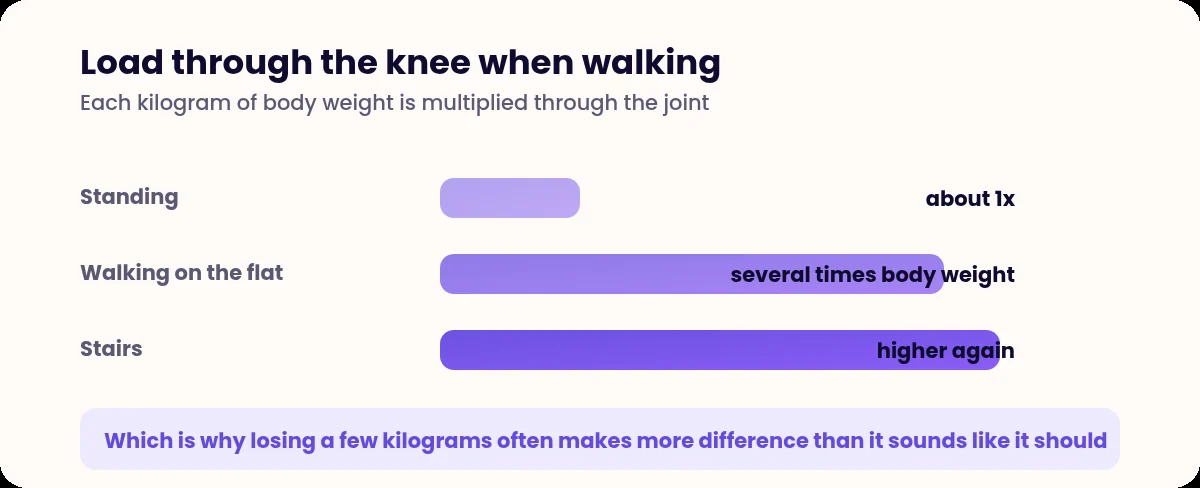
The original research measured compressive forces at the knee during walking. The finding: a weight reduction of about 1 kg was associated with a reduction of around 4 kg in compressive force at the knee [1] — the authors expressed it as a four-fold reduction in the load exerted on the knee per step.
The folk version — “every pound lost takes four pounds off your knees” — loses the crucial part. It is not about static body weight. It is about load per step, multiplied across thousands of steps a day.
Lose 10 kg and you remove roughly 40 kg of compressive force from every step you take. At 7,000 steps a day, that is a substantial change in cumulative load.
What NICE says
NICE treats osteoarthritis management as resting on two things. Recommendation 1.2.2 states that therapeutic exercise and weight management, if appropriate, are the core treatments, alongside information and support [3].
Not adjuncts. Core treatments, in the same sentence as each other.
On weight specifically, NICE advises clinicians to tell people with osteoarthritis living with overweight or obesity that [3]:
weight loss will improve their quality of life and physical function, and reduce pain
and to explain that any amount of weight loss is likely to be beneficial, but losing 10% of body weight is likely to be better than 5%.
That is a dose-response, explicitly. There is no threshold below which it does not count.
The trial worth knowing
IDEA randomised 454 adults aged 55 and over with knee osteoarthritis and a BMI of 27–41 to diet plus exercise, diet alone, or exercise alone, for 18 months [2].
| Weight lost | Knee pain (WOMAC, lower is better) | |
|---|---|---|
| Diet + exercise | 10.6 kg (11.4%) | 3.6 |
| Diet alone | 8.9 kg (9.5%) | 4.8 |
| Exercise alone | 1.8 kg (2.0%) | 4.7 |
Diet plus exercise also produced the best function scores and the best physical quality of life, and lower inflammatory markers.
Two lessons. Diet plus exercise beats either alone. And exercise alone produced almost no weight loss — 2% over 18 months — which is consistent with everything else we know about exercise and weight.
What exercise, when it hurts
The instinct is to rest the joint. The evidence points the other way: appropriate loading helps, and deconditioning makes it worse.
Strengthening, especially the quadriceps. The single most useful category. Seated leg extensions, sit-to-stands, wall sits, step-ups within a comfortable range.
Low-impact aerobic work. Water-based exercise is excellent — the buoyancy removes load while allowing movement. A static bike is the other reliable option.
Walking, built up gradually. Little and often beats one long walk at first.
Range of movement work daily, even in a flare.
A practical rule many physiotherapists use: pain during activity that settles within about 24 hours is acceptable. Pain that increases over days means you progressed too fast, not that you should stop.
If you are considering a knee replacement
Weight matters here in two ways. It affects surgical risk and technical difficulty, and some services apply BMI thresholds — which, as with bariatric surgery, are usually local commissioning rules rather than clinical guidelines.
It is worth asking directly what the local policy is, and whether the threshold is absolute or a target to work towards with support.
When to speak to a clinician
See a GP or physiotherapist if you have:
- knee pain that limits what you can do, or wakes you at night
- a knee that locks, gives way, or cannot be straightened
- a hot, swollen, very painful joint, particularly with fever — this needs urgent assessment
- pain that has not improved with several weeks of exercise and simple pain relief
- had an injury with immediate swelling
Osteoarthritis is diagnosed clinically and usually does not need a scan to confirm. If you are told you need an X-ray before anything can be done, that is worth questioning.
Frequently asked questions
Does losing weight help knee pain?
Yes, and it is one of the better-evidenced interventions. NICE advises telling people with osteoarthritis and excess weight that weight loss will improve quality of life and physical function and reduce pain.
Is it true that 1 lb lost takes 4 lb off your knees?
The research finding is that around 1 kg of weight loss reduces compressive force at the knee by about 4 kg with each step. It is a load-per-step multiplier rather than a statement about static body weight — which, across thousands of steps a day, is a bigger deal than the folk version suggests.
How much do I need to lose before my knees improve?
There is no threshold. NICE says any amount of weight loss is likely to be beneficial, and that losing 10% of body weight is likely to be better than 5%. It is a dose-response, not a gate.
What exercise can I do if my knees hurt?
Water-based exercise, a static bike, seated or supported resistance work, and walking built up gradually. Progressive strengthening of the thigh muscles is particularly useful. Pain during activity that settles quickly afterwards is generally acceptable.
References
- Messier SP, Gutekunst DJ, Davis C, DeVita P. Weight loss reduces knee-joint loads in overweight and obese older adults with knee osteoarthritis. Arthritis & Rheumatism. 2005;52(7):2026-2032. doi.org/10.1002/art.21139
- Messier SP, Mihalko SL, Legault C, et al. Effects of intensive diet and exercise on knee joint loads, inflammation, and clinical outcomes among overweight and obese adults with knee osteoarthritis: the IDEA randomized clinical trial. JAMA. 2013;310(12):1263-1273. doi.org/10.1001/jama.2013.277669
- NICE. Osteoarthritis in over 16s: diagnosis and management. NG226. www.nice.org.uk/guidance/ng226
- Versus Arthritis. Osteoarthritis of the knee. versusarthritis.org/about-arthritis/conditions/osteoarthritis-of-the-k
Medical reviewer
Naeem Teni
Clinical Lead at Manova. Registered pharmacist and independent prescriber, GPhC 2215591. Reviews Manova’s clinical content for accuracy and safety.
Written by
Manova Editorial Team
Researched and written to our editorial policy, using NICE, NHS, MHRA and peer-reviewed sources.
This article is for general information and isn’t a substitute for advice from your own clinician. If you feel unwell, contact your GP or NHS 111. In an emergency, call 999.