

Key takeaways
- Metabolism is essentially stable from 20 to 60, so age explains less than people assume.
- NICE no longer recommends a 600 kcal deficit and takes no position on intermittent fasting.
- The pill does not cause significant weight gain; the depot injection is the exception.
- Eating late is not independently fattening, but it reliably changes how much you eat.
Some of these were true once. Some were never true. Two of them changed in the last eighteen months, which is why you will still find the old version almost everywhere.
1. “Your metabolism slows down after 40”
Energy expenditure, adjusted for body size and composition, is essentially stable from age 20 to 60, and only then starts declining at about 0.7% a year [1]. Midlife weight gain is mostly lost muscle, less incidental movement, worse sleep and more alcohol.
2. “NICE recommends a 600 calorie deficit”
It did. NG246 replaced the older guidance in January 2025 and dropped that recommendation. The current position is simply that energy intake should be below expenditure, by whatever method suits [2].
3. “The pill makes you put on weight”
UK guidance states there is no evidence that the combined pill, progestogen-only pill, implant or intrauterine contraception causes significant weight gain [3]. The depot injection is the genuine exception, particularly in women under 18 with a BMI of 30 or above.
4. “You must complete a specialist programme before weight-loss surgery”
NICE explicitly rejected this, describing it as an unjustified barrier not supported by the evidence. Where such a rule exists it is a local commissioning restriction, not clinical guidance [2].
5. “NICE recommends semaglutide from a BMI of 30”
It does not. NICE recommends semaglutide at BMI 35 or above with a weight-related condition, in a specialist service. The BMI 30 route applies to tirzepatide, with conditions, and to orlistat. The 30-and-27 figures people remember come from the marketing authorisation, which is broader than what the NHS funds [2].
6. “Treating an underactive thyroid makes the weight fall off”
In a cohort of adults starting levothyroxine for clear hypothyroidism, the median weight change was about zero, and only around half lost anything.
7. “Lose 5% and your periods will come back”
In women with PMOS, the relationship is continuous: each 1% of body weight lost raised the odds of ovulating by around 5–6%, with no threshold.
8. “Obesity halves your chances with IVF”
The pooled relative risk for live birth was 0.85 — about a 15% relative reduction — and in women without PCOS/PMOS the effect was not statistically significant.
9. “Exercise is how you lose weight”
The UK Chief Medical Officers put it plainly: diet is the important factor in weight management, and physical activity plays a supporting role [5]. Activity is, however, the strongest predictor of keeping weight off.
10. “Apple cider vinegar helps you lose weight”
The trial behind almost all the recent coverage was retracted by BMJ Group in September 2025 [4].
11. “Berberine is nature’s Ozempic”
Berberine is not a GLP-1 and does not work by the same mechanism. The weight-loss evidence is weak, and it has real drug interactions.
12. “You have to eat breakfast”
Eating breakfast shows up in maintenance cohorts, but as a marker of a consistent pattern rather than a requirement. If you are not hungry, forcing it achieves nothing.
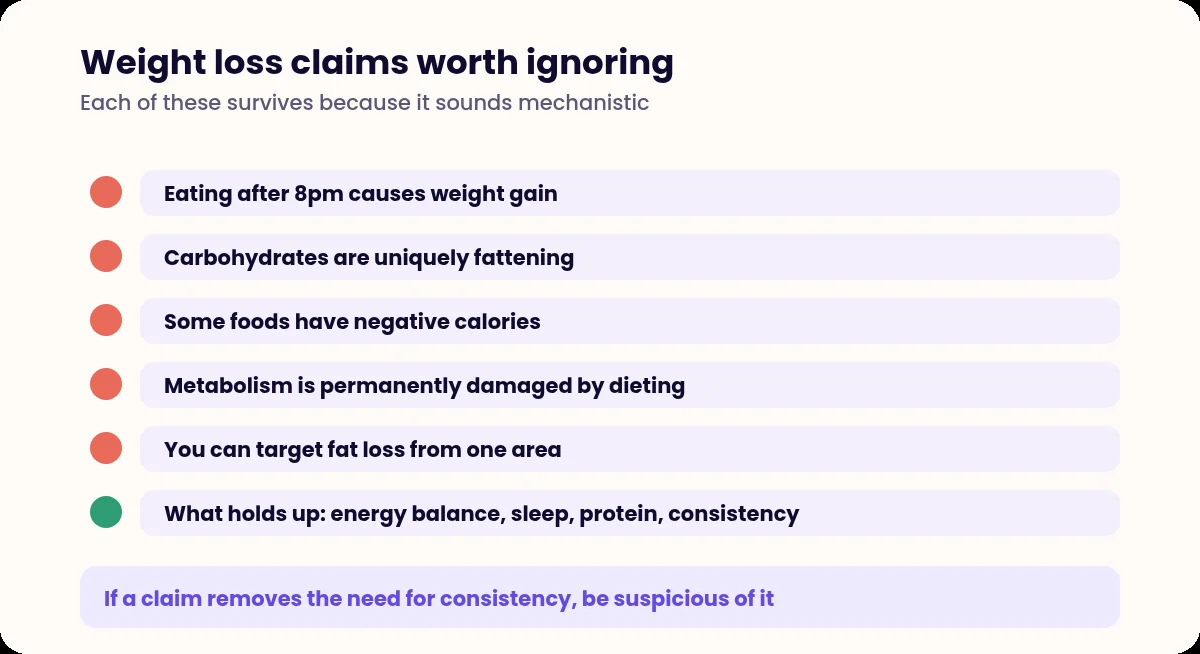
13. “Eating after 8pm makes you fat”
Not in itself. Total intake is what matters. But late eating is reliably associated with eating more overall and sleeping worse, so a cut-off often helps for practical reasons.
14. “You need to detox”
Your liver and kidneys do this continuously. No detox product, juice cleanse or tea has been shown to remove anything they are not already removing. Where these produce weight loss it is through eating very little for a few days, and it returns.
15. “Carbs make you fat” / “Fat makes you fat”
Head-to-head trials of a year or more find similar average weight loss between low-carbohydrate and low-fat approaches. Adherence predicts the result far better than the macronutrient split does.
The one that is true
Muscle does not weigh more than fat — a kilogram of each weighs a kilogram — but muscle is denser, so it takes up less space. Which is why two people at the same weight can be different sizes, and why the scales alone are a poor progress measure.
When to speak to a clinician
Speak to a clinician if you:
- have been told something about your weight that does not match what you are reading here and want it checked
- are losing weight without trying
- are eating at a genuine deficit and losing nothing over a month
- have symptoms suggesting thyroid disease, diabetes or sleep apnoea
- are considering a supplement or product and want to know whether it interacts with your medicines
Frequently asked questions
Does your metabolism slow down with age?
Much less than people think. A study of over 6,400 people found energy expenditure, adjusted for body composition, is essentially stable from age 20 to 60, then declines by about 0.7% a year.
Do you have to eat breakfast to lose weight?
No. Eating breakfast is associated with successful weight maintenance in cohort studies, but that is probably a marker of a consistent eating pattern rather than a requirement. Forcing breakfast if you are not hungry has no particular benefit.
Is eating after 8pm bad?
Not in itself. What matters is total intake. But late eating is associated with eating more overall and with worse sleep, so for many people a cut-off helps for practical reasons rather than metabolic ones.
Do you need to detox or cut out food groups?
No. There is no evidence that detox products or juice cleanses remove anything your liver and kidneys are not already removing. Cutting out entire food groups works only to the extent that it reduces total intake.
References
- Pontzer H, Yamada Y, Sagayama H, et al. Daily energy expenditure through the human life course. Science. 2021;373(6556):808-812. doi.org/10.1126/science.abe5017
- NICE. Overweight and obesity management. NG246. January 2025. www.nice.org.uk/guidance/ng246
- Faculty of Sexual and Reproductive Healthcare. CEU statement: contraception and weight gain. August 2019. www.fsrh.org/standards-and-guidance/
- BMJ Group retracts trial on apple cider vinegar and weight loss. September 2025. bmjgroup.com/bmj-group-retracts-trial-on-apple-cider-vinegar-and-weigh
- UK Chief Medical Officers. Physical activity guidelines. Updated 10 July 2026. www.gov.uk/government/publications/physical-activity-guidelines-uk-chi
Medical reviewer
Naeem Teni
Clinical Lead at Manova. Registered pharmacist and independent prescriber, GPhC 2215591. Reviews Manova’s clinical content for accuracy and safety.
Written by
Manova Editorial Team
Researched and written to our editorial policy, using NICE, NHS, MHRA and peer-reviewed sources.
This article is for general information and isn’t a substitute for advice from your own clinician. If you feel unwell, contact your GP or NHS 111. In an emergency, call 999.