
Key takeaways
- Excess weight lowers circulating testosterone, largely by reducing the protein that carries it in the blood.
- In men with simple obesity and normal pituitary hormones, this is a consequence of the weight rather than a failure of the testicles.
- Weight loss raises testosterone, and the more weight lost the larger the rise.
- Testosterone therapy is not a treatment for obesity-related low testosterone, and is not a weight-loss treatment.
A man in his forties notices his energy has gone, his sex drive with it, and the middle of him has thickened. He reads about testosterone, orders a private test, and finds his number is low. The conclusion seems obvious.
It usually isn’t, and the order of cause and effect matters enormously for what to do next.
What excess weight does to testosterone
Most testosterone in the blood is bound to a carrier protein called sex hormone binding globulin (SHBG). A clinical review in the Journal of Clinical Endocrinology and Metabolism sets out the mechanism plainly: in most men with simple obesity, the mild to moderate reduction in serum testosterone is mediated through lowered SHBG, driven by the metabolic changes that come with excess fat — raised insulin, raised triglycerides and fat in the liver [1].
The tell is what the pituitary hormones are doing. In men with obesity-related low testosterone, LH and FSH are typically normal — the review describes this as a “eugonadal state”. The testicles are being told to work and are working. The measured number is low because the carrier protein is low.
That is a different situation from pathological hypogonadism, where the signalling system itself has failed.
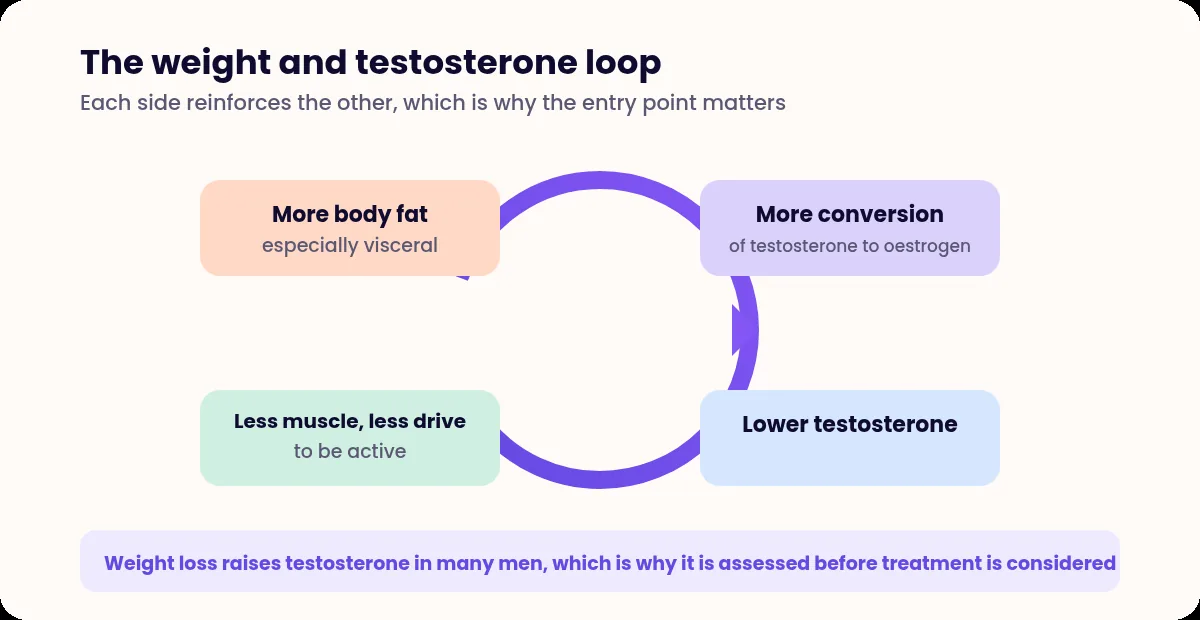
The loop that keeps it going
Fat tissue contains aromatase, an enzyme that converts testosterone into oestradiol. More fat tissue means more conversion. Lower testosterone makes it harder to hold muscle and easier to gain fat. More fat, more conversion.
It is a genuine feedback loop, and it explains why the problem tends to deepen quietly over years rather than arriving suddenly.
What weight loss does
A systematic review and meta-analysis in the European Journal of Endocrinology examined exactly this question and found that weight loss reverses obesity-associated low testosterone, with the size of the rise tracking the size of the weight loss — modest rises with diet-induced weight loss and substantially larger ones after bariatric surgery [2].
This is one of the clearer dose-response relationships in the area: lose more, recover more.
Why testosterone therapy is not the answer here
The 2025 clinical review is explicit: “Testosterone is not indicated for treatment of reduced serum testosterone concentrations in men with overweight and obesity, except where there is also pathological hypogonadism… weight loss is critical to restoring health” [1].
Three reasons that matters.
It treats the number, not the cause. The metabolic problems driving the low SHBG carry on.
It suppresses your own production. External testosterone switches off the signal from the pituitary, and the testicles reduce output accordingly. Coming off it afterwards is not always straightforward.
It reduces fertility. For men who may want children, this is the consequence that deserves the most attention, and the one least often mentioned by clinics selling it.
None of this means testosterone therapy is never appropriate. In genuine hypogonadism, with proper diagnosis and monitoring, it is an established treatment — prescribed against Society for Endocrinology guidance, with repeat morning blood tests, not on a single result from a home kit [3].
The other explanations for how you feel
Low energy, low mood and reduced libido are not specific to testosterone. Before concluding it is hormonal, the list worth ruling out includes: sleep apnoea, which is strongly linked to excess weight and wrecks sleep quality without waking you [6]; iron deficiency or anaemia; thyroid problems; depression; excess alcohol; poor sleep in general; and type 2 diabetes or prediabetes.
Most of these are simple blood tests and a conversation. All of them are more common than genuine hypogonadism.
What actually helps
Lose weight if you are carrying excess, particularly around the middle. This is the intervention with the clearest evidence in this specific situation.
Lift something heavy twice a week. UK guidelines recommend muscle-strengthening activity on at least two days a week [5]. Building muscle improves insulin sensitivity, which is upstream of the whole problem.
Fix your sleep. Short sleep lowers testosterone independently of weight, and sleep apnoea is common in men with a larger neck and waist.
Drink less. Alcohol affects testosterone production directly and adds calories that make the weight harder to shift.
When to speak to a clinician
See your GP if you have persistent fatigue, low mood, loss of libido or erection difficulties — not to demand a testosterone prescription, but to have the sensible things checked. If testosterone is measured, it should be a morning sample and repeated before any conclusion is drawn.
If you snore loudly and feel sleepy during the day, mention that specifically. Sleep apnoea is common, underdiagnosed, and treatable.
Frequently asked questions
Does being overweight lower testosterone?
Yes. In most men with simple obesity the reduction is mediated through lower sex hormone binding globulin, the protein that carries testosterone in the blood, driven by the metabolic changes that accompany excess weight.
Does losing weight increase testosterone?
The evidence says yes, in proportion to how much weight is lost. A systematic review found diet-induced weight loss raised total testosterone, with substantially larger rises after bariatric surgery where weight loss is greater.
Should I take testosterone if mine is low and I am overweight?
Clinical guidance is that testosterone is not indicated for reduced testosterone in men with overweight or obesity unless there is also genuine pathological hypogonadism. In that situation, weight loss is described as critical to restoring health.
Will testosterone help me lose weight?
It is not a weight-loss treatment and is not licensed as one. Testosterone therapy also suppresses the body's own production and can reduce fertility, which matters for younger men.
What are the symptoms of low testosterone?
Low energy, low mood, reduced sex drive, erection difficulties, loss of muscle and poor concentration — all of which have many other causes, which is why symptoms alone are not a diagnosis. Blood tests, taken in the morning and repeated, are needed.
References
- Muir A, Wittert G, Handelsman DJ. Approach to the patient: low testosterone concentrations in men with obesity. Journal of Clinical Endocrinology and Metabolism. 2025;110(9):e3125. academic.oup.com/jcem/article/110/9/e3125/8058933
- Corona G, Rastrelli G, Monami M, et al. Body weight loss reverts obesity-associated hypogonadotropic hypogonadism: a systematic review and meta-analysis. European Journal of Endocrinology. 2013;168(6):829-843. pubmed.ncbi.nlm.nih.gov/23482592/
- Jayasena CN, Anderson RA, Llahana S, et al. Society for Endocrinology guidelines for testosterone replacement therapy in male hypogonadism. Clinical Endocrinology. 2022. pubmed.ncbi.nlm.nih.gov/34811785/
- NHS. Tiredness and fatigue. www.nhs.uk/conditions/tiredness-and-fatigue/
- Department of Health and Social Care. UK Chief Medical Officers' physical activity guidelines. Updated 10 July 2026. www.gov.uk/government/collections/physical-activity-guidelines
- NHS. Sleep apnoea. www.nhs.uk/conditions/sleep-apnoea/
Medical reviewer
Naeem Teni
Clinical Lead at Manova. Registered pharmacist and independent prescriber, GPhC 2215591. Reviews Manova’s clinical content for accuracy and safety.
Written by
Manova Editorial Team
Researched and written to our editorial policy, using NICE, NHS, MHRA and peer-reviewed sources.
This article is for general information and isn’t a substitute for advice from your own clinician. If you feel unwell, contact your GP or NHS 111. In an emergency, call 999.