

Key takeaways
- In the UK product information, the formal contraindication for semaglutide is hypersensitivity to the medicine or its ingredients.
- A history of pancreatitis is a caution rather than an absolute bar — semaglutide has not been studied in those patients.
- Pregnancy and breastfeeding, severe gastrointestinal disease, and diabetic retinopathy on insulin all need specific discussion.
- The US labelling includes a thyroid tumour contraindication that the UK product information does not; if you have a family history of medullary thyroid cancer, raise it anyway.
People expect this list to be long and absolute. In the UK product information it is neither. What matters far more than a short list of formal bars is the much longer list of things that change the calculation — and the fact that a proper consultation is designed to surface them.
This page is information about prescription-only medicines. Only a prescriber who knows your history can decide what is appropriate for you.
The formal contraindication
The UK Summary of Product Characteristics for Wegovy lists a single contraindication [1]:
“Hypersensitivity to the active substance or to any of the excipients.”
That is genuinely it. There is no long list.
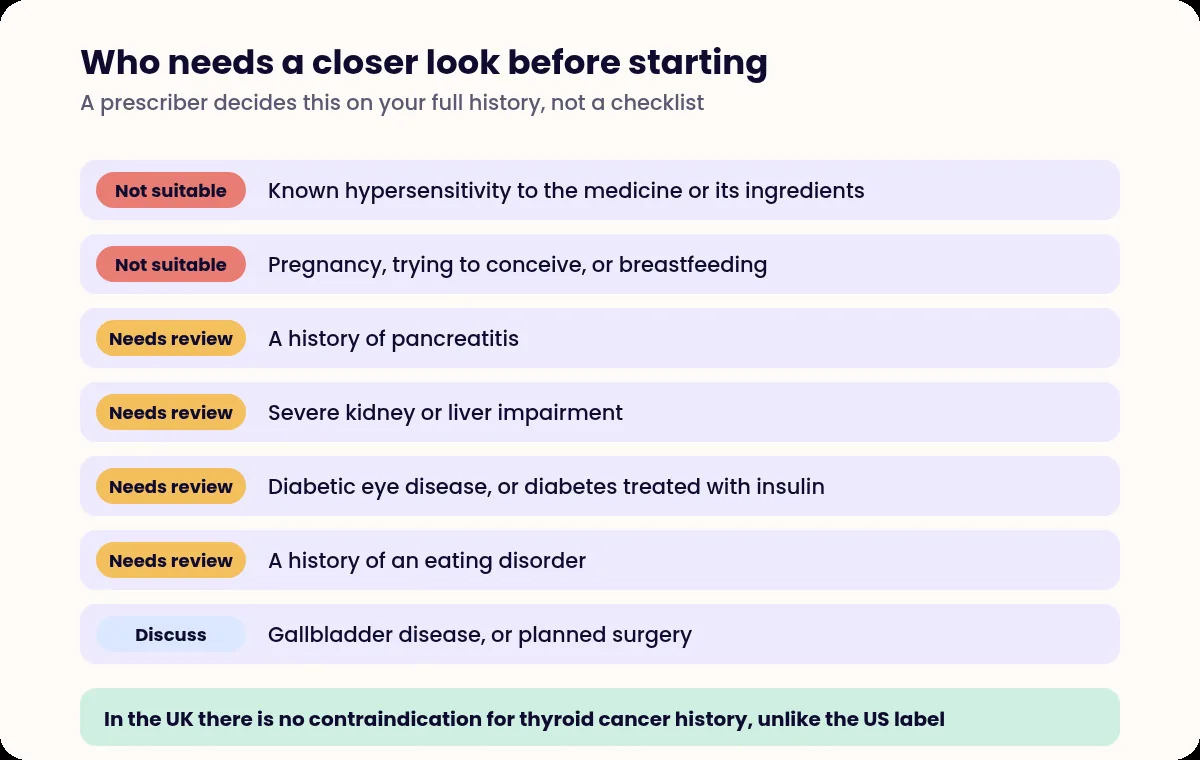
The things that need discussing first
These are cautions and warnings rather than absolute bars, and they are where an honest consultation earns its keep.
A history of pancreatitis. The semaglutide SmPC states it “has not been studied in patients with a history of pancreatitis, and should be used with caution in these patients” [1]. The MHRA strengthened class-wide pancreatitis warnings in January 2026 and advises that these medicines should not be restarted in anyone who develops confirmed pancreatitis on treatment [3].
Pregnancy or planning a pregnancy. These medicines are not for use in pregnancy. Semaglutide should be stopped at least two months, and tirzepatide at least one month, before a planned pregnancy [1][2].
Breastfeeding — and this one has changed. The semaglutide product information still advises against use while breastfeeding [1]. The tirzepatide product information, however, now states that it “could be considered for use during breast-feeding”, on the basis that concentrations in breast milk were undetectable to very low and that the molecule is an amino acid sequence unlikely to survive an infant’s digestion intact [2]. That is a clinician’s judgement rather than a green light, and it is a good example of why the leaflet for your specific medicine matters more than a general rule.
Severe gastrointestinal disease or gastroparesis. These medicines slow stomach emptying deliberately. In people whose stomach already empties poorly, that is not a side effect but an amplification of the problem. The SmPCs advise caution, and in severe cases the medicines are not recommended.
Diabetic retinopathy, if you use insulin. Rapid improvement in blood glucose can temporarily worsen diabetic eye disease. The SmPC notes an increased risk of retinopathy complications in people with diabetic retinopathy treated with insulin and semaglutide [1]. That means closer eye monitoring, not necessarily avoidance.
Insulin or a sulfonylurea. These do not become unsafe, but the risk of low blood sugar rises and doses often need reducing when a GLP-1 medicine is started [1][2].
Gallbladder problems. Gallstones are a recognised complication of rapid weight loss and are reported across this class.
Kidney problems. Vomiting and diarrhoea can cause dehydration, which in rare cases worsens kidney function [1].
Planned surgery or a procedure under sedation. In January 2025 the MHRA highlighted a risk of pulmonary aspiration during general anaesthesia or deep sedation because of delayed stomach emptying [5]. Tell any anaesthetist, surgeon, endoscopist or dentist that you take one.
Eye symptoms. In February 2026 the MHRA issued advice about a very rare association between semaglutide and NAION, which causes sudden loss of vision, usually in one eye. Sudden visual change needs urgent assessment [4].
The thyroid question
American labelling for these medicines carries a boxed warning about thyroid C-cell tumours seen in rodents, and contraindicates use in people with a personal or family history of medullary thyroid carcinoma or multiple endocrine neoplasia syndrome type 2.
The UK product information does not list that as a contraindication [1]. Regulators have reached different conclusions about how relevant the rodent findings are to humans.
The sensible position for a patient is straightforward: if you have a personal or family history of medullary thyroid cancer or MEN2, tell your prescriber. The difference between regulators is a reason to have the conversation, not to assume it does not matter.
Not licensed, not appropriate
- Under 18s, except liraglutide, which is licensed from 12 and belongs in specialist paediatric care
- Type 1 diabetes, for weight management
- Below the licensed BMI thresholds — a BMI of 30, or 27 with a weight-related condition (25 and 27.5 respectively where lower thresholds apply for some ethnic groups under NICE guidance)
- A current or recent eating disorder, which needs treatment in its own right
- Anyone whose history has not been properly assessed — which is the point of the consultation
The honest bit about online prescribing
A questionnaire that never says no is not a safety process. GPhC standards require that prescribing at a distance includes proper identity verification, checks on the information given, and the ability to refuse [6].
If a service has not asked about your medical history, your other medicines, pregnancy plans, or your weight and height in a way it can verify, the problem is not that you got through — it is that anyone would.
When to speak to a clinician
Before starting, if any of the above applies to you. Urgently, if you develop severe persistent abdominal pain, sudden vision changes, or cannot keep fluids down. Suspected side effects can be reported through the Yellow Card scheme [7].
Frequently asked questions
Who cannot take Wegovy or Mounjaro?
The formal contraindication in the UK product information is hypersensitivity to the active substance or excipients. Beyond that, they should not be used in pregnancy, and several conditions require caution and individual assessment rather than an automatic no. Breastfeeding advice now differs between products, so check the current leaflet for yours.
Can you take them if you have had pancreatitis?
The semaglutide product information says it has not been studied in people with a history of pancreatitis and should be used with caution in them. That is a conversation with a prescriber, not a decision to make yourself, and the MHRA advises not restarting these medicines in anyone who develops confirmed pancreatitis on treatment.
Is there a thyroid cancer warning in the UK?
US labelling carries a boxed warning about thyroid C-cell tumours based on rodent studies, and contraindicates use in people with a personal or family history of medullary thyroid carcinoma or MEN2. The UK product information does not list that as a contraindication. If it applies to you, tell your prescriber regardless.
What if I have type 1 diabetes?
These medicines are not licensed for weight management in type 1 diabetes and are not a substitute for insulin. Anyone with type 1 diabetes considering one needs specialist input.
Do I need to tell my prescriber about other medicines?
Yes, all of them. Delayed stomach emptying can change how other oral medicines are absorbed, and the risk of low blood sugar rises substantially if you also take insulin or a sulfonylurea.
References
- Novo Nordisk Limited. Wegovy: Summary of Product Characteristics, sections 4.3 and 4.4. Electronic Medicines Compendium. www.medicines.org.uk/emc/product/13803/smpc
- Eli Lilly and Company Limited. Mounjaro KwikPen: Summary of Product Characteristics. Electronic Medicines Compendium. www.medicines.org.uk/emc/product/15484/smpc
- MHRA. GLP-1 receptor agonists and dual GLP-1/GIP receptor agonists: strengthened warnings on acute pancreatitis. Drug Safety Update, 29 January 2026. www.gov.uk/drug-safety-update/glp-1-receptor-agonists-and-dual-glp-1-s
- MHRA. Semaglutide: risk of non-arteritic anterior ischaemic optic neuropathy (NAION). Drug Safety Update, 5 February 2026. assets.publishing.service.gov.uk/media/69847cb7468d351e1406b4d2/DSU_-_
- The Pharmaceutical Journal. MHRA warns of pulmonary aspiration risk for GLP-1 receptor agonists during general anaesthesia or deep sedation. 31 January 2025. pharmaceutical-journal.com/article/news/mhra-warns-of-pulmonary-aspira
- General Pharmaceutical Council. Guidance for registered pharmacies providing pharmacy services at a distance, including on the internet. www.pharmacyregulation.org/standards
- MHRA. Yellow Card: report a suspected side effect. yellowcard.mhra.gov.uk/
Medical reviewer
Naeem Teni
Clinical Lead at Manova. Registered pharmacist and independent prescriber, GPhC 2215591. Reviews Manova’s clinical content for accuracy and safety.
Written by
Manova Editorial Team
Researched and written to our editorial policy, using NICE, NHS, MHRA and peer-reviewed sources.
This article is for general information and isn’t a substitute for advice from your own clinician. If you feel unwell, contact your GP or NHS 111. In an emergency, call 999.