

Key takeaways
- A calorie deficit means taking in less energy than you use. It is the mechanism behind every diet that has ever worked, whatever it calls itself.
- The NHS suggests around a 600 kcal daily reduction as a safe, sustainable pace.
- The old '3,500 calories equals a pound' rule overestimates long-run weight loss, because your body needs less energy as it gets smaller.
- Counting is a tool, not the point. Most people under-record what they eat, so consistency matters more than precision.
Every diet that has ever worked, from cabbage soup to intermittent fasting to whatever is currently on TikTok, works for the same reason: it gets you eating less energy than you use. The packaging differs. The mechanism doesn’t.
That’s the easy part. The harder part is that the arithmetic everyone quotes is wrong in ways that matter.
What a calorie deficit actually is
Your body spends energy on three things: keeping you alive (the bulk of it), digesting food, and moving. Add those up and you get the energy you use in a day. Eat less than that and the shortfall comes out of your own stores, mostly fat.
For context, the UK’s estimated average requirement for energy is about 2,605 kcal a day for men and 2,079 for women at an average body size and activity level [1]. The rounded 2,500 and 2,000 figures you see on food labels come from a different, simplified convention — useful for labelling, not a personal prescription.
How big should the deficit be?
The NHS position is a reduction of around 600 kcal a day from what you currently need, which produces roughly the 0.5–1 kg a week that’s considered a sustainable pace [2].
That’s a deliberately moderate number, and the reasoning is sound:
- A deficit you can hold for six months beats a severe one you abandon in three weeks.
- Larger deficits increase the share of weight lost as muscle rather than fat.
- Very low intakes make it genuinely difficult to get enough protein, fibre, iron and calcium.
Why “3,500 calories equals a pound” is wrong
The rule goes: a pound of fat holds about 3,500 kcal, so a 500 kcal daily deficit loses a pound a week, every week, forever. Follow it for a year and you’d predict 52 lb of loss.
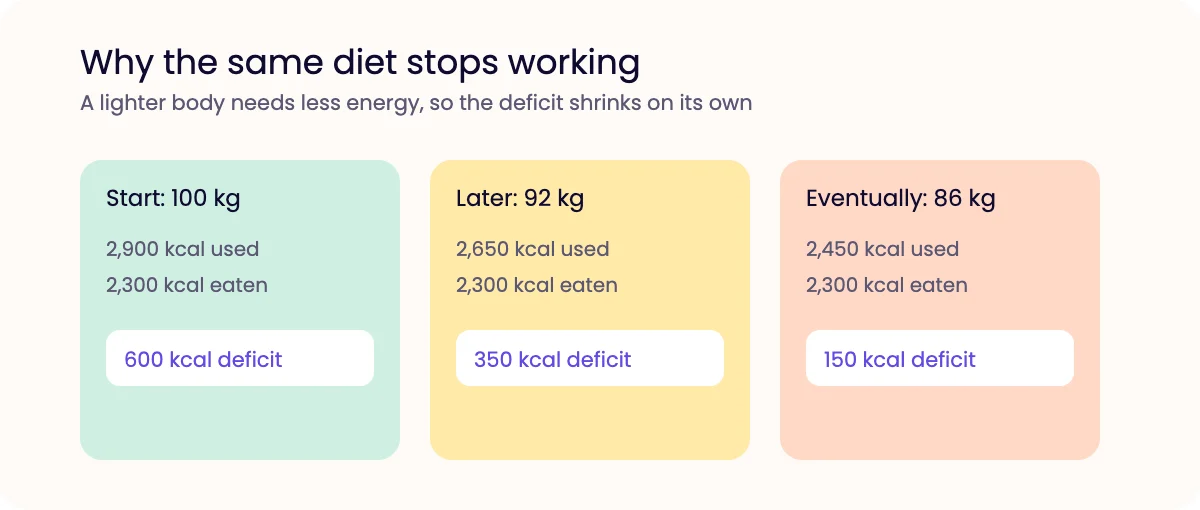
Nobody loses 52 lb that way, and the reason isn’t willpower. It’s that the target moves. As you get lighter you need less energy — less to maintain your tissue, less to move yourself around. The same food intake that created a 600 kcal deficit at the start creates a smaller one every month, until eventually it creates none at all and you settle at a new weight.
Mathematical models built from real metabolic data predict this curve accurately: fast loss at first, then a long flattening [3]. The static rule has been described in the obesity literature, bluntly, as wrong [4], and tools like the NIH Body Weight Planner exist specifically because the honest model needs a computer rather than a napkin [7].
There’s a second effect on top. After substantial weight loss, resting metabolic rate can fall by more than body size alone explains. In the well-known six-year follow-up of Biggest Loser contestants, resting metabolic rate was around 500 kcal a day below what their new body size predicted [6]. That study involved extreme, rapid loss and isn’t typical of ordinary weight loss, but it illustrates the direction of travel.
What this means in practice: expect progress to slow. Plan for it. It’s physiology, not failure.
The counting problem
Here’s the finding that ought to make everyone humble. When researchers compared what people reported eating with their actual energy expenditure measured by doubly-labelled water — the gold standard, and not something you can fool — people who described themselves as diet-resistant were substantially under-reporting their intake and over-reporting their exercise [5]. Not lying. Genuinely not seeing it.
The things that vanish from food diaries are consistent: cooking oil, the milk in coffees, tastes while cooking, the last of the children’s dinner, weekend drinks, portion sizes estimated by eye.
So if you count, count honestly for a fortnight to learn where your calories actually live, then stop worrying about the decimal places. If you don’t want to count at all, that’s a legitimate choice — the NHS says so explicitly [2].
Making a deficit without arithmetic
These work because they remove calories you weren’t enjoying much anyway:
- Drink your calories less. Juice, sugary coffees, alcohol and smoothies are easy to consume and don’t fill you up.
- Build meals around protein and vegetables. Both are filling per calorie. See our guide to how much protein you need.
- Fix the plate, not the portion. Half vegetables, a quarter protein, a quarter starch does most of the work automatically.
- Change the default snack. The bowl on the desk matters more than the one meal a month out.
- Walk more. Not because it burns much, but because daily movement is the easiest part of energy expenditure to increase and keep.
When the deficit isn’t working
If you’ve been consistent for a month and nothing has moved, the usual explanations are: the deficit is smaller than you think, water retention is masking fat loss, or the goalposts have shifted because you’ve already lost weight. Our guide to why the scales stop moving goes through the list properly.
If you’re gaining weight without a clear reason, or losing it without trying, that’s worth a conversation with your GP or a Manova clinician rather than a further cut to your food.
Frequently asked questions
How many calories should I eat to lose weight?
Rather than a fixed number, start from what you currently eat and reduce it by roughly 500–600 kcal a day. The NHS 12-week plan uses ceilings of about 1,900 kcal a day for men and 1,400 for women as one way of achieving that. If you are very tall, very active or starting from a high body weight, your maintenance level is higher and so is the number you should eat.
Is a 1,200 calorie diet safe?
Very low intakes are used clinically in some circumstances, but with supervision. Eating 1,200 kcal a day without support tends to be hard to sustain, makes it difficult to get enough protein and micronutrients, and is associated with more muscle loss. A smaller deficit you can keep to for months usually beats a severe one you abandon in three weeks.
Do I have to count calories to lose weight?
No. The NHS is explicit that calorie counting is not the only way. Portion control, changing what you drink, and building meals around protein, vegetables and fibre all create a deficit without arithmetic. Counting is useful mainly as a short-term education in where your calories actually come from.
Why has my weight loss slowed on the same calories?
Because a smaller body uses less energy. The deficit that worked at 100 kg is a smaller deficit at 90 kg, so progress naturally flattens. That is expected, not failure, and it is why the linear '3,500 kcal a pound, forever' assumption breaks down.
Does exercise create a deficit on its own?
It contributes, but it is a slower lever than most people expect, and fitness trackers overestimate calories burned substantially. Exercise earns its place for muscle, health and appetite regulation. What you eat generally does the heavier lifting on the deficit itself.
References
- Scientific Advisory Committee on Nutrition. Dietary Reference Values for Energy. 2011. assets.publishing.service.gov.uk/media/5a7edb37ed915d74e33f2d8f/SACN_D
- NHS Better Health. Calorie counting. www.nhs.uk/better-health/lose-weight/calorie-counting/
- Hall KD, Sacks G, Chandramohan D, et al. Quantification of the effect of energy imbalance on bodyweight. The Lancet. 2011;378(9793):826-837. doi.org/10.1016/S0140-6736(11)60812-X
- Thomas DM, Martin CK, Heymsfield S, Redman LM, Schoeller DA, Levine JA. Why is the 3500 kcal per pound weight loss rule wrong? International Journal of Obesity. 2013;37(12):1614. doi.org/10.1038/ijo.2013.112
- Lichtman SW, Pisarska K, Berman ER, et al. Discrepancy between self-reported and actual caloric intake and exercise in obese subjects. New England Journal of Medicine. 1992;327(27):1893-1898. doi.org/10.1056/NEJM199212313272701
- Fothergill E, Guo J, Howard L, et al. Persistent metabolic adaptation 6 years after 'The Biggest Loser' competition. Obesity. 2016;24(8):1612-1619. doi.org/10.1002/oby.21538
- National Institute of Diabetes and Digestive and Kidney Diseases. Body Weight Planner. www.niddk.nih.gov/bwp
Medical reviewer
Naeem Teni
Clinical Lead at Manova. Registered pharmacist and independent prescriber, GPhC 2215591. Reviews Manova’s clinical content for accuracy and safety.
Written by
Manova Editorial Team
Researched and written to our editorial policy, using NICE, NHS, MHRA and peer-reviewed sources.
This article is for general information and isn’t a substitute for advice from your own clinician. If you feel unwell, contact your GP or NHS 111. In an emergency, call 999.