

Key takeaways
- Food noise is the term for persistent, unwanted thoughts about food that people find intrusive or distressing.
- It entered the research literature recently — a 2025 paper in Nutrition & Diabetes set out a formal definition and research agenda.
- It is not the same as hunger, and it is not the same as an eating disorder, though it can overlap with both.
- The most useful non-drug approaches target the response to the thought rather than trying to suppress the thought itself.
You finish lunch. Within twenty minutes you’re thinking about what’s in the biscuit tin. Not because you’re hungry — you’ve just eaten — but because the thought has arrived, and it will keep arriving, and at some point in the afternoon you’ll stop arguing with it.
That background hum has acquired a name: food noise. It started as something people said to each other and to their clinicians, and in the last couple of years it has made its way into the research literature.
What researchers mean by it
A 2025 paper in Nutrition & Diabetes set out the first formal definition, describing food noise as persistent thoughts about food that the person perceives as unwanted or distressing, and which may cause social, mental or physical harm [1].
Three parts of that are doing work:
- Persistent. Not a passing thought about dinner, but a recurring one.
- Unwanted. The person doesn’t experience it as pleasant anticipation.
- Causing harm. It occupies attention, affects mood, and makes eating decisions harder.
The same paper traced how the term entered public use, noting that search interest in it rose sharply from late 2022 and peaked in spring 2024 — a fast journey from patient vocabulary to research topic.
Why it isn’t the same as hunger
This is the distinction that makes the concept useful.
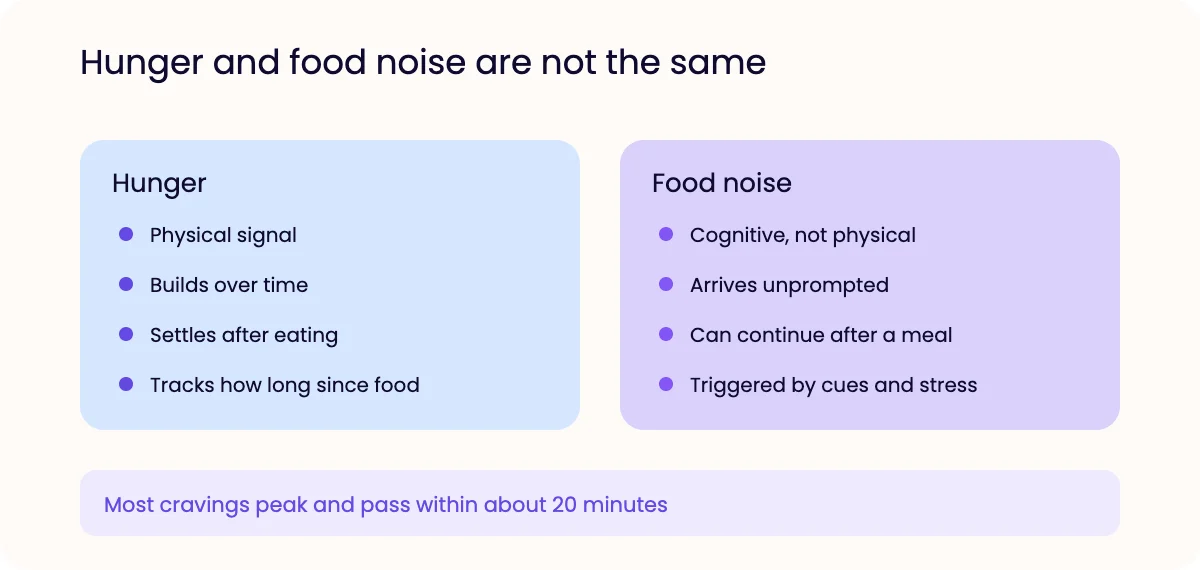
Hunger is a physical signal, generated by an empty stomach and falling blood sugar and mediated by hormones. It builds, it’s relieved by eating, and it goes quiet afterwards.
Food noise doesn’t reliably follow that pattern. It can be loudest after a meal, or during a stressful afternoon, or at 10pm on the sofa. It’s cognitive rather than physical, which is why eating in response to it so often fails to switch it off — and why people describe it as exhausting rather than simply inconvenient.
What drives it
The honest answer is that this is early research and the mechanisms aren’t settled. But a few things are reasonably well established in the wider literature on food cues and appetite.
Cues, not calories. Modern environments are engineered to prompt eating: food advertising, delivery apps, the shelf by the till, the smell outside a bakery. Every one of those is a trigger for the thought, regardless of whether your body needs anything.
Restriction amplifies it. Anyone who has tried to not think about a specific food knows how that goes. Deliberate suppression tends to increase the frequency of the thought rather than reduce it.
Under-eating protein and fibre. Meals that don’t satisfy leave a genuine physiological gap for the noise to fill. In controlled feeding work, raising protein produced sustained reductions in appetite and in preoccupation with food [4].
Short sleep. Sleep restriction consistently increases next-day energy intake and shifts food preference towards calorie-dense options [5]. Tired brains are worse at ignoring cues, which is covered in more detail in sleep and weight loss.
Stress, boredom and habit. Eating in response to a feeling rather than a signal is normal human behaviour. It becomes a problem when it’s the only available response.
Can it be measured?
Partly. A questionnaire designed to measure food noise — the Food Noise Questionnaire — was published in the journal Obesity in 2025 [2]. It’s a research instrument, not a diagnostic test, and there’s ongoing academic debate about how well it distinguishes food noise from related concepts such as craving and dietary restraint.
For personal use, the practical measure is simpler: how often do unwanted food thoughts occur, and how much do they bother you?
What helps
The most useful approaches come from work on food cue reactivity, and they share a principle: change your relationship to the thought rather than trying to delete it.
Decentring. Research on mindfulness and food cues suggests the effective ingredient isn’t relaxation but decentring — noticing a craving as a passing mental event rather than an instruction. In studies, this reduced subjective craving, physiological responses such as salivation, and unhealthy eating, without requiring people to suppress anything [3]. In practice: “I’m having the thought about biscuits” rather than “I need biscuits”, and then waiting. Most cravings peak and pass within about twenty minutes.
Remove the cue rather than resist it. Willpower is a poor long-term strategy against an environment. Not keeping the trigger food in the house, deleting the delivery app, and taking a different route past the bakery all remove the decision entirely. This isn’t weakness — it’s the strategy with the best evidence behind it.
Eat meals that actually satisfy. Protein and fibre at each meal, and enough of them. Chronic under-eating during the day is one of the most reliable ways to generate a loud evening.
Give the thought somewhere else to go. A short walk, a glass of water, a task with your hands. The aim isn’t distraction as denial but occupying the twenty minutes the craving needs to subside.
Protect sleep. It’s the least glamorous item on the list and often the highest-yield.
Stop moralising about it. Food thoughts aren’t a character flaw, and treating them as one adds guilt to an already tiring experience — which tends to make eating in response more likely, not less.
When it’s something more
Intrusive food thoughts sit on a spectrum, and at one end they’re part of an eating disorder. It’s worth speaking to your GP if the thoughts come with:
- Feeling out of control while eating, or eating unusually large amounts in one go
- Eating in secret, or hiding food
- Compensating afterwards — purging, fasting, or exercising to “undo” a meal
- Significant distress about your body, or food dominating your days
Eating disorders affect people of every size and every gender, and they’re very treatable, particularly early. Your GP can refer you, and the National Alliance for Eating Disorder helpline can point you towards support.
This is a sensitive area, and if any of it is landing close to home, it’s worth talking to someone rather than managing it alone.
Frequently asked questions
What is food noise?
Researchers define it as persistent thoughts about food that the person experiences as unwanted or distressing, and which may cause social, mental or physical problems. The everyday version is a running commentary about what you might eat next that does not switch off between meals.
Is food noise the same as hunger?
No. Hunger is a physical signal that usually settles after eating. Food noise can continue after a full meal, which is one of the things that makes it so wearing. They can occur together, and eating patterns that manage hunger well often reduce the noise too.
Is food noise a sign of an eating disorder?
Not on its own. Many people experience intrusive food thoughts without having an eating disorder. But if the thoughts come with loss of control around eating, eating in secret, compensating afterwards, or significant distress about your body, that deserves proper support — speak to your GP.
Can you measure food noise?
A questionnaire designed to measure it, the Food Noise Questionnaire, was published in the journal Obesity in 2025. It is a research instrument rather than a diagnostic test, and there is active academic debate about how well it captures the experience.
Does everyone get food noise?
Thinking about food is universal and normal. What researchers are describing is the intrusive, persistent version that people find burdensome. The distinction is about frequency and distress, not the presence of food thoughts as such.
References
- Dhurandhar EJ, Maki KC, Dhurandhar NV, et al. Food noise: definition, measurement, and future research directions. Nutrition & Diabetes. 2025;15:30. doi.org/10.1038/s41387-025-00382-x
- Diktas HE, et al. Development and validation of the Food Noise Questionnaire. Obesity. 2025. doi.org/10.1002/oby.24216
- Keesman M, Aarts H, Hafner M, Papies EK. Mindfulness reduces reactivity to food cues: underlying mechanisms and applications in daily life. Current Addiction Reports. 2017;4(2):151-157. doi.org/10.1007/s40429-017-0134-2
- Weigle DS, Breen PA, Matthys CC, et al. A high-protein diet induces sustained reductions in appetite, ad libitum caloric intake, and body weight. American Journal of Clinical Nutrition. 2005;82(1):41-48. doi.org/10.1093/ajcn/82.1.41
- Al Khatib HK, Harding SV, Darzi J, Pot GK. The effects of partial sleep deprivation on energy balance: a systematic review and meta-analysis. European Journal of Clinical Nutrition. 2017;71(5):614-624. doi.org/10.1038/ejcn.2016.201
- NHS. Eating disorders. www.nhs.uk/mental-health/feelings-symptoms-behaviours/behaviours/eatin
- NHS. Mindfulness. www.nhs.uk/mental-health/self-help/tips-and-support/mindfulness/
Medical reviewer
Naeem Teni
Clinical Lead at Manova. Registered pharmacist and independent prescriber, GPhC 2215591. Reviews Manova’s clinical content for accuracy and safety.
Written by
Manova Editorial Team
Researched and written to our editorial policy, using NICE, NHS, MHRA and peer-reviewed sources.
This article is for general information and isn’t a substitute for advice from your own clinician. If you feel unwell, contact your GP or NHS 111. In an emergency, call 999.