

Key takeaways
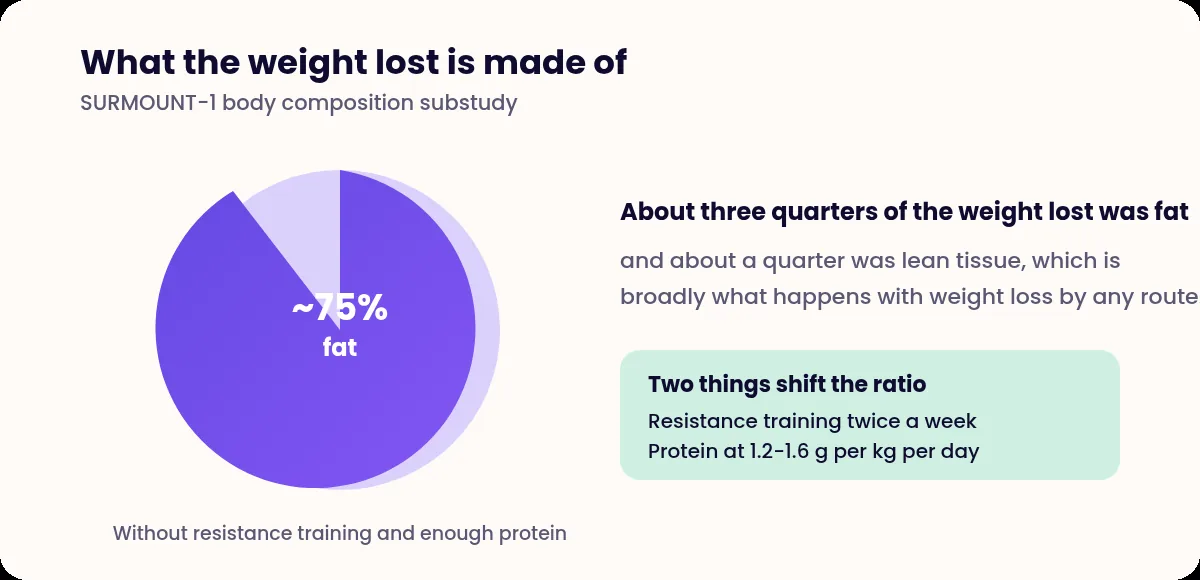
- In the SURMOUNT-1 body composition substudy, about 75% of the weight lost on tirzepatide was fat and about 25% lean mass.
- That proportion is broadly similar to what is seen with weight loss from dieting alone — the concern is the total amount lost, not a unique property of the medicines.
- Lean mass is not the same as muscle: it includes water, glycogen and organ tissue, some of which falls as body size falls.
- Protein intake and resistance training are the recognised ways to protect muscle, and are more important the faster the loss.
This is the most common criticism levelled at weight-management medicines, and it deserves a careful answer rather than either reassurance or alarm.
This page is information about prescription-only medicines, not personal medical advice.
What the data actually says
The relevant evidence comes from body composition substudies, where a subset of trial participants had DXA scans measuring fat and lean tissue separately.
Tirzepatide (SURMOUNT-1 substudy, 124 participants). Roughly 75% of the weight lost was fat mass and 25% lean mass [1].
Semaglutide (STEP 1 substudy, 140 participants). Fat mass fell substantially more than lean mass, so that lean tissue made up a larger proportion of total body mass at the end than at the start [2].
The three things this number needs
First, lean mass is not muscle. A DXA scan’s “lean body mass” includes skeletal muscle, but also body water, glycogen stores (which hold water with them), connective tissue and organs. When someone loses 20 kg, some fall in lean mass is simply the body needing less of everything — less blood volume, less supporting tissue. Treating the whole lean-mass figure as lost muscle overstates it.
Second, this is not unique to the medicines. Weight loss from dieting alone also comes partly from lean tissue, in broadly similar proportions. The medicines are not doing something distinctive to muscle; they are producing a large amount of weight loss, and weight loss has this property.
Third, the scale is the real issue. If a quarter of weight lost is lean mass, then someone losing 8 kg loses around 2 kg of it, while someone losing 24 kg loses around 6 kg. The proportion is the same; the absolute amount is not. That is why the question matters more with these medicines than it did with older ones — not because the ratio is worse, but because the totals are bigger.
What protects muscle
The evidence here is not medication-specific. It is the same evidence that applies to any weight loss.
Resistance training. UK Chief Medical Officers’ guidelines already recommend muscle-strengthening activity on at least two days a week for all adults [4]. During substantial weight loss it stops being a general health recommendation and becomes the main signal telling your body to keep the muscle it has. Bodyweight work, bands or weights all count.
Enough protein. A meta-analysis of protein intake and muscle mass found benefits up to around 1.6 g per kg of body weight a day in people doing resistance training [3]. A practical range during weight loss is 1.2 to 1.6 g per kg, spread across meals — which is harder on these medicines than off them, because appetite is suppressed and protein is the most filling macronutrient. Our guide to how much protein you need covers the detail.
Not losing faster than necessary. Larger deficits take a bigger share from lean tissue. On these medicines it is entirely possible to eat far too little without noticing, because hunger is not there to tell you.
The practical problem nobody warns about
The mechanism that makes these medicines work — reduced appetite — is the same mechanism that makes it hard to eat enough protein. People report being full after a few mouthfuls, and what gets dropped is usually the meat, fish or eggs, because protein is filling.
Ways round it that people find workable:
- Protein first at every meal, before anything else on the plate
- Smaller, more frequent protein-containing meals rather than three large ones
- Liquid protein — milk, yoghurt drinks, a shake — when solid food is unappealing
- Tracking protein for a fortnight, not forever, just to see the real number
Signs worth acting on
- Strength falling noticeably, or stairs becoming harder than they were
- Losing more than about 1% of body weight a week over several weeks
- Feeling weak, dizzy or unusually cold
- Being unable to eat a reasonable meal at all
Any of these is worth raising with your prescriber. Slowing the rate of loss, staying at a lower dose, or adding structured support are all legitimate responses.
Where this information comes from
Body composition figures are from the published substudies of the SURMOUNT-1 and STEP 1 trials; protein evidence from a meta-analysis in the Journal of Cachexia, Sarcopenia and Muscle; activity recommendations from the UK Chief Medical Officers. Research in this area is active and the picture may change.
Frequently asked questions
Do weight loss injections make you lose muscle?
Some of the weight lost is lean mass, as with any substantial weight loss. In the tirzepatide body composition substudy about a quarter of the weight lost was lean tissue and about three quarters fat. That ratio is broadly comparable with weight loss achieved by dieting.
Is that ratio worse than with dieting?
The published body composition data does not show it to be clearly worse. What is different is the scale: these medicines produce much larger total weight loss, so a similar proportion of lean mass adds up to more absolute lean tissue lost.
Does lean mass mean muscle?
Not exactly. Lean body mass on a DXA scan includes muscle but also water, glycogen stores, connective tissue and organs. Some fall in lean mass is expected simply because a smaller body needs less of all of it.
How do you protect muscle while taking one?
The two recognised levers are adequate protein and resistance training at least twice a week. Neither is specific to medication — they are what the evidence supports for any weight loss.
Should I be worried about it?
It is a reason to train and eat protein deliberately, not a reason to avoid treatment. Losing strength, struggling with stairs you managed before, or losing weight very rapidly are all reasons to raise it with your prescriber.
References
- Body composition substudy of SURMOUNT-1: tirzepatide in adults with obesity. Diabetes, Obesity and Metabolism. 2025. dom-pubs.onlinelibrary.wiley.com/doi/10.1111/dom.16275
- Wilding JPH, Batterham RL, Calanna S, et al. Once-weekly semaglutide in adults with overweight or obesity (STEP 1), including body composition substudy. New England Journal of Medicine. 2021;384(11):989-1002. doi.org/10.1056/NEJMoa2032183
- Nunes EA, Colenso-Semple L, McKellar SR, et al. Systematic review and meta-analysis of protein intake to support muscle mass and function in healthy adults. Journal of Cachexia, Sarcopenia and Muscle. 2022;13(2):795-810. doi.org/10.1002/jcsm.12922
- Department of Health and Social Care. UK Chief Medical Officers' physical activity guidelines. Updated 10 July 2026. www.gov.uk/government/collections/physical-activity-guidelines
- Eli Lilly and Company Limited. Mounjaro KwikPen: Summary of Product Characteristics. Electronic Medicines Compendium. www.medicines.org.uk/emc/product/15484/smpc
- Systematic review of body composition changes with GLP-1 receptor agonists. Cureus. 2025. assets.cureus.com/uploads/review_article/pdf/391807/20250829-207898-s6
Medical reviewer
Naeem Teni
Clinical Lead at Manova. Registered pharmacist and independent prescriber, GPhC 2215591. Reviews Manova’s clinical content for accuracy and safety.
Written by
Manova Editorial Team
Researched and written to our editorial policy, using NICE, NHS, MHRA and peer-reviewed sources.
This article is for general information and isn’t a substitute for advice from your own clinician. If you feel unwell, contact your GP or NHS 111. In an emergency, call 999.