

Key takeaways
- How much loose skin you get depends mostly on age, how much weight you lost, how long you carried it and genetics.
- Skin retracts to some degree over 12–24 months, and slower weight loss gives it more chance to.
- Building muscle underneath changes how loose skin looks more than any cream or supplement.
- For significant excess skin, surgery is the only reliable treatment, and NHS access is limited and conditional.
This is the part of weight loss that rarely appears in the before-and-after photos. After a large loss, the skin that was stretched around a bigger body does not always come back with you.
It is worth being straightforward about what can and cannot be done about it.
Why it happens
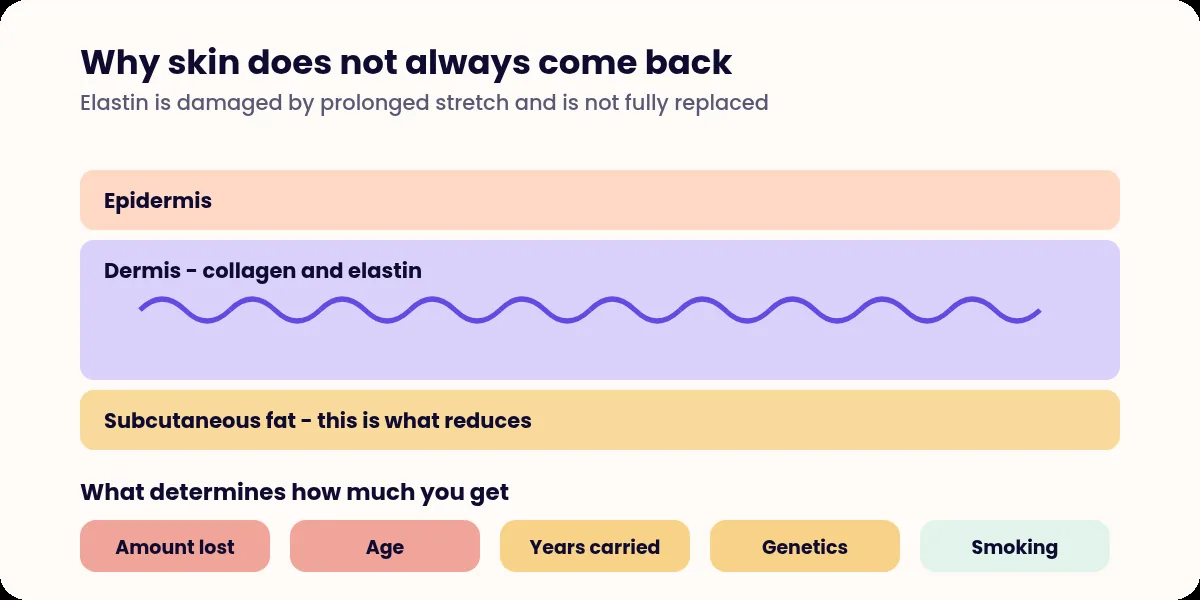
Skin stretches because of two proteins in the dermis: collagen, which gives structure, and elastin, which provides recoil. Carrying extra weight stretches the skin over years. During that time, some elastin fibres are damaged and not fully replaced.
When the volume underneath goes, the skin retracts as far as its remaining elasticity allows — and no further.
What determines how much you get
Amount of weight lost. The dominant factor. Loose skin after losing 10 kg is uncommon; after 40 kg it is close to expected.
Age. Collagen production and elastin quality decline from the late twenties. The same loss at 25 and at 55 does not produce the same result.
How long you carried the weight. Decades of stretch damages elastin more than a few years.
Genetics. Real, and not something you can influence.
Smoking. Directly degrades collagen and impairs healing.
Sun exposure over a lifetime. Same mechanism.
Notice how few of those are under your control. That is not a counsel of despair, but it is a reason not to blame yourself for the outcome.
What actually helps
Lose at a steadier pace
Skin retraction is gradual. Losing 0.5 to 1 kg a week gives it more opportunity to keep up than losing 2 kg a week. This is one of several reasons rapid loss is not a better plan.
Build muscle underneath
This is the highest-value item on the list. Loose skin looks different over a filled-out limb than over an empty one, and muscle is the only tissue you can deliberately add back. Resistance training twice a week, with adequate protein, changes the appearance of the same amount of skin considerably. See strength training over 40.
Keep protein up during the loss
Roughly 1.2 to 1.6 g per kg of body weight per day protects lean tissue and provides the substrate for collagen synthesis.
Give it time
Most of the retraction that is going to happen happens within 12 to 24 months of your weight stabilising. Judging the final result at three months is premature.
Don’t smoke, and look after the skin
Hydration, moisturiser and sun protection will not tighten loose skin, but they improve its condition and how it looks and feels.
What does not work
There is no good evidence that collagen supplements, firming creams, body wraps, or over-the-counter devices produce meaningful tightening of significantly loose skin. Some non-surgical clinic treatments (radiofrequency, ultrasound) can produce modest changes in mild laxity; they do not address substantial excess skin, and they are not cheap.
Be sceptical of anything marketed specifically at post-weight-loss skin. It is a market that knows its customers are motivated.
Surgery
For significant excess skin, surgery is the only reliable answer. Options include abdominoplasty, a lower body lift, brachioplasty (arms) and thigh lift.
On the NHS, this is generally considered only where the excess skin causes functional problems — recurrent skin infections, ulceration, difficulty with hygiene or mobility — rather than for appearance, and typically requires weight to have been stable for a period, often 12 to 24 months. Criteria vary between local commissioning policies, so the answer genuinely differs by area [1].
Privately, it is major surgery with real recovery time and permanent scars, and it is expensive. People who have it are generally glad they did; that is a reason to plan it properly rather than to rush it.
When to speak to a clinician
Get medical advice if you have:
- recurrent rashes, infections or broken skin in a skin fold
- pain, restricted movement or difficulty with hygiene because of excess skin
- skin that is persistently sore or ulcerated
- significant distress about your appearance affecting daily life
These are treatable problems, and the fold-related skin infections in particular should not be put up with.
Frequently asked questions
Does loose skin tighten on its own?
Partially, and gradually. Skin has some elastic recoil, and most of the retraction that is going to happen occurs over the first 12 to 24 months after weight stabilises. Younger skin retracts better than older skin.
Can you prevent loose skin?
Not entirely, but losing weight at a steadier pace, keeping resistance training in the plan, not smoking and staying well hydrated all help. The biggest single factor is how much weight is lost in total, which is not something you would choose to change.
Do creams or supplements help?
There is no good evidence that collagen creams, firming lotions or oral supplements meaningfully tighten significantly loose skin. They may improve the feel and appearance of dry skin, which is a different thing.
Can I get skin removal surgery on the NHS?
Sometimes. It is usually considered only where excess skin causes recurrent infections, ulceration or significant functional problems, after weight has been stable for a period, and criteria vary between local commissioning policies.
References
- NHS. Cosmetic procedures. www.nhs.uk/conditions/cosmetic-procedures/
- British Association of Plastic, Reconstructive and Aesthetic Surgeons. Body contouring after weight loss. www.bapras.org.uk/public/patient-information/surgery-guides/body-conto
- Biörserud C, Olbers T, Fagevik Olsén M. Patients' experience of surplus skin after laparoscopic gastric bypass. Obesity Surgery. 2011;21(3):273-277. doi.org/10.1007/s11695-009-9849-z
- NHS. Weight loss surgery. www.nhs.uk/conditions/weight-loss-surgery/
Medical reviewer
Naeem Teni
Clinical Lead at Manova. Registered pharmacist and independent prescriber, GPhC 2215591. Reviews Manova’s clinical content for accuracy and safety.
Written by
Manova Editorial Team
Researched and written to our editorial policy, using NICE, NHS, MHRA and peer-reviewed sources.
This article is for general information and isn’t a substitute for advice from your own clinician. If you feel unwell, contact your GP or NHS 111. In an emergency, call 999.