
Key takeaways
- Finasteride inhibits type 2 5-alpha reductase, lowering scalp DHT and slowing or reversing follicle miniaturisation in male pattern hair loss.
- It takes three to six months before change is visible, and stopping means losing the benefit over the following months.
- Sexual side effects are reported by a small percentage of men in trials; the MHRA has required warnings about mood changes including depression and suicidal thoughts.
- It is a prescription only medicine in the UK, must not be handled by women who are or may become pregnant, and lowers PSA readings.
This page is medicine information, not an advert. Finasteride is a prescription only medicine in the UK [5], and whether it is appropriate is a decision for a prescriber after an assessment.
What it does
Male pattern hair loss is driven by dihydrotestosterone (DHT) acting on genetically sensitive follicles, shortening each growth cycle until the hair produced is too fine to see. DHT is made from testosterone by the enzyme 5-alpha reductase.
Finasteride inhibits the type 2 form of that enzyme [1]. Scalp DHT falls substantially, serum DHT falls by roughly two-thirds, and testosterone rises modestly. With less DHT reaching the follicle, miniaturisation slows and some already-miniaturised follicles recover.
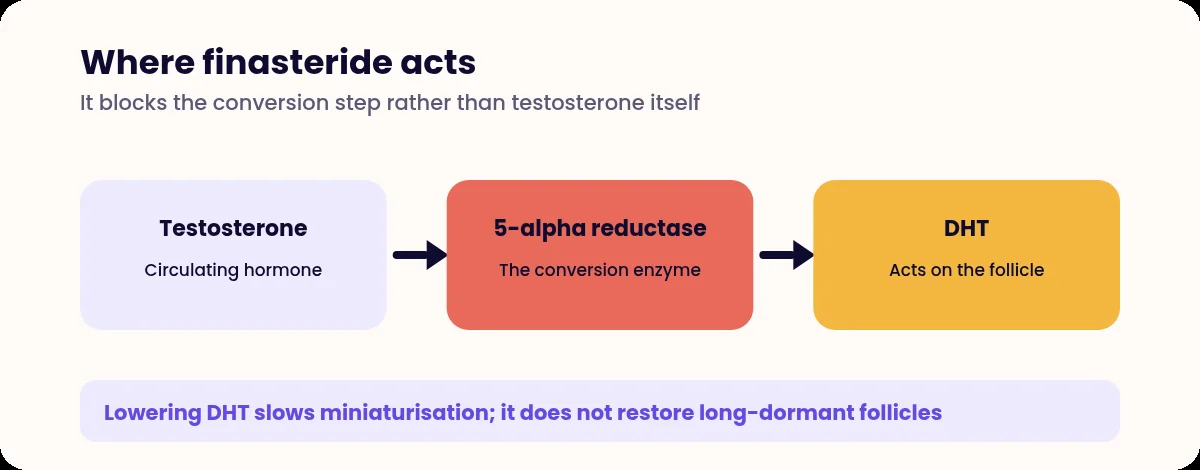
It does not affect follicles that have been dormant for years, and it does not work on hair loss that is not androgenetic.
What to expect, and when
The product information advises three to six months of daily use before any effect is visible, and continued use to maintain it [1]. There are good reasons for this: hair cycles are slow, and a follicle that starts producing a thicker hair still needs months to grow it to visible length.
In the pivotal trials, most men on finasteride either maintained or increased hair count over a year, while the placebo group continued to lose. Maintaining is the common result; visible regrowth is the less common one, and is most likely at the crown and least likely at a receded frontal hairline.
An honest way to judge it: photograph the same areas in the same light at the start and at twelve months. Day-to-day impressions in a bathroom mirror are unreliable in both directions.
Some men notice a temporary increase in shedding in the first weeks. This reflects follicles synchronising into a new cycle and is expected rather than a sign of failure.
Stopping reverses the benefit over roughly twelve months [1]. The hair does not fall out faster than it would have; you simply rejoin the trajectory you were on.
Side effects
This is where the honest discussion belongs, because the online conversation and the trial data pull in different directions and both contain something real.
From the trials and product information [1, 2], the sexual side effects reported were reduced libido, erectile difficulty and reduced ejaculate volume, each in a small percentage of men, with rates in the placebo groups not far behind — the gap between arms was a percentage point or so. Most resolved with continued use, and resolved on stopping.
The product information also records breast tenderness and enlargement, hypersensitivity reactions, depression, and — importantly — reports of persistent sexual dysfunction after discontinuation [1]. Male breast cancer has been reported very rarely, and any breast lump, pain, or nipple discharge should be reported promptly.
The MHRA has acted on psychiatric effects, twice. Product information carries warnings about mood changes including depression, depressed mood and suicidal thoughts, and advises stopping and seeking medical advice if these occur [1, 3]. A patient card is included in UK packs. In May 2026 the MHRA strengthened the warnings further: the product information now states that these effects may persist after treatment is stopped, and that sexual dysfunction may itself contribute to mood problems as well as occurring independently [3]. Our guide to finasteride side effects covers the current position in full.
“Post-finasteride syndrome” describes persistent sexual, physical and psychological symptoms reported by some men after stopping. Whether it is a distinct entity, its frequency and its mechanism are genuinely unresolved, and the research is contested. What is not in dispute is that some men report it and that the product information now acknowledges persistent symptoms. A prescriber who dismisses the question entirely is not reflecting the current position; nor is a website that presents the risk as universal.
The reasonable approach is to know the specific things to look out for, to stop and seek advice if they appear rather than pressing on, and to make the decision consciously.
Important practical points
Women who are or may become pregnant must not handle crushed or broken tablets [1]. Finasteride can cause abnormalities of the external genitalia in a male foetus. Coated whole tablets prevent contact with the active ingredient, but broken ones do not.
PSA testing. Finasteride roughly halves PSA readings [1]. Anyone interpreting your PSA must know you take it, or a meaningful rise can be masked. This becomes relevant from around age 40 onwards and is worth noting in your records now rather than remembering later.
Blood donation. UK guidance requires a deferral period after stopping finasteride before donating, because of the risk to a pregnant recipient.
Interactions are few, and finasteride is not known to interact significantly with common medicines. It is not licensed for use in women, in whom a different approach applies — see female pattern hair loss.
Topical finasteride
Topical formulations are used with the aim of reducing systemic exposure, and there is trial evidence that a topical spray lowers scalp DHT with far lower blood levels than the tablet. There is no MHRA-licensed topical finasteride product in the UK, so anything supplied here is an unlicensed preparation or an import. Systemic absorption is reduced but not eliminated — serum DHT still falls substantially — so the pregnancy handling precautions still apply, with the added issue of transfer from the treated scalp. Our guide to topical finasteride covers this in detail.
Where it sits among the options
Finasteride and topical minoxidil are the two treatments with the strongest evidence in male pattern hair loss [4], they work by unrelated mechanisms, and they are often used together. Our finasteride vs minoxidil guide compares them directly, and male pattern baldness covers the underlying condition.
Buying safely
Finasteride is prescription only in the UK. A legitimate service — online or otherwise — will ask about your health, your medicines, your mood history and your plans around fertility before supplying, and will be registered with the General Pharmaceutical Council. Anywhere that supplies it from a shopping basket is not operating legally, and what arrives cannot be verified.
Frequently asked questions
How long does finasteride take to work?
The UK product information advises that daily use for three to six months is generally needed before benefit is seen, and continued use is required to maintain it. Assessment at twelve months gives a fairer picture than at six.
What happens if I stop taking finasteride?
The benefit is gradually lost, typically over about twelve months, and hair returns to the state it would have reached without treatment. It is a maintenance treatment rather than a cure.
How common are sexual side effects?
In the randomised trials, reduced libido, erectile difficulty and reduced ejaculate volume were each reported by a small percentage of men, with placebo rates not far below. The product information also notes persistent symptoms after stopping have been reported. Discuss the balance with your prescriber.
Does finasteride affect PSA tests?
Yes. It roughly halves PSA readings in men taking it. Always tell whoever is interpreting a PSA test that you take finasteride so the result can be adjusted, otherwise a significant result can be missed.
References
- Summary of Product Characteristics: finasteride 1 mg film-coated tablets. Electronic Medicines Compendium. www.medicines.org.uk/emc/search?q=finasteride+1mg
- British National Formulary. Finasteride. bnf.nice.org.uk/drugs/finasteride/
- MHRA. Finasteride: reminder of the risk of psychiatric side effects and reports of sexual dysfunction. Drug Safety Update. www.gov.uk/drug-safety-update
- NICE Clinical Knowledge Summaries. Alopecia, androgenetic – male. cks.nice.org.uk/topics/alopecia-androgenetic-male/
- The Human Medicines Regulations 2012, regulation 284. www.legislation.gov.uk/uksi/2012/1916/regulation/284
Medical reviewer
Naeem Teni
Clinical Lead at Manova. Registered pharmacist and independent prescriber, GPhC 2215591. Reviews Manova’s clinical content for accuracy and safety.
Written by
Manova Editorial Team
Researched and written to our editorial policy, using NICE, NHS, MHRA and peer-reviewed sources.
This article is for general information and isn’t a substitute for advice from your own clinician. If you feel unwell, contact your GP or NHS 111. In an emergency, call 999.