

Key takeaways
- Hats, frequent washing and poor scalp circulation do not cause pattern hair loss.
- Baldness is inherited from both parents, not only the mother's side, though one important gene does sit on the X chromosome.
- Severe stress can cause a temporary diffuse shed called telogen effluvium, which recovers — it does not cause pattern baldness.
- Biotin supplements only help where there is a genuine deficiency, which is rare, and biotin interferes with several common blood tests.
Hair loss attracts more folklore than almost any other common condition, partly because it is visible, partly because it is emotive, and largely because there is money in it. Here is what holds up.
“Wearing hats causes baldness”
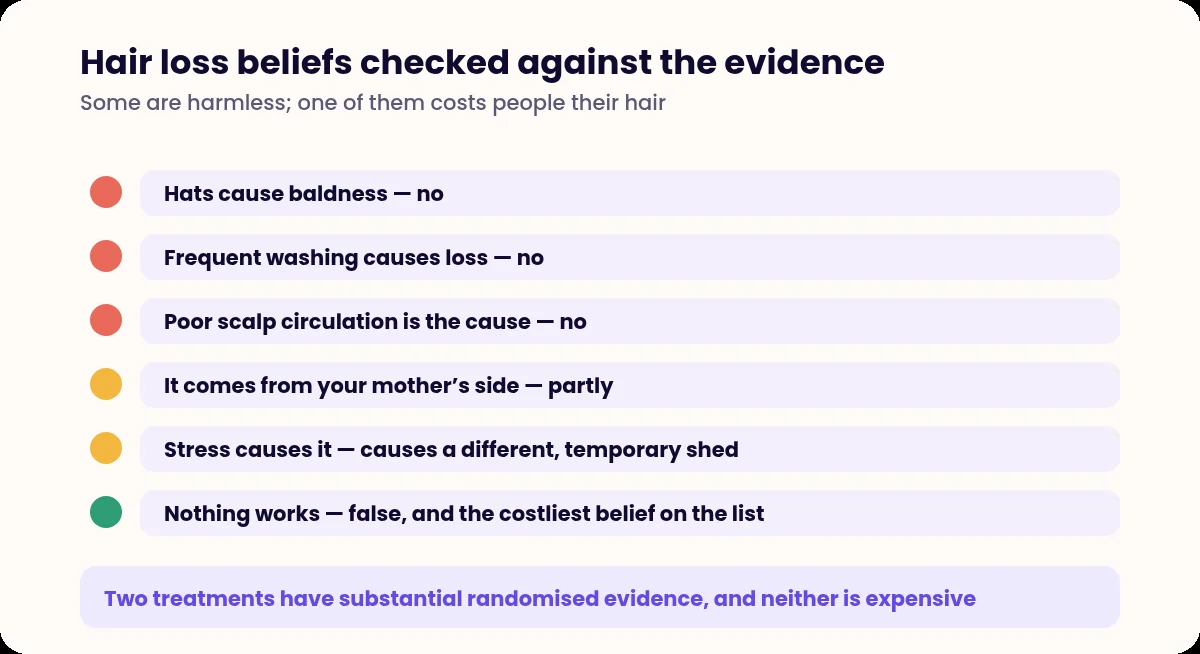
No. Pattern hair loss happens inside the follicle, driven by DHT sensitivity, and nothing worn on top of the scalp changes that [2]. The one exception is not really about hats: any style or headwear that applies sustained tension — very tight ponytails, braids, extensions — can cause traction alopecia along the hairline. Ordinary hats do not.
“Washing your hair too often makes it fall out”
No. On any given day a proportion of your hairs are in the shedding phase of their cycle and will come out regardless. Washing simply collects them all at once. Wash less often and you will see more come out each time, because you are collecting several days’ worth.
Seeing 50 to 100 hairs a day is normal. It only matters if it has clearly increased or if density is visibly dropping.
“It comes from your mother’s father”
Half true, which is why it persists. The androgen receptor gene sits on the X chromosome, which men inherit from their mother, and it is the single strongest known genetic contributor. But androgenetic alopecia is polygenic — dozens of variants across other chromosomes are involved — so your father’s side matters too [2].
Practically: look at both sides, and accept that family history predicts likelihood better than it predicts timing.
“Stress caused my baldness”
Not pattern baldness. Severe physical or emotional stress can cause telogen effluvium — a synchronised shift of many follicles into the resting phase, producing a noticeable diffuse shed two to four months later [3]. It comes out in handfuls, affects the whole scalp rather than a pattern, and recovers, usually within six to twelve months once the trigger has passed.
Illness, surgery, childbirth, crash dieting and rapid weight loss do the same thing. If your shedding is diffuse and started a few months after something significant, this is the more likely explanation — and it is the one that gets better on its own.
“Poor scalp circulation is the problem”
This was the theory behind decades of scalp massage devices and inversion routines. Pattern hair loss is a hormonal effect on the follicle, not a supply problem. Scalp massage is pleasant and harmless; it is not a treatment.
“Shampoos can regrow hair”
Shampoos can improve the condition and appearance of the hair you have, and some — ketoconazole-containing ones in particular — treat scalp conditions like seborrhoeic dermatitis that make shedding worse. That is worth having. But a shampoo is on the scalp for a minute and is not a substitute for treatments with randomised evidence behind them [5].
“Biotin makes hair grow”
Only if you are deficient, and genuine biotin deficiency is uncommon. There is no good evidence that supplementing biotin improves hair in people with normal levels.
It is also not entirely harmless: high-dose biotin interferes with several laboratory immunoassays, including thyroid function tests and troponin — the test used to diagnose heart attacks — producing misleading results in either direction [4]. Tell any clinician taking blood from you that you take it, and stop it before tests where advised.
“Supplements can reverse hair loss”
Correcting a real deficiency — iron in particular — can help, which is why blood tests for hair loss are worth doing where shedding is diffuse. Taking supplements without a deficiency does not.
Two specifics worth knowing: excess vitamin A causes hair loss, and so does excess selenium. Some hair supplements contain high doses of both. More is not better.
“Testosterone levels cause it, so I should get them tested”
Men with pattern hair loss usually have entirely normal testosterone. The difference is follicle sensitivity to DHT, which no blood test measures. Testosterone is worth checking if you have symptoms of deficiency — see low testosterone symptoms — not as part of a hair investigation.
“Nothing works, so there’s no point trying”
This one is the most expensive, because it keeps people away from the two treatments that do have substantial randomised evidence: finasteride and topical minoxidil [1, 5]. Neither restores what has been gone for years. Both are considerably better at preventing further loss than anything else available, and the earlier they start the more there is to keep. Our finasteride vs minoxidil guide compares them honestly, side effects included.
“Once it starts it’s fast”
Rates vary enormously. Some men progress from a mature hairline to substantial crown loss within five years; others sit at the same stage for two decades. The slow decline is the norm, which is precisely why people notice it late — and why photographs are more reliable than memory.
“A transplant is a permanent fix”
Transplanted follicles are permanent, but the native hair around them is not, and it continues to thin. Without ongoing medical treatment, a transplant can end up as an island. Surgeons say this; marketing often does not. See hair transplants in the UK.
What’s actually true
- Pattern hair loss is genetic, hormonal and progressive.
- It can be slowed and partly reversed, better early than late.
- Diffuse sudden shedding is usually something else, and usually recovers.
- Scalp redness, scaling, pain, round bald patches or a receding band at the hairline need seeing by a clinician, not treating at home — some of those causes are permanent if left.
- Most of what is sold for hair loss has no evidence behind it, and the small amount that does is not expensive.
Frequently asked questions
Does wearing a hat cause hair loss?
No. Pattern hair loss is caused by follicle sensitivity to DHT, not by anything sitting on top of the head. A hat tight enough to cause sustained traction could theoretically contribute to traction alopecia, but ordinary hat wearing does not.
Does washing your hair make it fall out?
No. Washing releases hairs that were already in the shedding phase of the cycle, so they appear in the shower rather than on your pillow over the following days. Washing less often just relocates where you see them.
Does biotin help hair growth?
Only where there is a genuine biotin deficiency, which is uncommon. It also interferes with several laboratory tests, including thyroid and troponin assays, which can produce misleading results — so tell any clinician taking blood if you take it.
Is baldness inherited from my mother's father?
Partly. The androgen receptor gene on the X chromosome, which men inherit from their mother, is the strongest single contributor, but many other genes are involved and inheritance comes from both sides.
References
- NHS. Hair loss. www.nhs.uk/conditions/hair-loss/
- DermNet. Androgenetic alopecia. dermnetnz.org/topics/androgenetic-alopecia
- DermNet. Telogen effluvium. dermnetnz.org/topics/telogen-effluvium
- MHRA. Biotin interference with laboratory tests. Drug Safety Update. www.gov.uk/drug-safety-update
- British Association of Dermatologists. Patient information leaflets. www.skinhealthinfo.org.uk/
Medical reviewer
Naeem Teni
Clinical Lead at Manova. Registered pharmacist and independent prescriber, GPhC 2215591. Reviews Manova’s clinical content for accuracy and safety.
Written by
Manova Editorial Team
Researched and written to our editorial policy, using NICE, NHS, MHRA and peer-reviewed sources.
This article is for general information and isn’t a substitute for advice from your own clinician. If you feel unwell, contact your GP or NHS 111. In an emergency, call 999.