

Key takeaways
- Pooled trial data give roughly 1 mmHg systolic and 0.9 mmHg diastolic reduction per kilogram lost.
- The effect is larger when more than 5 kg is lost, and larger for diastolic pressure in people already on treatment.
- Salt reduction, alcohol reduction, activity and potassium-rich foods add to it.
- Never stop blood pressure medicine on the strength of weight loss without a review.
Most relationships in lifestyle medicine are messy. This one is close to linear, well quantified, and usable as a rule of thumb.
The number
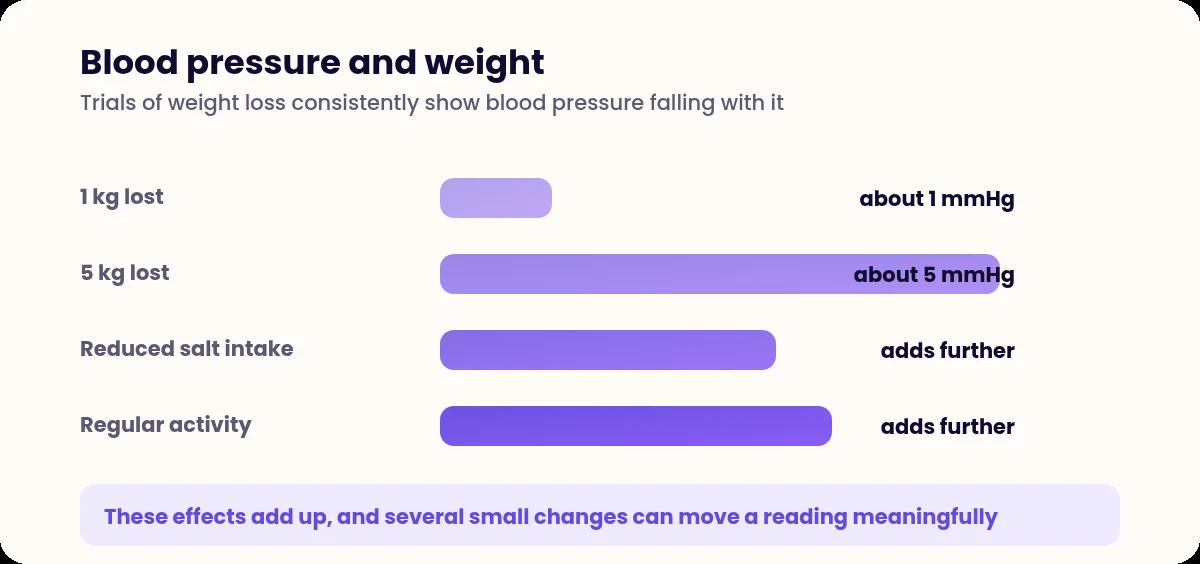
A meta-analysis of 25 randomised trials involving nearly 4,900 participants produced the figures everyone now quotes [1]:
- Systolic: −1.05 mmHg per kilogram lost (95% CI −1.43 to −0.66)
- Diastolic: −0.92 mmHg per kilogram lost (95% CI −1.28 to −0.55)
So a 10 kg loss corresponds to roughly 10 mmHg systolic. For context, that is comparable to what a single blood pressure medicine typically achieves.
Two refinements from the same analysis:
- The effect was larger where mean weight loss exceeded 5 kg — systolic −6.6 mmHg versus −2.7 mmHg
- The diastolic effect was significantly larger in people already taking antihypertensives — −5.3 versus −2.9 mmHg
That second point is counterintuitive and useful: if you are already on treatment, weight loss appears to add more, not less.
Why weight raises blood pressure
Several mechanisms, all running at once. Higher circulating volume and cardiac output. Increased sympathetic nervous system activity. Activation of the renin-angiotensin system by fat tissue. Insulin resistance affecting sodium handling in the kidney. And, frequently, obstructive sleep apnoea, which raises blood pressure through repeated overnight oxygen dips.
That last one matters practically. If your blood pressure is hard to control and you snore heavily and wake unrefreshed, sleep apnoea is worth investigating — it is a common reason treatment underperforms.
What else moves the number
Salt. UK adults average well above the 6 g a day maximum. Most of it is not the salt cellar — it is bread, processed meat, sauces, ready meals and eating out. Reducing intake produces a measurable fall within weeks [4].
Alcohol. A strong, dose-related effect on blood pressure, and one of the quickest to reverse.
Activity. Lowers blood pressure independently of weight change. Both aerobic activity and resistance training contribute.
Potassium-rich foods. Vegetables, fruit, pulses. Worth care if you have kidney disease or take certain medicines, so ask first in that case.
Sleep. Short and fragmented sleep raise blood pressure.
How to measure it properly
A single reading in a clinic is a poor measure, and the number that guides decisions is usually an average from home readings or 24-hour monitoring [2].
If you measure at home: sit for five minutes first, back supported, feet flat, arm supported at heart level, no caffeine or exercise in the previous half hour, correct cuff size. Take two readings a minute apart, morning and evening, for several days, and give your GP the whole set rather than the worst one.
The medication question
Weight loss genuinely does allow some people to reduce or stop blood pressure medicines. It should still happen as a planned review with monitoring, not unilaterally.
The reason is straightforward: blood pressure that rises again after stopping often does so silently, and the risk you were treating does not announce itself. Ask for a review, and expect to be monitored for a few months afterwards.
When to speak to a clinician
Seek advice if you:
- have a home reading consistently at or above 135/85, or a clinic reading at or above 140/90
- have a reading of 180/120 or higher — seek same-day advice
- have blood pressure that is not controlled despite treatment, particularly with loud snoring or daytime sleepiness
- want to reduce or stop medication after losing weight
- get symptoms with low readings — dizziness on standing, faintness — which can happen as weight falls and doses become too high
Headache with visual disturbance, chest pain, breathlessness or new weakness alongside very high readings needs urgent assessment.
Frequently asked questions
How much does blood pressure drop when you lose weight?
Pooled data from 25 randomised trials give about 1.05 mmHg systolic and 0.92 mmHg diastolic per kilogram lost. A 10 kg loss therefore corresponds to roughly 10 mmHg systolic, which is a clinically meaningful change.
Can I come off blood pressure tablets if I lose weight?
Sometimes, and it does happen. But doses should only be reduced or stopped under review, with monitoring, because blood pressure can rise again and rebound matters. Book the review rather than making the change.
What lowers blood pressure fastest?
Reducing salt and alcohol usually produce the quickest measurable change, within weeks. Weight loss acts more gradually. Regular activity lowers pressure independently of weight.
Does losing a small amount help?
Yes. The relationship is roughly linear over modest ranges, so a few kilograms produces a few mmHg. The effect is proportionally larger once more than 5 kg is lost.
References
- Neter JE, Stalenhoef AFH, Kok FJ, Grobbee DE, Geleijnse JM. Influence of weight reduction on blood pressure: a meta-analysis of randomized controlled trials. Hypertension. 2003;42(5):878-884. doi.org/10.1161/01.HYP.0000094221.86888.AE
- NICE. Hypertension in adults: diagnosis and management. NG136. www.nice.org.uk/guidance/ng136
- NHS. High blood pressure (hypertension). www.nhs.uk/conditions/high-blood-pressure-hypertension/
- NHS. Salt: the facts. www.nhs.uk/live-well/eat-well/food-types/salt-nutrition/
Medical reviewer
Naeem Teni
Clinical Lead at Manova. Registered pharmacist and independent prescriber, GPhC 2215591. Reviews Manova’s clinical content for accuracy and safety.
Written by
Manova Editorial Team
Researched and written to our editorial policy, using NICE, NHS, MHRA and peer-reviewed sources.
This article is for general information and isn’t a substitute for advice from your own clinician. If you feel unwell, contact your GP or NHS 111. In an emergency, call 999.