

Key takeaways
- Erectile dysfunction risk rises with how much you smoke: pooled data put current heavy smokers at roughly one and a half times the risk of non-smokers, and lighter smokers at a smaller but still raised risk.
- Quitting improves erectile function in a substantial proportion of men, with one counselling cohort reporting improvement in 53.8% of quitters against 28.1% of those who continued.
- Recovery is real but incomplete: men with a heavy smoking history retain measurably raised risk years after stopping, which is an argument for quitting sooner rather than for not bothering.
- Vaping is not established as a cause of erectile dysfunction; for a smoker, switching completely is very likely better than continuing, and quitting nicotine entirely is better still.
Of all the modifiable causes of erectile dysfunction, smoking has the cleanest evidence and the most direct mechanism. It is also the one men are most likely to have heard about and least likely to have been given numbers for.
The numbers matter here, because the relationship is dose-dependent. That makes the amount you smoke a dial rather than a switch — which is a more useful thing to know than a general warning.
What the pooled data show
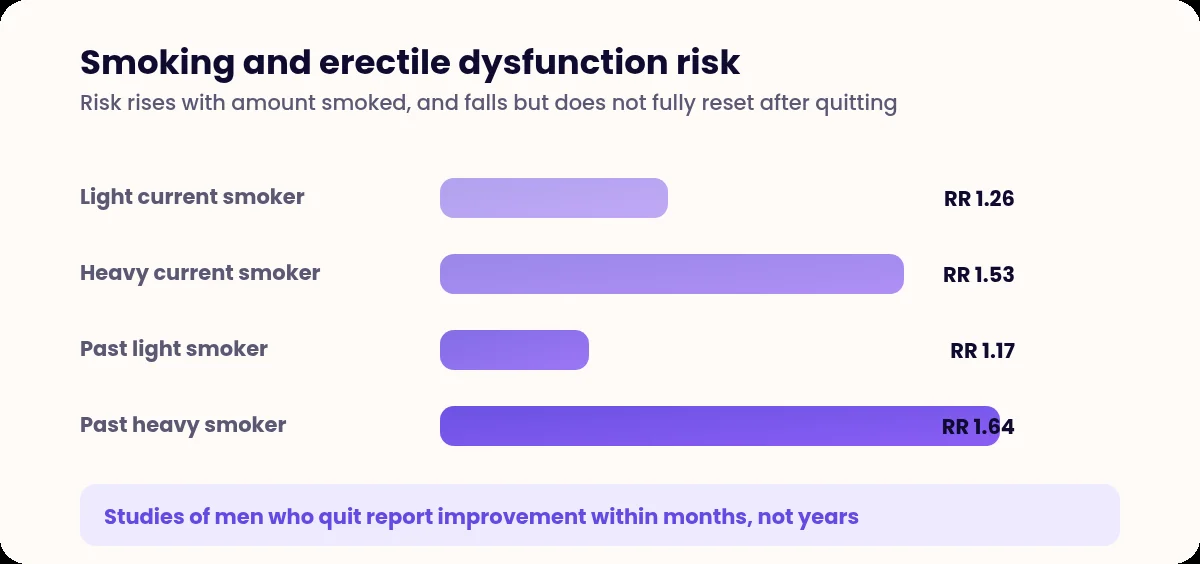
A meta-analysis bringing together 62 population-based studies found a consistent gradient rather than a threshold [3]:
- Current smokers at more than 20 a day: relative risk of erectile dysfunction around 1.53 compared with non-smokers.
- Current lighter smokers, averaging roughly 8 to 9 a day: relative risk around 1.26.
- Former heavy smokers — around 23 pack-years, fewer than five years since quitting: relative risk around 1.64.
- Former lighter smokers — around 10 pack-years, more than ten years since quitting: relative risk around 1.17.
The associations persisted after adjustment for other factors, which is what you would want to see before taking them seriously.
Two things stand out. First, even modest smoking carries a measurable excess risk, so “only a few a day” is not the reassurance it sounds like. Second, and less comfortably, the former-heavy-smoker figure of 1.64 is higher than the current-heavy-smoker figure. That is almost certainly not because quitting is harmful. It reflects who quits: men who stop after heavy, long-duration exposure, often prompted by a health event, carry that accumulated vascular damage with them. It is a reason to stop earlier, not a reason to carry on.
Why smoking does this
The mechanism is vascular and it is not subtle.
An erection depends on nitric oxide released from nerve endings and from the endothelium — the single-cell lining of the blood vessels — relaxing the smooth muscle of the corpora cavernosa so that blood can fill them. Tobacco smoke impairs endothelial function and reduces nitric oxide availability, and over years it accelerates atherosclerosis in the arteries supplying the penis. Those arteries are narrow, which is why erectile symptoms often show up before coronary symptoms do.
This is why erectile dysfunction in a smoker is worth treating as a cardiovascular signal rather than a purely sexual complaint. Our guide to ED and heart disease explains why, and what a proper risk assessment covers.
Nicotine itself also acts as a short-term vasoconstrictor, which is a separate and more immediate effect from the long-term arterial damage caused by the rest of the smoke.
What quitting actually recovers
The cessation evidence is made up of small studies, and it should be read as encouraging rather than definitive. But it points consistently in one direction.
- A pilot study of ten men found improved night-time erections after just 24 hours of abstinence.
- An eight-week cessation programme found that the 20 men who quit showed enhanced erectile tumescence compared with those who relapsed.
- A six-month counselling cohort of 143 men found that 53.8% of quitters reported improved erectile function, against 28.1% of those who did not quit — a relative risk of around 2.10.
- At one year, 25% of 118 cessation participants reported improvement, against 0% of 163 men who continued smoking [3].
That last comparison is the one worth sitting with. Not because 25% is a high number, but because the continuing-smoker figure was zero. Erectile function did not spontaneously improve in men who kept smoking.
Set against that, the residual risk in former heavy smokers is real. The honest summary is that quitting improves erectile function for a meaningful proportion of men and stops the damage accumulating, but it does not fully reset what has already happened.
Where vaping honestly sits
This is where a lot of content gets it wrong in both directions, so it is worth being precise.
One large US cross-sectional study of 45,971 adults found that e-cigarette users were more likely to report erectile dysfunction, with an odds ratio of 2.24. That is a headline that travels well. It is also a cross-sectional survey, which cannot establish cause and effect, and it is confounded by age, by dual use — many e-cigarette users also smoke, or recently did — and by baseline cardiovascular health. The authors themselves noted that the effect of e-cigarettes on endothelial damage and erectile dysfunction remains largely untested [3].
So the defensible UK position is three-part, and all three parts matter:
- Vaping is not established as a cause of erectile dysfunction. The supportive evidence is one confounded cross-sectional study.
- For someone who currently smokes, switching completely to vaping is very likely better for erectile function than continuing to smoke. This is consistent with UK public health guidance treating e-cigarettes as a cessation aid [5].
- Quitting nicotine entirely is better still. Nothing here makes vaping a neutral long-term habit, and the long-term vascular data simply do not exist yet.
Dual use — vaping and still smoking — is the pattern with the least to recommend it, because the tobacco exposure continues.
How to actually stop, in the UK
The intervention with the best evidence is not willpower. It is behavioural support combined with pharmacotherapy, which NICE recommends and which is available free through NHS stop smoking services [5]. Local services vary but are generally accessible by self-referral, through your GP practice, or via the NHS Better Health quit smoking programme [4].
A few practical points that apply specifically when erections are the motivation:
- Give it three to six months before judging. The rapid changes in the small studies are measurable rather than dramatic. Meaningful improvement is a months-scale change.
- Deal with the other vascular factors at the same time. Blood pressure, HbA1c, cholesterol, weight and activity all act on the same endothelium. Our guide to lifestyle changes for erections covers what has evidence behind it.
- Don’t stop a prescribed medicine on your own if you suspect it is contributing. Raise it with your prescriber — there are often alternatives within the same therapeutic class.
- Expect some weight gain and plan for it. It is common after quitting and it is a poor reason to restart, given the relative sizes of the two risks.
If erectile difficulty has persisted for more than a few weeks, it is worth an assessment regardless of smoking status — partly to look at what else is contributing, and partly because it is a reasonable prompt for blood pressure, glucose and lipid checks [1, 2]. Our guide to erectile dysfunction causes sets out the wider list.
Frequently asked questions
How quickly do erections improve after stopping smoking?
Small studies have found measurable changes fast — one pilot found improved night-time erections after 24 hours of abstinence, and an eight-week cessation programme found enhanced erectile tumescence in quitters compared with relapsers. Larger, more meaningful change is reported over months rather than days, so judge it at three to six months, not three to six days.
Is light smoking fine for erections?
It is better than heavy smoking but not neutral. Pooled population data give a raised relative risk even at around eight or nine cigarettes a day. The relationship is a gradient, so cutting down genuinely helps, but it does not reach the risk level of a non-smoker.
Does vaping cause erectile dysfunction?
Not established. One large US cross-sectional survey found e-cigarette users more likely to report erectile dysfunction, but that design cannot show cause, and it is confounded by age, dual use and baseline cardiovascular health. The effect of e-cigarettes on the blood vessel lining remains largely untested.
Will my erections go back to normal if I quit?
Often they improve substantially, but a full reset is not what the data show. Men with a heavy smoking history still carry raised risk more than five years after stopping. How much recovers depends on how much damage was done and on what else is going on — blood pressure, glucose, weight and medication all matter.
References
- NHS. Erection problems (erectile dysfunction). www.nhs.uk/conditions/erection-problems-erectile-dysfunction/
- NICE Clinical Knowledge Summaries. Erectile dysfunction. cks.nice.org.uk/topics/erectile-dysfunction/
- Meta-analysis of 62 population-based studies on cigarette smoking and erectile dysfunction. pubmed.ncbi.nlm.nih.gov/
- NHS. Quit smoking — Better Health. www.nhs.uk/better-health/quit-smoking/
- NICE. Tobacco: preventing uptake, promoting quitting and treating dependence (NG209). www.nice.org.uk/guidance/ng209
- British Society for Sexual Medicine. Guidelines on the management of erectile dysfunction in men. www.bssm.org.uk/guidelines/
Medical reviewer
Naeem Teni
Clinical Lead at Manova. Registered pharmacist and independent prescriber, GPhC 2215591. Reviews Manova’s clinical content for accuracy and safety.
Written by
Manova Editorial Team
Researched and written to our editorial policy, using NICE, NHS, MHRA and peer-reviewed sources.
This article is for general information and isn’t a substitute for advice from your own clinician. If you feel unwell, contact your GP or NHS 111. In an emergency, call 999.