

Key takeaways
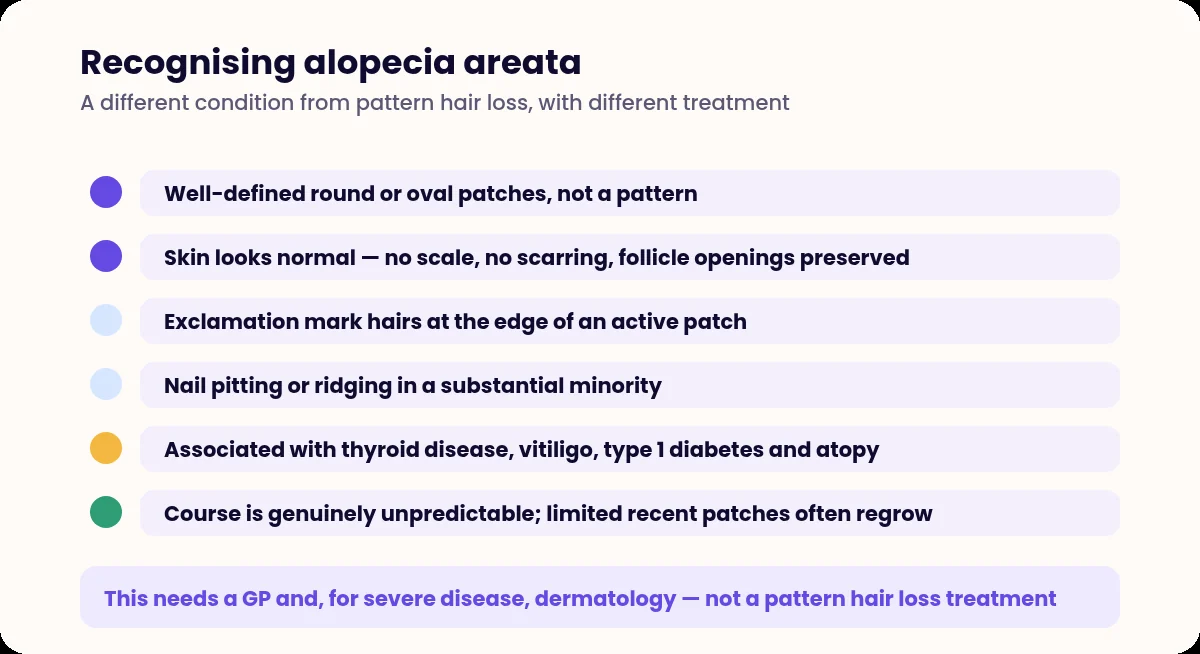
- Alopecia areata is an autoimmune condition in which the immune system attacks the hair follicle, producing well-demarcated round or oval patches of non-scarring loss. It is not male or female pattern hair loss and is not treated the same way.
- Lifetime risk is around 2%, with peak onset in the second and third decades, and nail changes occur in 10 to 40% of people.
- The course is genuinely unpredictable: limited recent-onset patches often regrow without treatment, while extensive disease has a poor spontaneous remission rate.
- Two JAK inhibitors are now NICE-recommended for severe disease on the NHS — ritlecitinib since March 2024 and deuruxolitinib from mid-August 2026 — while baricitinib is licensed in Great Britain but was not recommended by NICE.
If your hair is coming out in discrete round patches with normal-looking skin underneath, you are almost certainly not dealing with pattern baldness. Alopecia areata is an autoimmune condition. The cause is different, the treatment is different, and it belongs with your GP and NHS dermatology rather than with an online hair loss service. This clinic does not treat it.
It is also a condition where the honest answer to the most important question — will it come back — is that nobody can tell you.
What it is
In alopecia areata the immune system attacks the hair follicle, interrupting the growth phase. The follicle itself is not destroyed, which is why regrowth remains possible even after years. Loss is non-scarring: the skin looks normal, with no scale and no shine, and the follicular openings are still visible [1].
Lifetime risk is around 2%. Incidence peaks in the second and third decades, and most people have their first episode before the age of 40, though it occurs at any age and in all hair and skin types [1].
The patterns
Most people present with one or several round or oval patches on the scalp. It can also affect the beard, eyebrows and eyelashes [1].
- Patchy alopecia areata — the common presentation, one or more well-demarcated patches.
- Alopecia totalis — complete loss of scalp hair, in roughly 5% of cases.
- Alopecia universalis — loss of scalp and body hair, in under 1%.
- Ophiasis — a band of loss around the occipital and temporal margins. This pattern tends to respond less well.
- Diffuse or incognita — rapid, widespread thinning without discrete patches, which is the form most often confused with other causes of shedding.
The signs a clinician looks for
Exclamation mark hairs at the edge of a patch are the classic finding: short broken hairs that are thicker at the tip and taper towards the scalp, produced when the growth phase is abruptly arrested. A hair pull test at an active margin is positive. On dermoscopy, yellow dots, black dots and short vellus hairs are typical [1].
Nail changes occur in 10 to 40% of people. Pitting and ridging are the most common; more severe disease can produce roughened, sandpapery nails or frank dystrophy. Nail involvement is worth mentioning to your clinician because it carries prognostic weight [1].
What it is associated with
Alopecia areata runs with other autoimmune and atopic conditions: thyroid disease, vitiligo, psoriasis, type 1 diabetes, and atopy including eczema, asthma and hay fever. Risk is higher with a family history, with Down syndrome and some other chromosomal disorders, and in polyglandular autoimmune syndrome [1].
That association is the main reason a blood test is sometimes worth doing — principally thyroid function — rather than because a deficiency is driving the hair loss. Our guide to blood tests for hair loss covers what is and is not worth checking.
Prognosis: genuinely unpredictable
DermNet describes the course as unpredictable with variable spontaneous remission, and that is the accurate framing [1]. A first, limited patch of recent onset has a good chance of regrowing on its own within months. Extensive disease, totalis and universalis have poor rates of spontaneous remission.
Factors associated with a worse outlook [1]:
- young age at onset
- extensive disease
- long duration
- nail dystrophy
- the ophiasis pattern
- family history
- atopy
Relapse after regrowth is common and does not mean treatment failed. Regrown hair is often initially white or fine and usually repigments.
How it is treated in the UK
Treatment escalates with severity, and watchful waiting is a legitimate first step for limited recent disease [1].
- Topical corticosteroids, potent or ultrapotent.
- Intralesional triamcinolone injections — first-line in UK dermatology for limited patchy scalp disease.
- Topical immunotherapy with diphencyprone (DPCP), in specialist centres only.
- Topical minoxidil as an adjunct rather than a primary treatment.
- Systemic corticosteroids short-term, with relapse common on stopping; ciclosporin and methotrexate are used off-label.
- Camouflage, hairpieces and wigs, some of which are NHS-funded.
None of these is the treatment for pattern hair loss, which is why the distinction between the conditions matters practically and not just academically. If you are unsure which you have, our guide to male pattern baldness sets out what patterned loss looks like, and telogen effluvium covers diffuse shedding after an illness or shock.
JAK inhibitors: where the UK now stands
This is the part that has genuinely changed, and the UK position differs from the US.
- Ritlecitinib is recommended by NICE (TA958, published 27 March 2024) as an option for treating severe alopecia areata in people aged 12 and over, within its marketing authorisation. Severe was defined by a SALT score of 50 or above. It was the first JAK inhibitor available on the NHS for this condition [2].
- Baricitinib is licensed in Great Britain for severe alopecia areata in adults, but NICE did not recommend it for routine NHS commissioning (TA926). Licensed but not NHS-funded is an unusual combination and a common source of confusion [3].
- Deuruxolitinib received final NICE guidance on 15 July 2026 (TA1178) for adults aged 18 and over with severe alopecia areata, including totalis and universalis. NHS organisations have 30 days to comply, with access through specialist dermatology teams from mid-August 2026 [4, 5].
So there are now two NICE-recommended JAK inhibitors for severe disease on the NHS. For comparison, the US FDA approved baricitinib in 2022, ritlecitinib in 2023 and deuruxolitinib in 2024 — the difference is that the UK licenses baricitinib without funding it.
These are specialist-prescribed medicines carrying MHRA class warnings for the JAK inhibitor group, including serious infection, herpes zoster, venous thromboembolism, cardiovascular events and malignancy. Relapse on stopping is usual. None of this is something to arrange outside dermatology.
What to do next
Book an appointment with your GP and ask for referral if the loss is extensive, progressing, affecting eyebrows or eyelashes, or causing you significant distress. Take photographs before the appointment, since patches change between the day you book and the day you are seen.
Alopecia UK is the national charity and worth contacting early rather than late — for support, for information on wigs and camouflage, and for plain accounts of what treatment access actually looks like.
Frequently asked questions
Will my hair grow back?
Often, but it cannot be predicted. A single small patch of recent onset has a good chance of regrowing on its own. Extensive loss, loss present for a long time, onset in childhood, nail changes and the band-like ophiasis pattern all point to a poorer outlook. Regrowth can also be followed by relapse, which is normal for this condition.
Is alopecia areata caused by stress?
Stress is frequently reported around the time patches appear, but alopecia areata is an autoimmune condition with a strong genetic component, and stress has not been shown to cause it. Sudden diffuse shedding a few months after a stressful event is more likely to be telogen effluvium, which is a different condition.
Can I get JAK inhibitors on the NHS?
For severe disease, yes, through specialist dermatology. NICE recommends ritlecitinib for people aged 12 and over with severe alopecia areata, and recommended deuruxolitinib for adults aged 18 and over in July 2026, with NHS access from mid-August 2026. Baricitinib is licensed in Great Britain but was not recommended by NICE, so it is not NHS-funded.
Should I see my GP or go private?
See your GP. Alopecia areata needs a diagnosis rather than a product, and the treatments that matter — intralesional steroid injections, topical immunotherapy, and JAK inhibitors for severe disease — sit in NHS dermatology, not in online hair loss clinics. Alopecia UK is also a useful source of support and information.
References
- DermNet. Alopecia areata. dermnetnz.org/topics/alopecia-areata
- NICE. Ritlecitinib for treating severe alopecia areata in people 12 years and over. TA958, 27 March 2024. www.nice.org.uk/guidance/ta958
- NICE. Baricitinib for treating severe alopecia areata. TA926. www.nice.org.uk/guidance/ta926
- NICE. Deuruxolitinib for treating severe alopecia areata in adults. TA1178, published 15 July 2026. www.nice.org.uk/guidance/ta1178
- Alopecia UK. NICE recommends deuruxolitinib for adults with severe alopecia areata. www.alopecia.org.uk/news/nice-recommends-deuruxolitinib-for-adults-wit
- NHS. Hair loss. www.nhs.uk/conditions/hair-loss/
Medical reviewer
Naeem Teni
Clinical Lead at Manova. Registered pharmacist and independent prescriber, GPhC 2215591. Reviews Manova’s clinical content for accuracy and safety.
Written by
Manova Editorial Team
Researched and written to our editorial policy, using NICE, NHS, MHRA and peer-reviewed sources.
This article is for general information and isn’t a substitute for advice from your own clinician. If you feel unwell, contact your GP or NHS 111. In an emergency, call 999.